













Quantum Careers Near You in South Korea
What You Need to Know
South Korea’s chaebol giants and a ₩3 trillion government mandate are turning the peninsula into one of Asia’s most aggressive quantum employment markets.
Korea’s quantum roadmap is one of the most funded per capita of any nation — the jobs will follow. Dr. Lee Kwang-hyung, Minister of Science and ICT, South Korea
What quantum computing roles exist in South Korea right now?
- Samsung Advanced Institute of Technology (SAIT) hires Quantum Device Engineers for superconducting qubit research in Suwon.
- Qunova Computing, Korea’s leading quantum startup, hires Quantum Software Developers for drug discovery and materials simulation projects;
- SK Telecom’s Quantum Cryptography division posts Quantum Network Engineer roles in Seoul and Seongnam
- KRISS (Korea Research Institute of Standards and Science) recruits Quantum Metrology Scientists with postdoctoral experience
What educational background do South Korean employers expect?
The basic requirement for chaebol labs is having a PhD in Physics or EE from KAIST, POSTECH, or SNU. Entry at the quantum divisions of SK Telecom and LG is available for Master’s graduates, who have thesis-based research in quantum information or photonics. Engineers with practical quantum networking experience at IBM are also hired directly at ETRI, as practical experience and credentials become more important.
Suggested Read: Programming languages for quantum jobs
What salaries are offered for quantum jobs in South Korea?
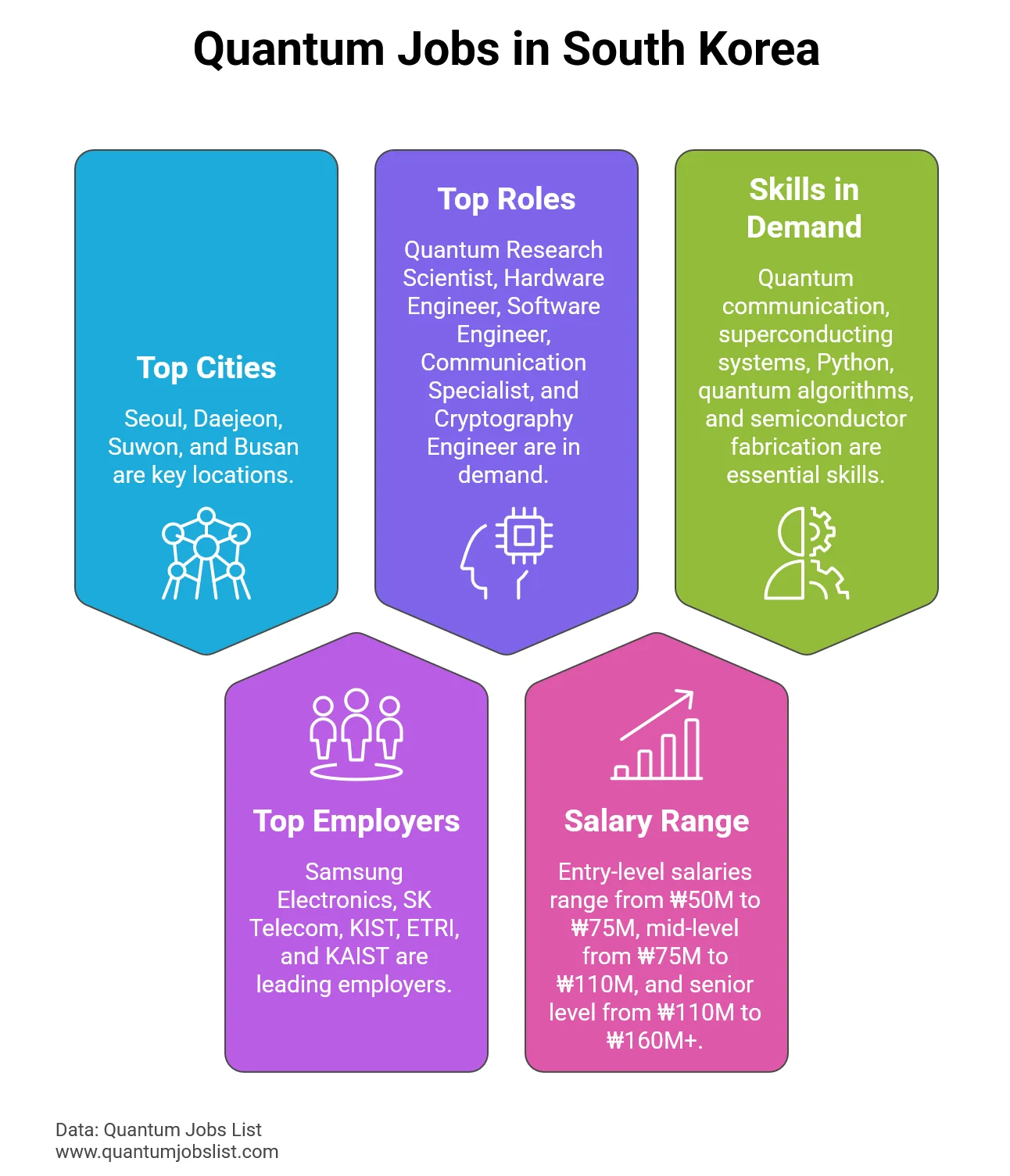
- Entry-level researchers at KRISS or KIST: ₩45-60M KRW/year (~$34-45K USD)
- Foreign expert hires at national labs receive additional housing allowances and tax exemptions under Korea’s Brain Pool program;
- Quantum Engineers at Samsung SAIT or SK Telecom: ₩70-120M KRW/year ($52-90K USD) plus chaebol performance bonuses
- Senior Quantum Scientists with 5+ years: ₩130-180M KRW at top conglomerates, competitive with Singapore rates
What skills are most in-demand for Korean quantum roles?
- Qiskit and Cirq proficiency, IBM and Google have official Korean quantum network partnerships that directly drive these requirements.
- Experience with photonic quantum systems is a fast-rising requirement, especially at ETRI and LG’s optics-focused quantum teams;
- Post-quantum cryptography skills (CRYSTALS-Kyber, NTRU) are urgently sought by Korean banks & telcos after NIST’s 2024 standardization.
- Korean language (TOPIK Level 4+) is required for most government lab and chaebol roles, unless hired under a foreign expert contract
Which South Korean companies are the top quantum employers?
Researchers in superconducting and topological qubits are employed at the most advanced quantum hardware lab in South Korea, located at Samsung SAIT. Specialists in QKD will be recruited by SK Telecom, as they run the first commercial quantum-safe network in the world. LG Electronics is an active employer in the applied manufacturing sector, as they run a Quantum AI Lab in Gangnam, which focuses on the relatively unique field of quantum machine learning.
Which South Korean cities offer the best quantum opportunities?
Daedeok Innopolis in Daejeon is the center for quantum research in South Korea, as it hosts KAIST, ETRI, KRISS, and KIST in close proximity. Commercial quantum roles are concentrated in the Gangnam and Yeouido districts of Seoul, while applied quantum engineering is located in the fast-growing centers of Seongnam (NAVER, Kakao) and Suwon (Samsung HQ).
What government programs support quantum careers in South Korea?
The Korean Quantum Initiative (KQI) 2023–2035 will invest ₩3 trillion KRW in developing domestic quantum technology and preparing 2,500 quantum specialists. With 400-plus funded quantum positions opened annually at the national labs, the IITP is undershooting regional demand. Joint postdoctoral fellowships at KIST and KRISS are also quantum-focused, and these two-year contracts have stipends designed to outcompete the private sector.
We’ve raised quantum researcher salaries three times in two years to compete with US offers. Park Jung-ho, CEO, SK Telecom
How is South Korea’s quantum job market projected to grow by 2030?
By 2035, the KQI aims to create 5,000 jobs in quantum-related industries, with 2,500 of those anticipated before 2030. Due to the projected 2030 value of $1.2B USD for Korea’s quantum cryptography market, specialists will be hired in that field. Anticipating this demand, KAIST and POSTECH will triple quantum enrolment between 2025 and 2028.
.svg)

