

10 Min. Read

Dec 6, 2025
8 Steps to Prepare for a Quantum Computing Job Interview
Learn how to prepare for quantum computing job interviews with 8 proven steps. Master algorithms, coding skills, and communication strategies to succeed.
SHARE


Getting a job interview in quantum computing is a big step, but is there good knowledge to wow employers like Google, IBM, or growing quantum businesses? Quantum computing job interviews cover a range of topics from the most basic aspects of quantum mechanics to real-life applications, meaning the groundwork is more complex than the typical tech job interviews.
If quantum mechanics hasn’t profoundly shocked you, you haven’t understood it yet. Niels Bohr
The job market for quantum computing is highly competitive, but the job opportunities are plentiful and lucrative. Companies are in search of professionals with a theoretical foundation and the ability to code in quantum. This guide is based on reliable evidence with an 8-step job interview preparation method to help you obtain a high paying job in quantum computing. The average successful candidate earns between $95000 to $180000.
Whether you want to be a quantum software engineer, an algorithms developer or a quantum research scientist, The job interview tips in this guide can help you stand out and succeed in your job search.
Step 1: What Core Quantum Concepts Must You Master?
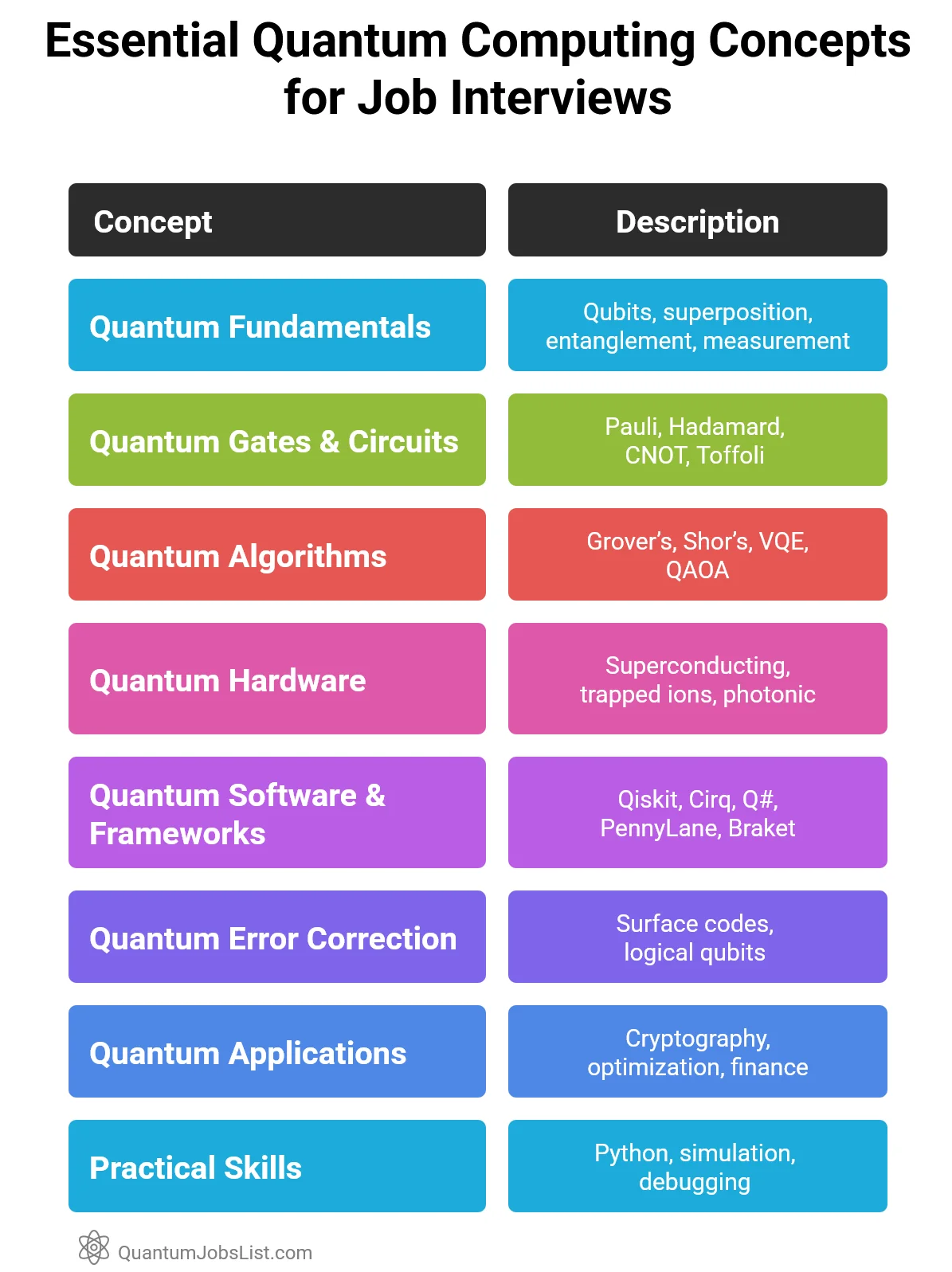
Questions in quantum computing interviews are based on the main ideas that form the foundation for all discussions about quantum topics. Certainly, all the interviewers will ask about quantum gates, qubits, superposition and entanglement. Be ready to discuss the Bloch sphere, Dirac notation, and some fundamental quantum algorithms like Grover's and Shor's, among others.
Essential Quantum Mechanics Fundamentals
Core Concepts to Master:
- Superposition of Qubits vs. Classical Bits: Learn how qubits can reside in a superposition of 0 and 1 states
- Superposition Principle: Describe how a quantum system resides in multiple states at the same time and why the superposition advances quantum computing
- Entanglement: how do qubits that have become entangled remain correlated, regardless of how much distance exists between them?
- Quantum Measurement: Explain how the measurement of an unknown quantum state collapses the wave function and the quantum state
- Interference: Explain how quantum algorithms use constructive and destructive interference
Key Quantum Algorithms You'll Be Asked About
Must-Know Algorithms:
- Shor's Algorithm: Explain how to factor large numbers, and do so exponentially faster
- Grover's Algorithm: Explain the speed of the database search. How does it speed up the cases
- Quantum Fourier Transform (QFT): Explain the foundation of the many quantum algorithms, including Shor's
- Variational Quantum Eigensolver (VQE): Explain the algorithm that is hybrid used in Quantum Chemistry
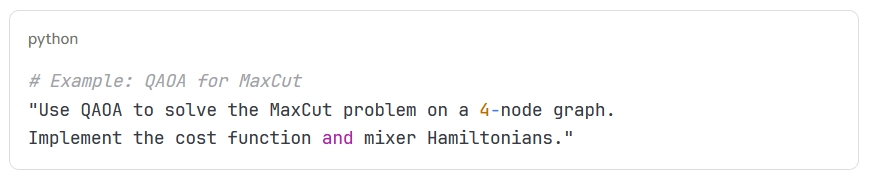
- Quantum Approximate Optimization Algorithm (QAOA): Explain it for near-term Optimization, dedicated to advanced applications
Mathematical Foundations Required
- Linear Algebra: Vectors, matrices, eigenvalues, eigenvectors and tensor products
- Group Theory Basics: Understanding quantum gate operations & symmetries
- Complex Numbers: Understanding quantum state representation with complex amplitudes
- Probability Theory: Statistical interpretation of quantum measurements
Practice Exercise: Before your interview, explain each quantum algorithm in simple terms to someone without quantum knowledge. If you can not simplify it, you do not understand it deeply enough.
Step 2: How Should You Demonstrate Quantum Programming Skills?
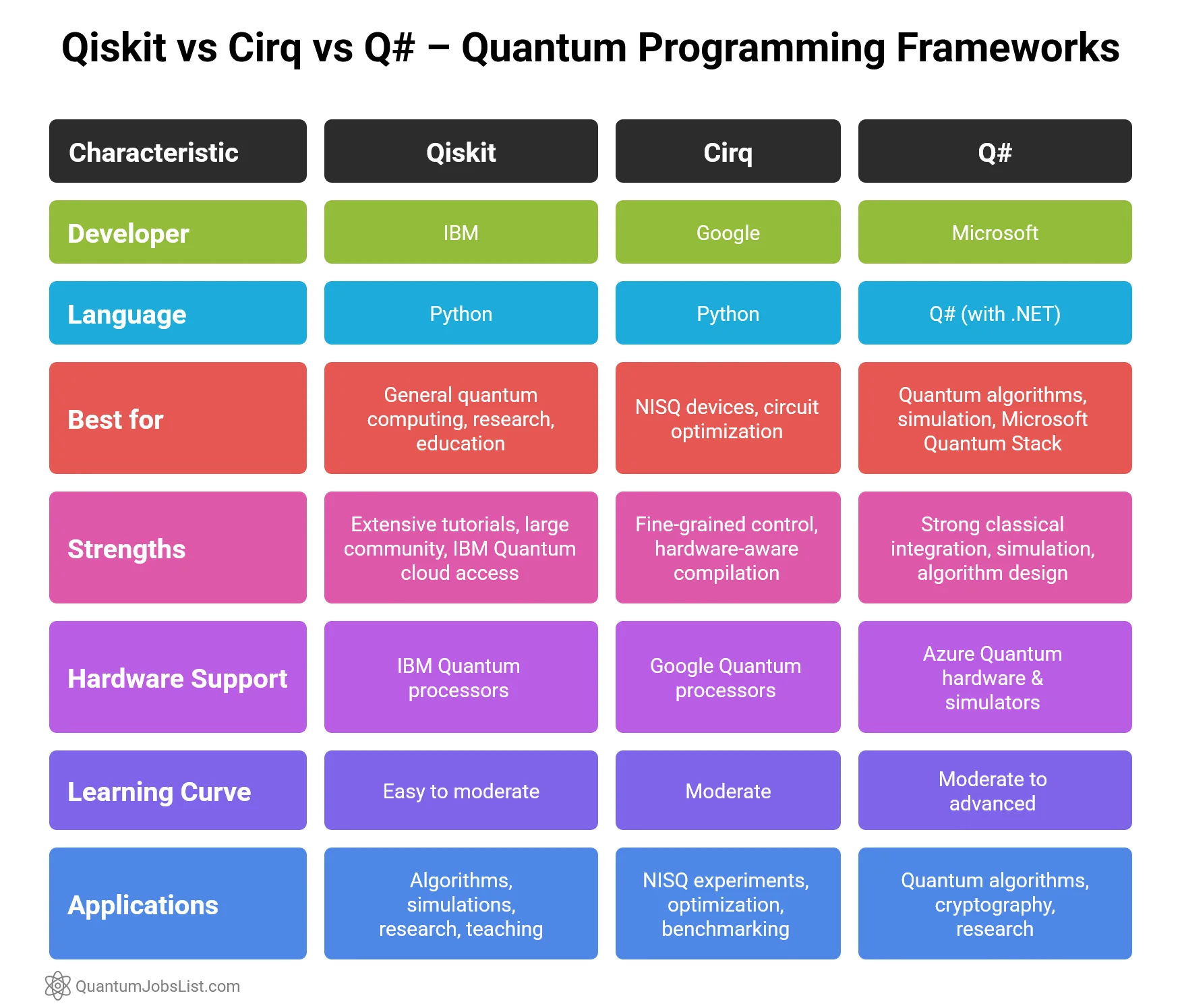
Most quantum jobs involve programming in Qiskit, Cirq, or Q#. Also, you’ll need knowledge of classical data structures and algorithms, particularly if the job involves hybrid quantum-classical workflows. Real programming skills differentiate serious applicants from those with just the theory.
Master Multiple Quantum Frameworks
IBM Qiskit (Most Popular):
- Build quantum circuits using Python
- Access IBM quantum computers for hands-on exercises
- Learn the Terrah, Aer, Ignis, and Aqua of Qiskit
- Employ circuit patterns and practice with transpilation
Google Cirq (Industry Standard):
- Build and design quantum algorithms for Google’s quantum processors
- Understand programming in the NISQ era
- Learn Cirq’s models for gate scheduling and optimization
- Work with more realistic models of noise in the system
Microsoft Q# (Enterprise Focus):
- Understand designing programming languages for quantum
- Learn quantum resource estimation and optimization
- Work with the Azure quantum services
- Understand the integration of Q# with classical programming.
Common Coding Interview Patterns
Expect These Coding Challenges:
Circuit Construction Tasks:
- Implement basic quantum gates, which include Hadamard, CNOT, and Toffoli.
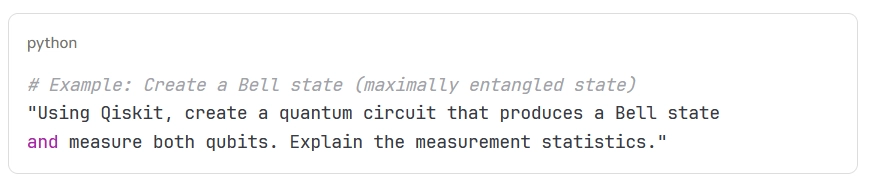
- Construct basic entangled states such as Bell and GHZ states.
- Develop circuits for quantum teleportation.
- Make and design random number generators based on quantum principles.
Algorithm Implementation:
- Code Grover’s algorithm for defined problems.
- Apply phase estimation.
- Develop variational quantum circuits integrating optimizers.
- Establish routines for quantum error mitigation.
Hybrid Classical-Quantum:
- Build parameterized quantum circuits.
- Integrate classical optimization loops such as COBYLA and SPSA.
- Manage the post-processing of measurement results.
- Enhance the circuitry’s depth and reduce the number of gates.
Portfolio Projects That Impress Interviewers
Strong Portfolio Examples:
- QML Project: Realize quantum neural networks or algorithms for quantum machine learning.
- Optimization Problem Solution: se QAOA to solve real-world optimization challenges
- Quantum Chemistry: Employ the Variational Quantum Eigensolver to compute the ground states of molecules.
- Develop quantum analogs of traditional games for software.
- Research error mitigation techniques aimed at enhancing NISQ-era results.
Pro Tip: You can host your quantum projects on GitHub with clear README files, well-documented code and visualization of results. Interviewers often review candidates' GitHub profiles before interviews.
Quantum information is going to change your life. And the one of your kids. And the one of your grandkids. And this is what I want to see. And this is what I expect to see: before I pass away, I will see that this quantum revolution is in full swing. Raymond Laflamme
Step 3: Why Must You Understand Quantum Hardware Limitations?
The development of quantum hardware faces several challenges. Interviewers might ask how you would deal with noise, decoherence, and limited qubit availability. A winning candidate understands the principles of error correction, the various hardware topologies, and reasonable amounts of available resources. Understanding constraints is what sets apart useful, hands-on industry experience from theoretical knowledge.
Current Quantum Hardware Landscape
Superconducting Qubits (IBM, Google, Rigetti):
- Analyse and understand transmon qubit error profiles
- Know typical coherence times (50-200 microseconds)
- Understand the quantum processor architecture connectivity constraints
- Know the gate fidelity ranges (~99% for single-qubit, ~95-99% for two-qubit)
Trapped Ion Systems (IonQ, Honeywell/Quantinuum):
- Know the advantages of all-to-all connectivity
- Be aware of longer coherence times but slower gate operations
- Understand laser-based gate implementation systems
- Get familiar with ion transport and shuttling concepts
Photonic Quantum Computing (Xanadu, PsiQuantum):
- Learn the basics of continuous variable quantum computing
- Understand the advantages for quantum communication
- Know the measurement-based quantum computing approaches.
- Understand the challenges of scalability and potential solutions.
NISQ Era Realities
Key Limitations to Discuss:
Noise and Errors:
- Decoherence: Loss of quantum information over time
- Crosstalk: Unwanted interactions between qubits;
- Gate errors: Imperfect quantum gate implementations
- Measurement errors: Incorrect readout of quantum states
Resource Constraints:
- Low qubit availability: Existing systems contain 50-1000 qubits.
- Shallow circuit depth: Due to decoherence, the depth of the algorithms is limited.
- Limited connectivity: Not all qubits can communicate with each other.
- Limited gate sets: Implementation of hardware specific qubit gates.
Error Mitigation Techniques
Practical Approaches You Should Know:
- Zero-noise extrapolation: Extrapolating to zero-noise results
- Error mitigation circuits: Measuring and compensating for specific error sources
- Probabilistic error cancellation: Using quasi-probabilities to cancel errors;
- Symmetry verification: Checking results against known symmetries
Interview Question Example: "How would you design a quantum algorithm knowing you have only 50 qubits with 99% gate fidelity, and 100 microsecond coherence times?"
Step 4: How Do You Research the Company and Role?
To succeed in your interview, it is crucial to understand the company's focus on quantum projects & what the role requires. General knowledge about quantum topics is not enough. You need to show how your skills fit the company's quantum goals.
Company-Specific Research Strategy
For Quantum Hardware Companies (IBM, Google, IonQ, Rigetti):
- Get to know the specific quantum hardware topology and benefits of the company.
- Know the quantum developments the company has made and the quantum supremacy the company talks about.
- Know the quantum plans of the company and how they plan to scale their qubits.
- Know the company's quantum computing, that is accessible through the cloud.
- Get to know the company's research and any recent publications.
For Quantum Software Companies (Zapata, QC Ware, 1QBit):
- Know what quantum algorithms the company has and what they focus on.
- Get to know the target sectors and their relevant use cases.
- Understand software development tools and other software tools they use.
- Know the case studies that show the company's success with their customers.
- Understand their approach to near-term quantum advantage
For Enterprise Quantum Adopters (JPMorgan, BMW, Volkswagen):
- Get to know the specific quantum case studies in the relevant industry.
- Know why quantum computing is the solution to the business problems of that industry.
- Get to know the quantum collaborations the company has.
- Know how the company approaches and the timeline they are expecting for quantum advantage.
- Get to know the specific challenges of the industry in quantum computing.
Role-Specific Preparation
For Quantum Software Engineer Roles:
- Review job description for specific frameworks (Qiskit, Cirq and Q#)
- Prepare examples of relevant coding projects and contributions;
- Understand if role focuses on algorithms, applications or infrastructure
- Know if position involves customer-facing work or internal development
For Quantum Research Scientist Positions:
- Research the team's recent publications & research focus
- Know current state-of-the-art in their specific quantum domain
- Get to know the unsolved problems in the area of their research,
- Prepare to discuss your thesis or research experience relevantly
For Quantum Applications Developer Roles:
- Understand target industry applications (finance, chemistry, optimization)
- Be ready to discuss hybrid classical-quantum workflows;
- Know domain-specific challenges quantum computing addresses
- Prepare examples of translating business problems to quantum algorithms
Leveraging LinkedIn and Professional Networks
Research Strategies:
- Connect with current employees: Learn about company culture & quantum projects
- Attend company webinars: Many quantum companies host public technical talks
- Review team publications: Understand technical depth and research directions;
- Follow company quantum news: Stay updated on announcements & milestones
- Join quantum computing communities: Engage in discussions about the company's technology.
Step 5: What Technical Questions Should You Expect?
Interviews for quantum computing jobs focus on real-world examples and cover topics like system design, computing skills and advanced theories. Quantum computing is the most interdisciplinary field among all engineering areas. As of 2024, there are still engineering challenges to create reliable & scalable fault-tolerant quantum computing. Top candidates understand these challenges and work on solving important engineering problems in quantum computing.
Common Theoretical Interview Questions
Fundamental Concepts (Entry-Level):
- “Tell me what quantum superposition is and what its role is in quantum computing?"
- "What is quantum entanglement? For what purpose is it used in quantum algorithms?"
- "How does the measurement of a quantum state affect it?"
- "What are the benefits of a quantum computer compared to a classical computer?".
- "What is the no-cloning theorem? What are the consequences in quantum computing?"
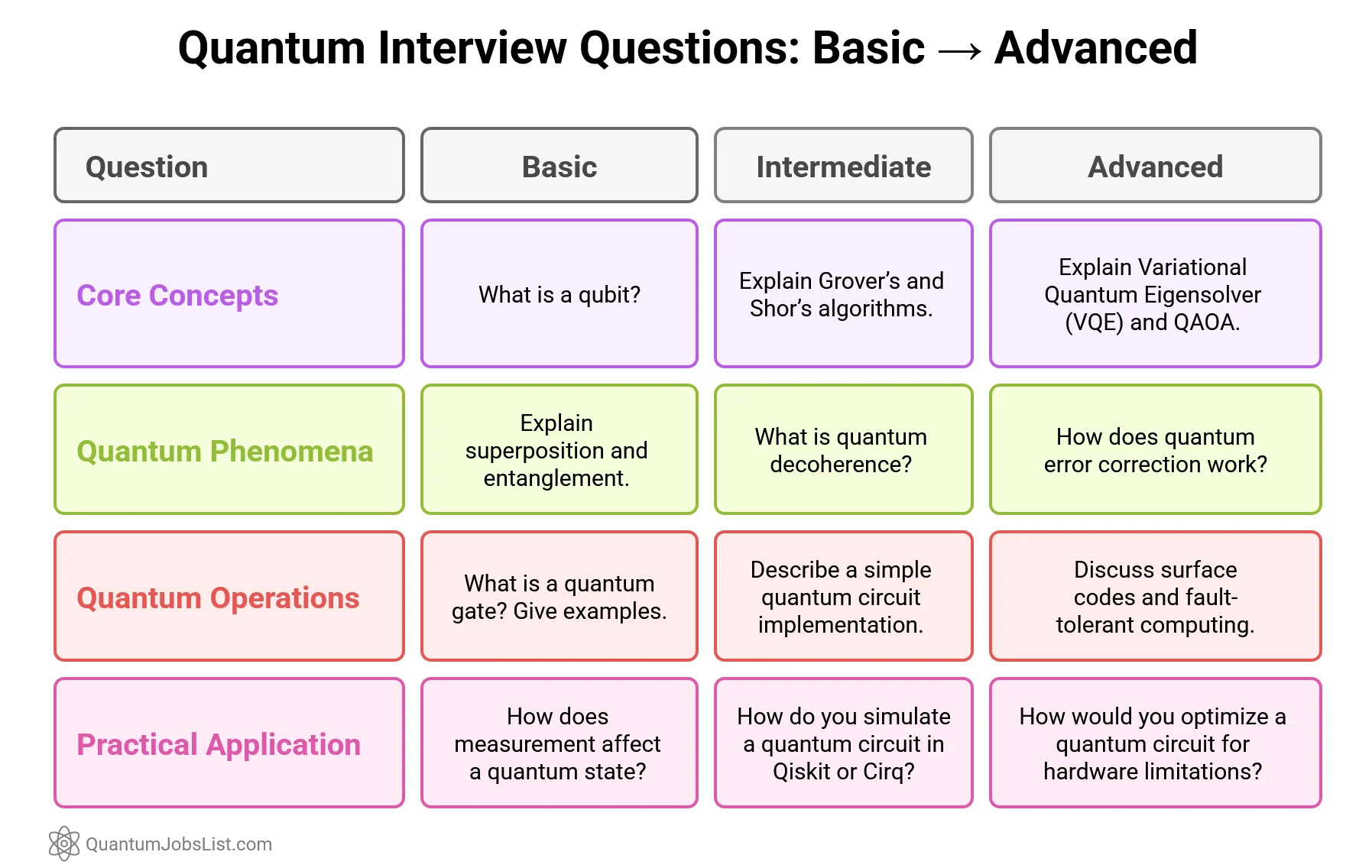
Intermediate Algorithm Questions:
- "Describe Grover's algorithm and the problem to which it offers a solution. Describe its complexity. Why is it an advantageous solution?"
- "Tell me how Shor's algorithm achieved the exponential speedup in factoring very large numbers."
- "What are the major differences between quantum annealing and gate-based quantum computing?"
- "What is the Variational Quantum Eigensolver? In what context would you need it?"
- "Provide an overview of how quantum error correction would work."
Advanced Technical Questions:
- "How would you design a quantum algorithm for [specific problem]?"
- "What is the idea of fault-tolerant quantum computing, and what are its implications?"
- "What is your experience working with quantum error correction codes and trade-offs between resources?"
- "How do topological quantum computers differ from other architectures?"
- "Discuss the challenges of achieving quantum advantage for practical problems"
Coding Challenge Examples
Typical Programming Tasks:
Basic Circuit Construction:
Algorithm Implementation:

Optimization Problems:
Error Mitigation:
System Design Questions
Architecture and Scalability:
- "Design a quantum classical hybrid system for portfolio optimization"
- "How would you scale a quantum algorithm from 10 to 100 qubits ?"
- "How would you architect a quantum machine learning pipeline ?"
- "Design a quantum error mitigation strategy for a specific application"
Practical Implementation:
- "What factors would you consider, when choosing a quantum hardware platform?"
- "How would you handle quantum circuit optimization for limited connectivity ?"
- "How would you validate quantum advantage claims for a business application ?"
- "Design a benchmarking system for comparing quantum algorithms"
Step 6: How Should You Prepare Your Quantum Story?
You should build a portfolio showcasing your quantum projects. Develop a clear "Quantum Story" explaining your interest and experience. You should prepare for technical interviews covering both classical & quantum computing. Your personal narrative connects your background to quantum computing careers convincingly.
Crafting Your Quantum Journey Narrative
Key Elements of Your Story:
Why Quantum Computing:
- What first sparked your interest in quantum computing?
- How did you discover quantum technology could be a career path?
- Which quantum challenges/applications are of greatest interest to you?
- Why do you think now is the right moment to pursue a career in quantum computing?
How You Built Expertise:
- Which books, resources, and courses did you engage with to study quantum computing?
- While you were learning quantum concepts, what barriers did you encounter and how did you overcome them?
- How did you move from a purely theoretical perspective to a real-world application?
- What projects or research helped solidify your quantum knowledge?
Where You're Headed:
- What specific areas of quantum computing do you want to specialize in?
- How do you stay current with rapid quantum computing developments ?
- How does this role align with your long term quantum computing goals?
- What contributions do you hope to make to the quantum computing field?
Highlighting Transferable Skills
From Classical Computing to Quantum:
- Software Development: Discuss your coding ability and how it is relevant to quantum programming.
- Algorithm Design: How do you transfer your knowledge as a designer of traditional algorithms to the quantum domain?
- Problem-Solving: How do your skills in debugging and optimization assist you in solving quantum problems?
- Mathematics: How do you use your knowledge in mathematics to formulate quantum algorithms?
From Physics to Quantum Computing:
- Quantum Mechanics: Direct application of physics knowledge to quantum algorithms.
- Measurement Theory: Understanding quantum measurement in computing contexts.
- Experimental Design: Translating lab skills to quantum hardware work;
- Mathematical Physics: Using theoretical physics for quantum computing research.
From Other Fields to Quantum:
- Finance Background: Domain expertise for quantum finance applications.
- Cryptography: Leveraging security knowledge for post - quantum cryptography
- Chemistry Knowledge: You must understand quantum chemistry simulation needs
- Optimization Experience: Applying operations research to quantum optimization.
Discussing Your Quantum Projects
Project Presentation Framework:
Project Overview (30 seconds):
- What problem were you solving?
- What was the expected quantum advantage?
- Why did you choose a quantum approach?
Technical Implementation (1-2 minutes):
- What quantum algorithms or techniques did you use?
- How did you validate your results?
- Which frameworks & tools did you employ ?
- What technical challenges did you encounter?
Results and Learnings (30 seconds):
- What results did you achieve?
- What surprised you during the project?
- What did you learn about quantum computing?
- How would you improve the project, if you had more time?
Practice Tip: Record yourself explaining your quantum projects. Time each explanation & ensure you can deliver clear, concise summaries within interview time constraints.
Step 7: Why Must You Practice Explaining Complex Concepts Simply?
The ability to explain quantum computing concepts in simple terms is very important for all jobs in the quantum field. Whether you are communicating with stakeholders, writing documentation or collaborating with cross-functional teams , a clear communication distinguishes exceptional quantum professionals.
The Feynman Technique for Quantum Concepts
Step 1: Choose a Concept
You should select a complex quantum concept like superposition, entanglement or quantum gates. Then write the concept name at the top of a blank page. This will be your target for simplification.
Step 2: Explain in Simple Terms
Write an explanation as if teaching a 12-year-old. Use analogies and everyday examples, avoid technical jargon & equations, and focus on intuitive understanding rather than mathematical rigor.
Step 3: Identify Knowledge Gaps
Review your explanation for areas where you struggled. Note concepts you could not simplify effectively. Research these areas until you can explain them simply; then return to your explanation and improve it.
Step 4: Review and Refine
Read your explanation aloud. Simplify further by removing unnecessary words, add clarifying analogies or examples and test your explanation on non-technical friends or family.
Effective Quantum Analogies
Superposition:
"A qubit in superposition is like a coin spinning in the air. It is simultaneously heads and tails until it lands. A classical coin flip results in either heads or tails. In contrast, a spinning coin is in both states at the same time."
Entanglement:
"Entangled qubits act like a pair of magical dice. No matter how far apart you put them, when you roll one and get a 6, the other one will always show 1. They are connected in a strange way; and measuring one affects the other instantly."
Quantum Interference:
"Quantum interference works like noise canceling headphones. Just as sound waves can cancel each other out , quantum probability waves can interfere to cancel wrong answers and boost correct ones in quantum algorithms."
Quantum Measurement:
"Measuring a quantum state is like opening Schrödinger's famous box. Before you look , the cat (quantum state) is both alive & dead (superposition). The moment you open the box (measure), the cat becomes definitely alive or dead (collapsed state)."
Practice Questions for Communication Skills
Interview Scenarios to Prepare:
- "Explain quantum computing to a marketing executive with no technical background."
- "How would you convince a doubtful client that quantum computing can solve their problem?"
- "Describe your quantum research to a high school student interested in physics."
- "Explain to a software engineer why quantum computers won't replace classical computers."
- "How would you present quantum computing ROI to a CFO or business stakeholder?"
Video Practice Exercise:
Record yourself giving 60-second explanations of quantum concepts. Watch the recordings & identify areas where you use jargon, speak too quickly or lose clarity. Iterate until your explanations are crystal clear.
Suggested Read: Top Quantum Programming Languages to Learn
Step 8: How Do You Prepare Thoughtful Questions for Interviewers?
Asking insightful questions shows your real interest in quantum computing, your strategic understanding of its present state, your understanding of its limits, and your understanding of its future trajectory. Your insightful questions allow me to see how you wish to pursue a career in quantum computing and what your professional priorities and values are.
Technical and Research-Focused Questions
About the Company's Quantum Work:
- "What specific quantum algorithms or applications is your team currently prioritizing?"
- "How do you balance near-term NISQ applications with long-term fault-tolerant goals?"
- "What quantum error mitigation strategies or quantum error corrections techniques have you found to be the most effective with your quantum systems?"
- "What do you feel is the most difficult part of proving quantum advantage to your customers?"
- "What is your projected timeline for achieving practical quantum advantage over your competitors in your desired applications?"
About Technical Challenges:
- "What are the biggest technical obstacles your quantum team is currently facing?"
- "How will you validate quantum results & ensure algorithmic correctness?"
- "How will you handle the trade-off between circuit depth and gate fidelity?"
- "What quantum hardware platforms do you use and why did you choose them?"
- "What role does classical simulation play in your quantum development process?"
Career Development Questions
About Growth and Learning:
- "How does your company support quantum learning?"
- "How do you keep team members updated on field developments?"
- "Tell us the opportunities exist for research & conferences?"
- "How can quantum team members progress in their careers?"
- "What mentorship is available for quantum professionals ?"
About Team Structure:
- "How is the quantum team structured & linked to other departments?"
- "How does the team manage quantum's interdisciplinary nature ?"
- "What is the background mix of team members (physics, CS and engineering)?"
- "How can hardware & software teams collaborate?"
- "What tools & processes support quantum development?"
Strategic and Business Questions
About Market Position:
Consider how competitors address quantum technology, which sectors or applications are most promising, how to bridge the NISQ to fault-tolerant quantum computing gap; and what to do to ensure quantum advantage as the field shifts.
About Company Culture:
Understand what success means for them in the quantum space after 6-12 months and how the company manages the tradeoff between quantum research and practical product development. What are the timelines in that tradeoff, from research to production, and how do they celebrate quantum team achievements and milestones?
Red Flag Questions to Avoid:
Don’t ask questions that have already been answered on the company website or are stated in the job description, do not focus on compensation, benefits, or time-off in the early interviews. Don’t ask basic questions like “What does your company do?”, don’t ask overly skeptical questions that doubt the viability of quantum computing.
How long should I prepare for a quantum computing interview?
The time you need to prepare depends on how long you have worked in the role you want and your background. For someone with a background in classical computing or physics, 4 to 8 weeks of preparation should suffice. 2 to 3 weeks can be dedicated to the review of the basics and algorithms. For the next 2 to 3 weeks, the focus should be on the practice of quantum programming using either Qiskit or Cirq. In the last 1 to 2 weeks, focus on preparing for the specific role. Practice with mock interviews.
If you are changing your career or are new to quantum computing, it will take about 3 to 6 months. First, 4 to 6 weeks should be dedicated to the development of the skills. Then, 2 to 4 weeks should be dedicated to interview preparation. There should be a total of 6 to 8 weeks on the basics of quantum mechanics and the algorithms. You can spend 6 to 8 weeks improving your math skills by studying linear algebra and complex number systems.
Suggested Read: Why choose quantum over classical Computing
You should practice this key task every day, rather than trying to do it all at once in a short time. Working 1 to 2 hours each day and using the weekends for deeper projects should be the goal. The information may seem complex and abstract at first; but over time it will become clearer. Reviewing the information from different perspectives and trying out practical applications will help clarify it.

What quantum certifications should I complete before interviews?
Ethical hacking and quantum-assisted cybersecurity are new fields. By learning these skills now, you can stay ahead of the competition. Machine learning and AI are future quantum-adjacent domains.
Your best pick is the Qiskit Developer Certification, the most recognized quantum credential, which confirms working knowledge of practical quantum programming. The exam requires knowledge of quantum circuits, quantum algorithms, and Qiskit. IBM’s study materials and practice problems should get you ready in 4 to 8 weeks. Expect to pay around $200 to get qualified, which will show others that you possess the ability to run quantum algorithms on actual quantum computers.
If you want to work in cloud-focused quantum positions, Azure Quantum certification is useful. Deep knowledge of Cirq, Google's quantum program, can be demonstrated through open-source work, so you need not possess formal certification. For more specialized positions, you can take the CompTIA Security+ certification for Quantum Cybersecurity, or the PMP certificate for Project Management in Quantum. Certifications are valuable but having solid fundamentals in the subject is most important. First, deep learning, and later, use certificates to prove the knowledge you possess
Should I mention my lack of PhD in quantum interviews?
Don’t apologize for your past academic jobs or focus on any shortcomings. Employers value candidates who are willing to adapt and learn new skills. There are new frameworks to be learned and new disciplines to be worked on. Quantum computing is relatively new, and more and more companies are committed to employing people with diverse and non-PhD backgrounds.
Consider and emphasize more your quantum skills that are practical, the completed projects that you have, and what you are willing to learn. When you are asked about your education, make sure you emphasize the relevant coursework, any certifications, autodidactic learning, project work, and the practical hands-on projects you have done. An example of what you might say is “While I have pursued my bachelor's in computer science, the past year I have focused on my quantum education, completing online quantum courses from MIT and receiving certification on IBM's Qiskit while constructing my projects on quantum machine learning."
Suggested Read: How to get Quantum job without PhD
Many successful people in the quantum field have grown through projects, online courses, and self-study. Companies and most employers want and value demonstrated skills more than hollow credentials, and they want to see your quantum programming, your skills, and performance in the interview, and those skills they want to see in the GitHub portfolio you talk about. In this field, your practical contributions, problem-solving skills, and curiosity matter most.
How technical should my answers be in non-technical interviews?
Adjust your technical details and how you communicate based on your audience. Different groups have different needs and require different information. This is one of the main communication skill indicators people look for in quantum computing.
How to Communicate With HR and Recruiters?
For HR and recruiter's first screenings, focus on practical impacts and results, and don't delve too much into the math. For example, describe quantum computing as "using quantum physics principles to solve complex optimization , simulation and cryptography problems faster than current computers."
How to Communicate With Non-Technical Hiring Managers?
When interviewing hiring managers who are not experts in quantum technology, use clear explanations with relatable examples. Talk about algorithms like Shor’s and Grover’s, but explain why they matter for business. For instance, "Grover's algorithm speeds up database searches by a factor of four; which helps solve optimization problems in areas like logistics and finance."
How to Communicate With Technical Quantum Teams?
On the other hand, for technical interviews with other members of the quantum team, you can go ahead and dive into the nitty-gritty of math formulation, details of implementation, and theoretical aspects of research. Talk about gate fidelities and error rates of specific frameworks and algorithm complexity. You can also ask if they want you to focus on math or implementation.
The best way to strategize your approaches is to begin somewhere in the middle, use the audience's responses to gauge the level, and modify your depth of explanation.
Conclusion
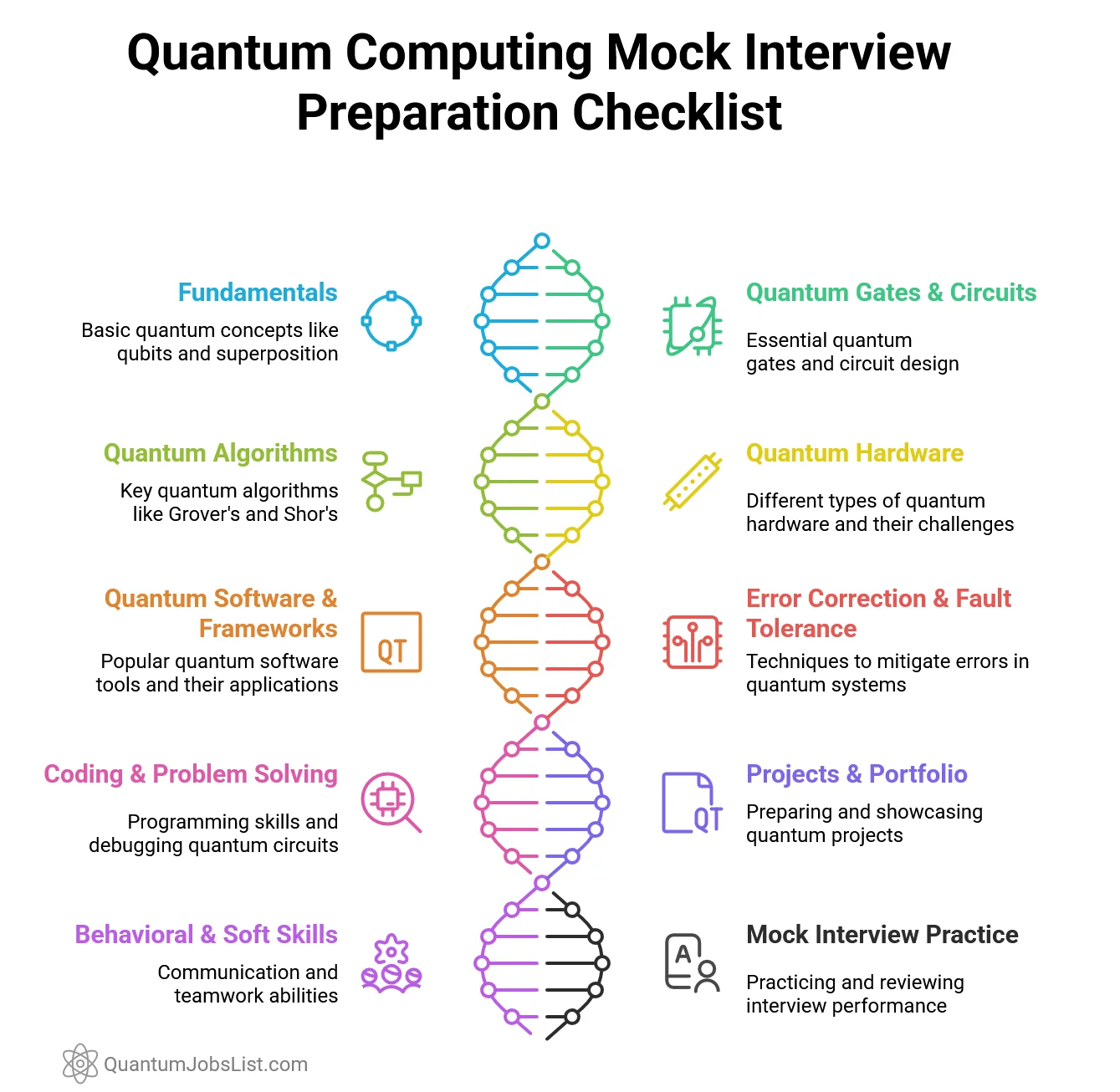
To ace quantum computing interviews, you need to focus on the theory, practice, hardware knowledge, and communication. This includes learning the core topics and programming, knowing the hardware, and doing company research. Then you can expect particular questions, structure your story, explain multiple times, and have good questions ready.
Companies hiring for quantum computing roles expect communication skills to match the technical expertise. They expect the applicants to bring understanding and problem-solving skills rather than rote knowledge.
The time spent preparing for interviews is time spent investing in the future. To develop your communication and programming skills in quantum computing, you need to first understand quantum algorithms. The field of quantum computing is competitive, so being well-prepared is crucial for your confidence & to overcome any gaps in your background. Interviews with companies like IBM and Google require intense preparation.
Suggested Read:
- Qualification required for Quantum jobs
- Top Quantum Banking & Finance Jobs and Skills
- Top Entry Level Quantum Jobs required no experience
Focus on being curious and creative rather than knowing everything about the field. Show your problem-solving skills. Your commitment and enthusiasm for technology will prove your dedication to the field. Show that you are willing to put in the time, and have the confidence that this revolution needs your passion. You will succeed!
Editorial Team
Author: Quantum Jobs List Editorial Team
This resource is curated by the Quantum Jobs List team, a specialized group of technical recruiters and industry analysts dedicated to the quantum computing sector. Every listing and career guide is manually reviewed for accuracy and technical relevance to ensure high-quality opportunities for the global quantum community.
FAQs
How do I explain career gaps in my quantum interview?
Highlight your knowledge in quantum topics, by focusing on what you did during any gaps in your studies. Mention online courses you took, projects you worked on, books you read or community contributions you made. Highlight the skills you gained and how you used that time to improve your understanding of quantum knowledge.
What programming languages must I know for quantum interviews?
Python is important for almost all quantum roles, including Qiskit and Cirq. Try to be proficient in object-oriented Python, NumPy and Matplotlib. Focus on secondary languages like C++ for simulations, Julia for algorithms, or JavaScript for web quantum apps are also useful.
Should I specialize in hardware or software for quantum interviews?
Each specialization depends on your background. Software roles fit computer science backgrounds and require strong programming & algorithm skills. Hardware roles often need physics or electrical engineering degrees. A flexible approach is to build software skills, while understanding hardware basics.
What if I can't answer a technical question during the interview?
Be honest about gaps in knowledge. Explain what you do know, relate it to similar concepts and work through the problem logically. Interviewers value a problem-solving approach and reasoning more than perfect answers.
Should I bring physical materials to my quantum interview?
For remote interviews, keep notes and references ready, but off-screen. For in-person interviews, bring a printed project portfolio, copies of your resume, and a notebook. Avoid textbooks; a tablet with GitHub projects is helpful for discussion.
How important is knowing quantum physics for software roles?
Having basic understanding of superposition, entanglement, measurement and gates is enough. Focus on quantum algorithms and linear algebra, rather than deep physics or experimental knowledge.



.svg)