

8 Min. Read

Jan 2, 2026
What Does a Quantum Physicist Do? Skills, Education & Jobs
Discover what quantum physicists do, from theoretical research to experimental work. Learn about career paths, required skills, salaries, and opportunities.
SHARE


Have you wondered who is creating the future of computing, communication, and cryptography? The quantum physicists, of course! The scientists who work with the smallest things imaginable, manipulating atoms and photons to create technologies that were once thought to be impossible. But what do quantum physicists do every day?
Quantum physicists work in computing, and in theoretical, quantum many-body physics, and quantum information theory. Their work encompasses various branches of mathematics, coding, and brainstorming/collaborative sessions. These scientists are not working in isolation. They work with other scientists using the latest technology to solve practical, complex problems that will define the next century from the rest of technology.
If anybody says he can think about quantum physics without getting giddy, that only shows he has not understood the first thing about them. Niels Bohr (Danish physicist and pioneer of quantum mechanics)
This guide has multiple parts and will show you everything there is to know about quantum physicists. What skills do they need? What is their education? What is the salary? What are the opportunities? What are the responsibilities? As a physics student, someone looking to change careers, or a curious individual, you will find this guide very helpful. You will learn what it takes and how it is like to work as a quantum physicist.
What Exactly Is a Quantum Physicist?
A quantum physicist is someone who studies the interaction of energy and matter at the most granular level. This is at the level of atoms and subatomic particles. At this level, the laws of classical physics break down.
Who Are Quantum Physicists?
Quantum physicists explore how matter and energy behave at the atomic level. This is done through the principles of quantum mechanics. Classical physicists look at large-scale objects and the forces that act upon them. Quantum physicists look at particles that can exist in more than one state, and the act of measuring can change the state of the particle. Also, quantum physicists study entangled particles, which are particles separated over large distances but are still somehow connected.
These professionals work at the cutting edge of science and technology, contributing to:
- Quantum computing: Building computers that harness quantum phenomena.
- Semiconductor design: Advancing electronics at atomic scales
- Quantum cryptography: Creating unbreakable communication systems.
- Quantum sensing: Developing ultra precise measurement devices.
- Medical imaging: Improving diagnostic technologies
What Makes Quantum Physics Different?
Quantum physics describes how matter and energy behave at the smallest scales. Challenging and specialized opportunities are found in the field of quantum mechanics. Strange behavior is exhibited at the atomic level. And that is the essence of quantum physics. Superposition. This means that particles can exist in more than one state at the same time.
Key quantum phenomena physicists study:
- Superposition: Particles existing in multiple states simultaneously
- Wave-particle duality: Matter exhibiting both wave & particle properties.
- Entanglement: Particles remaining connected regardless of distance.
- Quantum tunneling: Particles passing through seemingly impenetrable barriers
What Do Quantum Physicists Do Every Day?
There are many differences in the daily activities of quantum physicists because some may focus on theoretical research, and some will focus on applied technology development. But there is a common set of core activities that quantum physicists perform, which involves scientific research and the application of practical solutions.
How Do Theoretical Quantum Physicists Spend Their Time?
Theoretical quantum physicists draft papers, analyze data, run simulations, test models, construct models, and propose (or add to) theories.
Morning routine typically includes:
- They start at blackboards to sketch equations and conceptual models
- Planning computational approaches to test theoretical predictions.
- They review recent research publications in quantum physics journals.
- Developing mathematical frameworks to predict quantum phenomena
Theorists develop insights to guide experimentalist colleagues. These help them avoid costly trial-and-error by identifying optimal parameters before experiments begin. Core daily activities:
Research and Analysis:
- They formulate mathematical models of quantum systems.
- Comparing theoretical predictions with experimental data
- Running computer simulations to test theoretical predictions
- They analyze simulation results for emergent patterns.
Collaboration and Communication:
- Discussing results with colleagues and collaborators
- Meeting with experimental partners to determine and plan new research avenues
- Defending research at departmental gatherings and public seminars
- Composing research monographs for rigorous academic journals
Computational Work:
- Programming in standard Python, Julia or quantum-specialized languages
- Creating and improving software packages for and to quantum many-body systems
- Enhancing the speed and resource consumption for inter-complex calculations
- Handling data streams and files from quantum simulations
While theoretical research remains central, quantum physicists today are also contributing to software development, AI integration, and practical hardware experiments in industry settings. Quantum Jobs List
What Does an Experimental Quantum Physicist's Day Look Like?
Experimental quantum physicists spend their time designing, conducting and analyzing physical experiments. These experiments test quantum theories and develop new quantum technologies.
Day to day responsibilities include planning and performing experiments, doing research, using computer simulations & mathematical models, and analyzing experimental data. Laboratory activities:
Equipment Management:
- Operating lasers and electromagnets to manipulate individual atoms.
- Troubleshooting experimental apparatus & instrumentation.
- Maintaining ultra cold quantum systems near absolute zero
- Calibrating sensitive measurement equipment
Experimental Procedures:
- Creating experimental protocols to test specific hypotheses
- Finding quantum measurement data
- Monitoring compute systems and experimental state.
- Tuning control parameters based on results
Data Analysis:
- Applying statistical methods to experimental data.
- Comparing results and experimental data with theoretical predictions
- Telling about unanticipated phenomena or anomalies.
- Documenting findings for presentation and publication
Where Do Quantum Physicists Work?
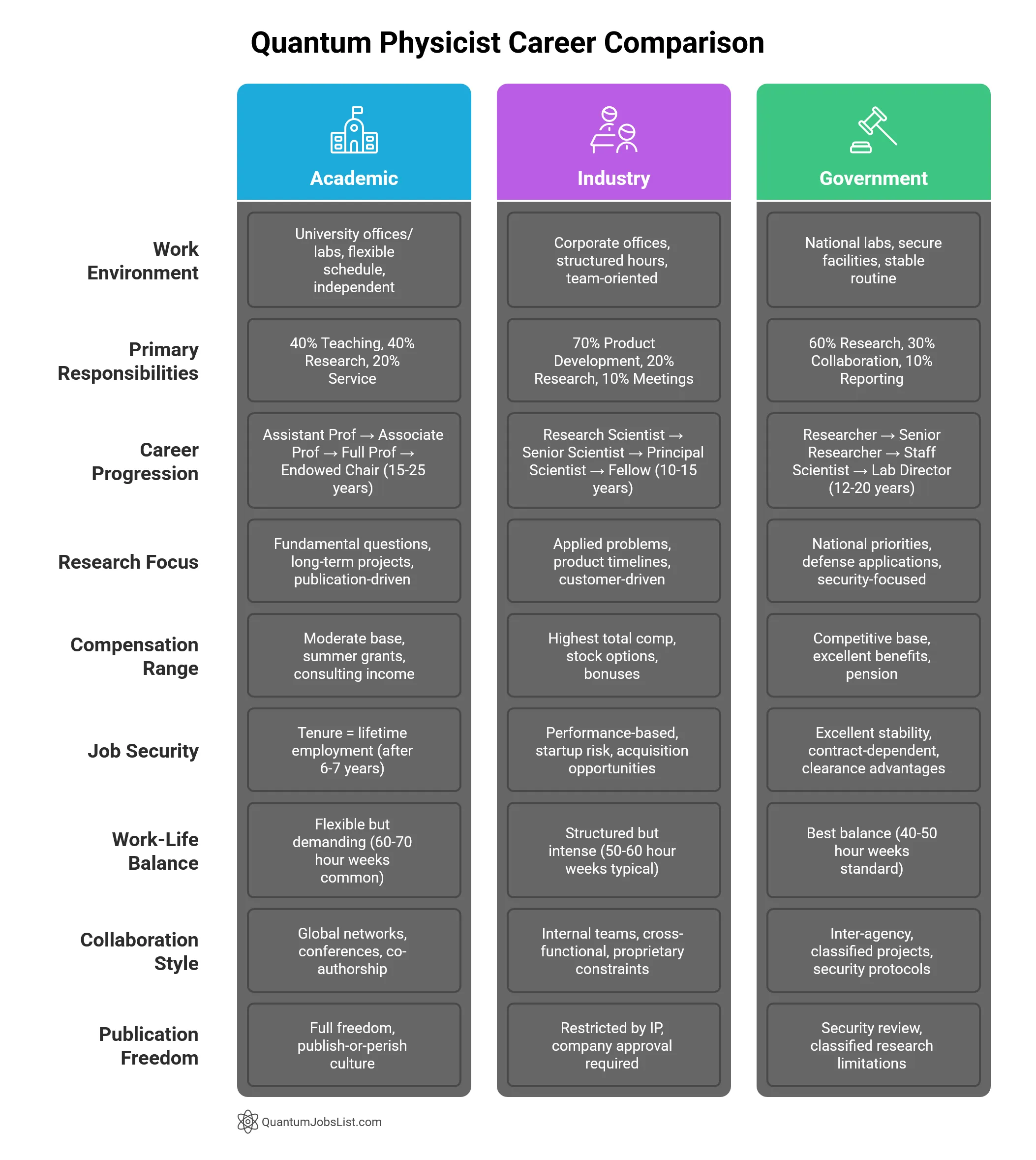
A majority of quantum physicists work in academia as researchers or professors. Some others employed by government agencies and private companies developing new technologies. Primary employment sectors:
Academic Institutions:
- Universities that conduct basic research in quantum phenomena.
- Research centers that develop quantum technologies.
- Positions in teaching and research.
- Supervising graduate and post-doctorate students.
Government Organizations:
- National laboratories (Los Alamos, Sandia, Oak Ridge)
- Standards organizations (NIST).
- Defense agencies (DARPA, NSA and DoD).
- Research funding agencies (NSF, DOE)
Private Industry:
- Tech giants (IBM, Google, Microsoft, Amazon).
- Financial institutions exploring quantum applications.
- Quantum computing startups (such as IonQ, Rigetti and PsiQuantum).
- Consulting firms advising on quantum technology.
Specialized Research Centers:
- CERN (European Organization for Nuclear Research)
- Institute for Quantum Computing.
- Max Planck Institutes.
- Perimeter Institute for Theoretical Physics.
What Are the Two Main Types of Quantum Physicists?
The quantum physics field divides into two complementary specializations. These work together to advance both fundamental understanding and practical applications of quantum phenomena.
What Do Theoretical Quantum Physicists Focus On?
The role of theoretical quantum physicists involves the construction of a formal, predominantly mathematical, structure and conceptual frameworks that account for, and are able to predict, the operational behavior of a quantitative system. Primary responsibilities:
Theory Development:
- Creating new mathematical models of quantum systems
- The Domain Extension of existing quantum theories,
- Integration of quantum mechanics with other theories of physics
- From theoretical constructs, producing empirical claims that can be validated.
Computational Modeling:
- Simulating quantum many-body systems computationally
- The construction of novel computational techniques for quantum systems
- Emergent behavior of computational systems and its analysis
- The improvement of quantum systems simulation algorithms.
Research Communication:
- Writing research papers for academic journals
- Applying for research grants to fund theoretical work.
- Presenting findings at conferences & workshops.
- Collaborating with experimentalists on research directions
Skills emphasized:
- Advanced mathematical proficiency (linear algebra, differential equations)
- Programming expertise in languages like Python, Julia, and C++
- Must have a strong analytical and problem-solving capabilities
- An ability to communicate complex concepts clearly
How Do Experimental Quantum Physicists Differ?
Experimental quantum physicists design and conduct physical experiments to test theories, discover new phenomena and develop quantum technologies. Core activities:
Laboratory Experimentation:
- They build experimental apparatus and quantum systems
- Maintaining and troubleshooting complex instrumentation.
- Operating sophisticated quantum measurement equipment.
- They conduct experiments to test specific hypotheses
Technology Development:
- Creating quantum devices and systems
- Enhancing quantum system functionality and dependability
- Developing quantum technology prototypes for complex use cases
- Shifting discoveries from the lab to great real-world applications
Data Collection and Analysis:
- Collecting and reporting experimental results with great precision
- Data interpretation and analysis through computational and/or statistical methods
- Experimental results vs. theories
- Publishing the results of experiments in relevant fields of physics
Skills emphasized:
- Ability to work in a lab and use various equipment
- Ability to work with various measurement methods and methods of error analysis
- Knowledge of mechanics and electrical engineering
- Can work with attention and detail
How Do These Two Types Collaborate?
The most impactful quantum physics research emerges from close collaboration between theoretical and experimental physicists, who complement each other's strengths.
Collaborative workflows:
- Theorists predict phenomena to be tested by experimenters.
- Experimental findings motivate theorists to produce new explanations.
- Collaborative research involves theoretical predictions and experimental proof.
- The frequent prediction and control of the experiment make the theory valid.
What Skills Do You Need to Become a Quantum Physicist?
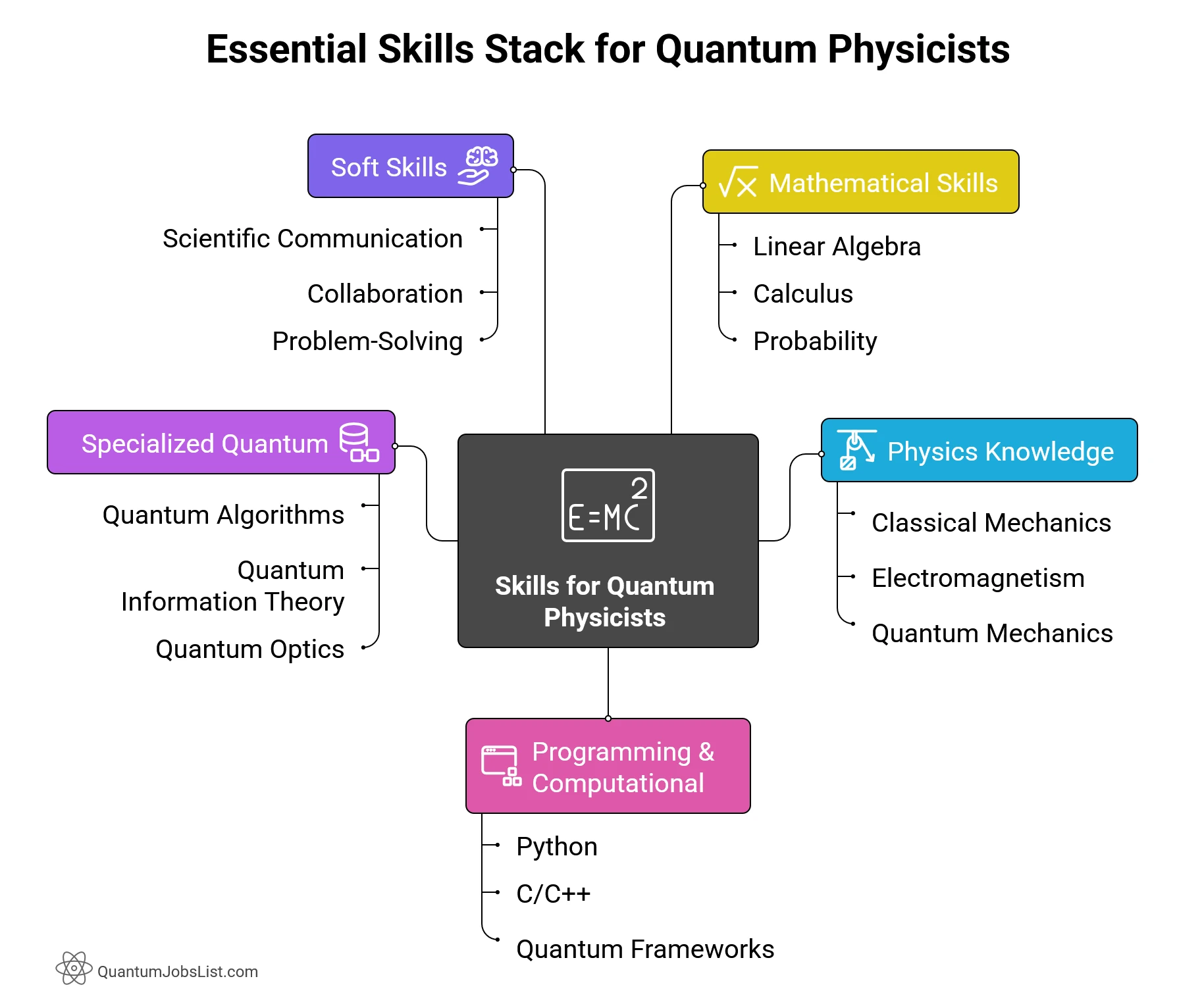
To succeed in this field, you require a very specific set of skills, ranging from a sound grasp of mathematics and a good knowledge of science to engineering. Having the the ability to work and cooperate with a team will be nice.
What Mathematical Background Is Essential?
Mathematics forms the foundational language of quantum physics, and strong mathematical skills are absolutely critical for success in the field.
Core mathematical requirements:
Linear Algebra:
- Matrix operations and eigenvalue problems.
- Applications to quantum gates and circuit operations.
- Vector spaces & linear transformations.
- Quantum state representation using vectors and matrices.
Calculus and Differential Equations:
- Single and multivariable calculus
- Optimization techniques for quantum systems.
- Ordinary and partial differential equations.
- Applications to quantum wave equations
Probability and Statistics:
- Probability theory and statistical mechanics.
- Error analysis & experimental precision.
- Statistical analysis of experimental data.
- Quantum measurement outcomes and uncertainty.
Advanced Mathematics:
- Complex analysis and complex numbers
- Numerical methods and computational mathematics
- Group theory and symmetry operations,
- Topology and differential geometry (for theoretical work)
Suggested Read: Qualifications You Need for a Quantum Job
What Physics Knowledge Is Required?
Extensive and profound knowledge in the field of quantum mechanics, along with critical thinking skills to reason with the available data, would certainly come in handy when solving challenging quantum mechanics problems. Essential physics topics:
Classical Physics Foundation:
- Try to master mechanics and electromagnetism fundamentals
- Thermodynamics and statistical mechanics.
- Wave phenomena and optics.
- Learn classical field theory basics
Quantum Mechanics Core:
- Schrödinger equation and quantum states.
- Quantum entanglement and measurement theory.
- Quantum operators and observables;
- Perturbation theory and approximation methods.
Specialized Quantum Topics:
- Quantum field theory (for particle physics focus).
- Quantum information theory (e.g. For computing applications).
- Condensed matter physics (for materials applications).
- Quantum optics (for photonic systems).
What Programming Skills Are Important?
Because modern quantum physics is highly dependent on computational methods, programming skills are necessary in both the theoretical and experimental domains. Key programming competencies:
Primary Languages:
- Python for quantum programming and data analysis.
- Julia for high-performance quantum simulations.
- C/C++ for quantum algorithms that are critical to performance.
- MATLAB for academic research and data visualization.
Quantum-Specific Programming:
- Qiskit (IBM's quantum programming framework)
- Cirq (Google's quantum programming library)
- Q# (A Microsoft quantum programming language)
- PennyLane (quantum machine learning framework)
Computational Tools:
- Scientific computing libraries (NumPy and SciPy).
- High performance computing and parallel processing.
- Data visualization (Matplotlib and Plotly).
- Version control (Git, GitHub).
Suggested Read: Top Quantum Programming languages to Learn
What Soft Skills Matter for Quantum Physicists?
Technical expertise alone is not sufficient. Quantum physicists need strong communication, collaboration, and problem-solving skills to succeed in research environments. Critical soft skills:
Communication Abilities:
- You must be able to explain complex quantum concepts to diverse audiences.
- Teaching and mentoring students or junior researchers.
- Writing clear research papers and technical documentation.
- Presenting findings at conferences and seminars.
Collaboration Skills:
- Can work effectively in interdisciplinary research teams.
- Managing research projects and coordinating group efforts.
- Coordinating with experimentalists, theorists and engineers.
- Participating in international research collaborations.
Problem-Solving and Creativity:
- Approaching novel quantum problems with creative solutions.
- Must be able to generate innovative ideas for new research directions.
- Persistent troubleshooting of experimental or theoretical challenges.
- Adapting research directions based on unexpected results.
Professional Development:
- Always stay current with rapidly evolving quantum research.
- Applying for research grants and managing project budgets.
- Try to attend conferences and workshops regularly.
- Building professional networks within the quantum community.
How Much Do Quantum Physicists Earn?
The salary range for quantum physicists, due to the varying levels of education, experience, location, industry, and type of employment, is generally well compensated for the salary range due to the quantum specialization.
What Are Entry-Level Quantum Physicist Salaries?
As of 2026, the average annual pay for an Entry Level Quantum Physicist in the United States is $94,805 a year, with salaries ranging from $59,000 to $112,000. In EU salaries are ranging from €45,000 to €90,000 a year.
Entry-level salary breakdown:
Academic Positions:
- Postdoctoral researchers: $55,000 - $75,000 a year.
- Assistant professors: $70,000 - $95,000 base salary.
- Research associates: $60,000 - $80,000 starting pay.
- University lecturers: $65,000 - $85,000 annually.
Industry Positions:
- Quantum software engineers: $95,000 - $130,000 a year in starting.
- Quantum hardware engineers: $90,000 - $125,000 starting salary.
- Research scientists: $100,000 - $140,000 initial compensation.
- Quantum algorithm developers: $105,000 to $145,000 for entry-level.
Government Positions:
- National laboratory researchers: $80,000 - $110,000 in starting.
- Defense research positions: $85,000 - $115,000 (plus clearance premiums).
- Government agency scientists: $75,000 - $105,000 initial pay.
- Research facility staff: $70,000 to $100,000 for the entry-level.
Suggested Read: Top Quantum Jobs and Salaries
How Do Salaries Progress with Experience?
The average salary for a Quantum Physicist is $263,765 (€225,000) per year in the United States, with top earners making up to $460,301 at the 90th percentile.
Career progression salary ranges:
Mid-Career (5-10 years experience):
- Academic positions: $90,000 - $140,000 (For tenured associate professors)
- Consulting positions: $140,000 - $200,000+ a year.
- Industry roles: $150,000 - $220,000 (For senior quantum scientists).
- Government labs: $110,000 - $160,000 (For senior researchers)
Senior Level (10-20 years experience):
- Full professors: $120,000 - $180,000 (top universities pay more).
- Research fellows: $140,000 - $220,000 a year.
- Principal scientists (industry): $200,000 - $350,000+ a year in total compensation.
- Laboratory directors: $150,000 - $250,000 as base salary.
Leadership Positions (20+ years):
- Department chairs: $150,000 - $250,000 a year in a academic leadership.
- Distinguished fellows: $180,000 - $300,000+ elite researchers.
- Chief quantum officers: $250,000 - $500,000+ a year as industry executives.
- Laboratory directors: $200,000 - $400,000 national labs.
Which Locations Pay the Most?
Geographic location significantly impacts quantum physicist compensation, with certain regions offering substantial salary premiums.
Highest-paying locations:
United States:
- Silicon Valley, CA: $117,698 average in California, with top positions exceeding $300,000.
- Austin, TX: Growing quantum hub, $95,000 - $170,000 a year with favorable taxes.
- Boston, MA: Strong quantum ecosystem, $110,000 - $200,000 a year as typical range.
- Seattle, WA: Microsoft and Amazon presence, $105,000 - $190,000 range.
International Markets:
- Zurich, Switzerland: Premium European quantum salaries
- Singapore: This a growing Asian quantum hub with tax advantages;
- Toronto, Canada: A very competitive with strong quantum community
- London, UK: European quantum center with strong compensation
Not only is the universe stranger than we think, it is stranger than we can think. Werner Heisenberg (German theoretical physicist and key figure in quantum mechanics):
Suggested Read:
How Do You Become a Quantum Physicist?
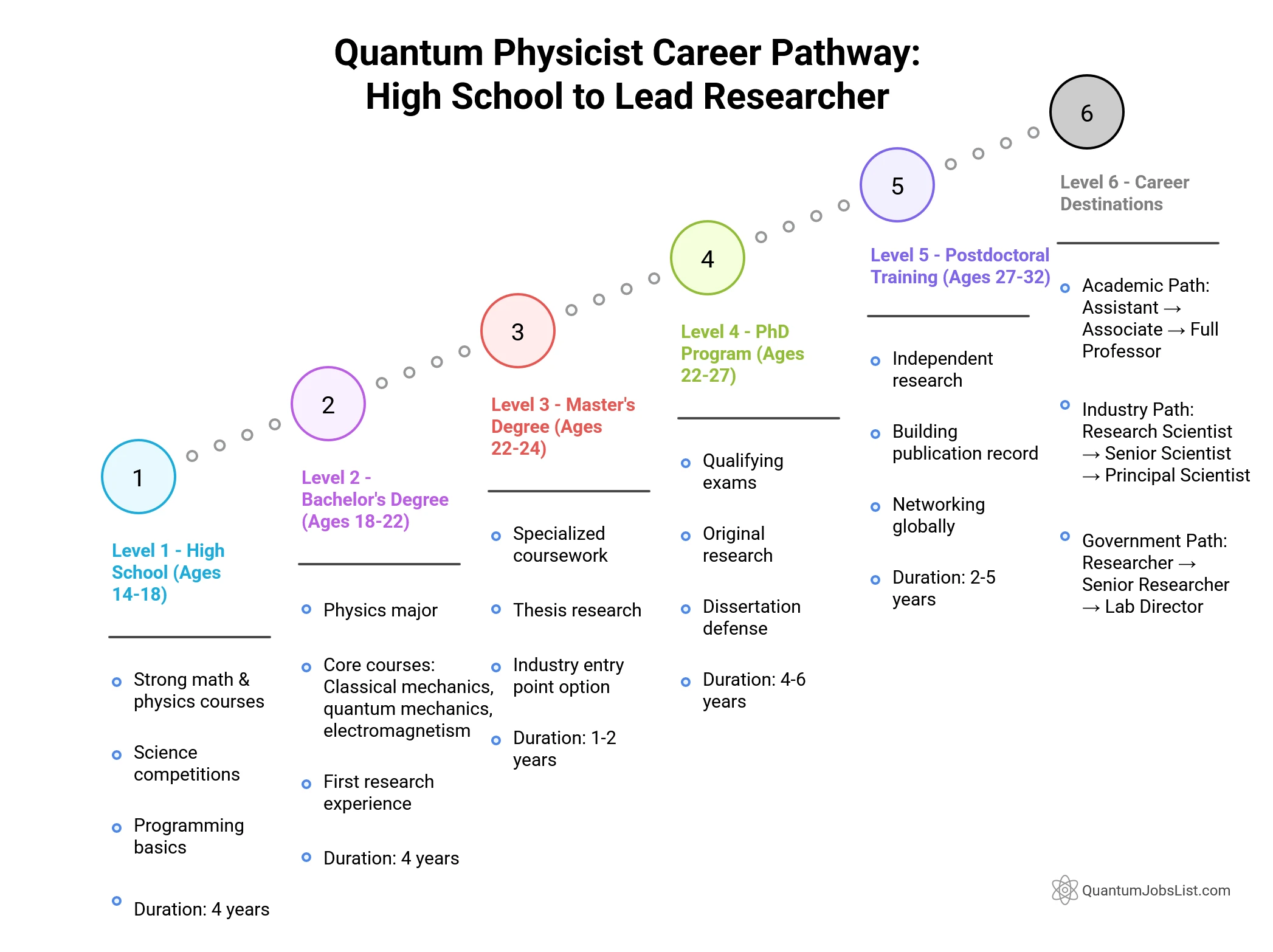
Becoming a quantum physicist requires an immense educational commitment, which typically spans 8 to 10 years. Years will be spent on preparation from high school through doctoral research.
What High School Preparation Is Needed?
A future quantum physicist must acquire high marks in the core subjects such as biology, physics, chemistry, and maths. These are necessary to gain entry into a university. High school requirements:
Core Academic Subjects:
- Mathematics: Pre-algebra, algebra, advanced algebra, precalculus and calculus.
- Biology: General biology for scientific foundation.
- Physics: General physics, AP Physics 1, AP Physics 2, AP Physics C.
- Chemistry: General chemistry and advanced chemistry courses.
Recommended Activities:
- Science fairs and physics competitions.
- Science-related clubs and research projects.
- Summer programs at universities or research institutions.
- Independent study of quantum physics through online resources.
Skills Development:
- Programming basics (Python is recommended).
- Mathematical problem solving beyond curriculum.
- Laboratory experience through school projects.
- Scientific writing and communication practice.
What Undergraduate Degree Should You Pursue?
A quantum physicist requires, as a minimum, a bachelor's degree in physics and a master’s degree. Bachelor’s degrees are costly, however, so consider apprenticeship programs.
Undergraduate pathways:
Physics Major (Most Common):
- A broad physics curriculum covering both classical and modern physics.
- Comprehensive mathematics coursework including calculus, linear algebra, and differential equations.
- Laboratory courses are designed to develop experimental skills.
- Research with physics faculty.
Related Majors:
- Mathematics: Excellent preparation for theoretical quantum physics
- Engineering Physics: Combines physics with engineering applications.
- Chemistry: Can transition to quantum chemistry specialization,
- Computer Science: Growing path for quantum computing careers
Recommended undergraduate courses:
Core Physics:
- Learn classical mechanics and electromagnetism.
- Modern physics and atomic physics.
- Master the thermodynamics and statistical mechanics.
- Quantum mechanics (introduction and advanced).
Mathematics:
- Linear algebra and abstract algebra
- Learn the probability and statistics
- Complex analysis and mathematical physics
- Differential equations and numerical methods
Supplementary Skills:
- Scientific programming (Python and MATLAB).
- Research methodology and scientific ethics.
- Electronics and experimental methods.
- Communication and technical writing.
Is Graduate School Necessary?
Most quantum physicists working in research possess a PhD. This degree is basically a requirement for independent research jobs in academia, the national labs, or higher-level industry positions.
Graduate education pathways:
Master's Degree (1-2 years):
- Deepen physics knowledge beyond the undergraduate level
- Provides a chance for research experience and specialization
- Can lead to industry jobs or a PhD
- Some include research scientist apprentice positions
Doctoral Degree (3-5 years):
- Necessary for academic faculty jobs
- Mandatory for independent research in most places
- Constructs deep knowledge in a particular quantum subdomain
- Ends with a piece of original research and a dissertation defense
PhD program components:
Coursework Phase (1-2 years):
- Advanced quantum mechanics and quantum field theory.
- Qualifying examinations demonstrating mastery.
- Specialized courses in research area.
- Learn mathematical methods for physics.
Research Phase (2-4 years):
- Original research with faculty advisor
- Creation of research proposal and methodology
- Collection, analysis, and interpretation of (research) data
- Presentation at group meetings and conferences
Dissertation Phase (Final year):
- Writing a complete dissertation document
- Defending one’s research before the faculty jury
- Publishing research results in peer-reviewed journals.
- Preparing for postdoctoral jobs or industry positions.
Quantum physicist roles are no longer limited to academia; nearly 40% of positions we track are in private sector companies and startups driving applied quantum solutions. Quantum Jobs List
Suggested Read: How to get Quantum job without PhD
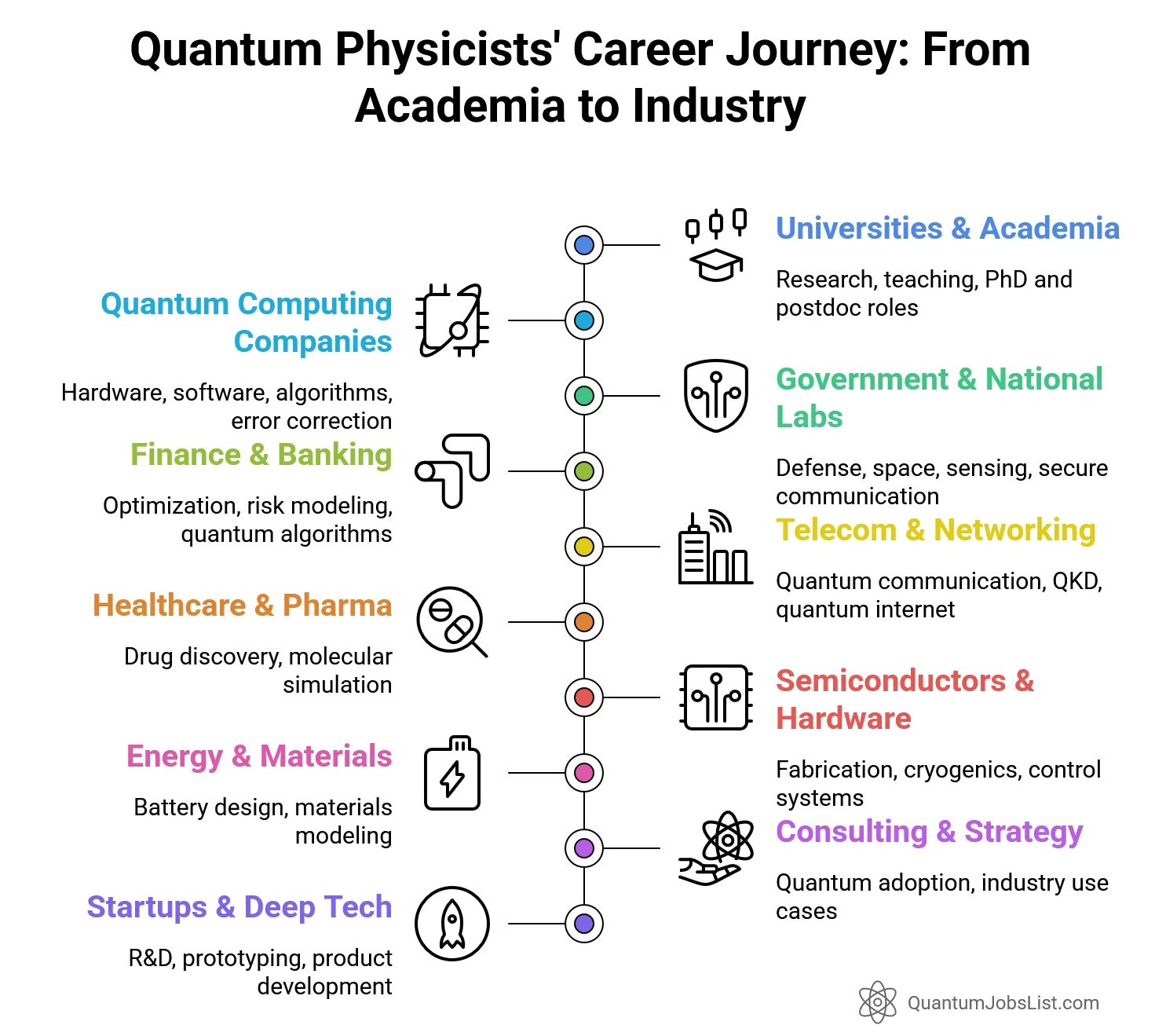
What Career Opportunities Exist for Quantum Physicists?
As quantum technologies become more commercial and research projects increase, the demand for quantum physicists is rising. This means physicists are finding jobs in a wider range of fields.
What Academic Career Paths Are Available?
Quantum physicists are employed by universities and research institutes to conduct advanced fundamental science, and are also responsible for teaching and training future scientists.
Academic positions:
Faculty Positions:
- Assistant Professor: Entry-level tenure-track, $70,000 - $95,000 a year.
- Associate Professor: Mid-career tenured position, $90,000 - $140,000 annually
- Full Professor: Senior faculty role, $120,000 - $180,000+ a year.
- Endowed Chairs: Distinguished professorships, $150,000 - $250,000+ annually
Research Positions:
- Postdoctoral Researchers: $55,000 - $75,000 typical range.
- Research Scientists: $70,000 - $110,000 a year non-tenure track
- Research Fellows: $90,000 - $140,000 a year senior research roles
- Laboratory Directors: $150,000 - $250,000 managing research facilities.
Academic responsibilities:
Teaching Duties:
- Delivering lectures on quantum physics and related subjects
- Designing and grading examinations
- Managing and guiding students in the lab
- Mentoring students at the undergraduate and graduate levels
Research Activities:
- Conducting original quantum physics research
- Writing and submitting manuscripts to peer-reviewed journals
- Participating in conferences and presenting research in various countries
- Working in partnership with other researchers at different institutions
Service Obligations:
- Working in the university and department committees
- Evaluating papers for scientific journals
- Providing advice on academic programs and curriculum policies
- Working in the leadership of professional associations
What Industry Career Options Are There?
Physicist Jobs in the industrial sector may include research, data science, and quantum computing, with industrial physicists developing new technology working with semiconductors and lasers.
Technology Giants:
- IBM Quantum: $120,000 - $250,000 for quantum researchers and engineers
- Amazon Braket: $130,000 - $280,000 a year competitive packages;
- Google Quantum AI: $150,000 - $350,000+ a year, total compensation packages
- Microsoft Azure Quantum: $140,000 - $300,000 including stock options
Few Quantum Startups:
- IonQ: $110,000 - $220,000 a year with significant equity.
- Quantinuum: $115,000 - $230,000 with growth potential.
- Rigetti Computing: $100,000 - $200,000 a year + stock options.
- PsiQuantum: $120,000 - $240,000 competitive compensation.
Few Financial Services:
- JPMorgan Chase: $140,000 - $260,000 a year quantum finance roles
- Risk Management: $120,000 - $240,000 quantum risk modeling;
- Goldman Sachs: $150,000 - $280,000+ a year including some bonuses
- Trading Firms: $160,000 - $350,000 quantum algorithm development
Top Consulting Firms:
- McKinsey & Company: $150,000 - $300,000 a year quantum strategy consulting.
- Deloitte: $130,000 - $260,000 quantum advisory services,
- Boston Consulting Group: $140,000 - $280,000 a year technology consulting.
- Accenture: $120,000 - $250,000 for quantum implementation consulting.
A Day in the Life: Real Quantum Physicist Experiences
To truly grasp the nature of the work done by quantum physicists, it is important to examine the daily activities of physicists in various subfields and professional levels.
What Does a Theoretical Quantum Physicist's Day Include?
I am a computational and theoretical physicist in quantum many-body physics and quantum information theory. My work involves a lot of mathematics and programming, and I sometimes work with others at a whiteboard.
Typical daily schedule:
Morning (9:00 AM - 12:00 PM):
- 9:00 - 10:00: I start at blackboard sketching equations and models to understand physics before coding.
- 10:00 - 11:30: Move to laptop to write simulations for quantum systems using Python or Julia;
- 11:30 - 12:00: Coffee or Tea break and informal discussions with colleagues about recent papers.
Afternoon (12:00 PM - 5:00 PM):
- 12:00 - 1:00: Lunch and reading recent quantum physics publications.
- 1:00 - 3:00: I analyze simulation results looking for emergent patterns or useful findings;
- 3:00 - 4:30: Meeting with experimental partners to discuss theoretical predictions and experimental plans.
- 4:30 - 5:00: Document progress & plan next day's research activities.
Evening (Flexible):
- Participating in online workshops and conferences
- Drafting and editing research papers
- Reviewing manuscripts as a peer reviewer
- Writing and editing grant applications and progress reports
Research focus example: Researching quantum many-body dynamics in sparse coupling graphs— systems with few interconnects between nodes, crucial for network theories of quantum information dissemination.
How Does an Experimental Quantum Physicist Spend Their Day?
Experimental quantum physicists study the effects of subatomic particles. A well-known example is the collaboration with CERN, where physicists study and analyze the data from the Large Hadron Collider.
Laboratory day structure:
Morning Laboratory Work (8:00 AM - 12:00 PM):
- 8:00 - 9:00: They review overnight experimental runs and data quality.
- 9:00 - 10:30: They prepare and calibrate quantum system for day's experiments.
- 10:30 - 12:00: Run experiments manipulating quantum states with lasers and magnetic fields.
Afternoon Analysis (12:00 PM - 5:00 PM):
- 12:00 - 1:00: Physicist lunch and lab group meeting discussing experimental progress
- 1:00 - 3:00: Analyze morning's experimental data using statistical methods;
- 3:00 - 4:30: They troubleshoot equipment issues and plan modifications
- 4:30 - 5:00: Document experimental procedures and results
Evening Activities (Variable):
- Attending group meetings on recent breakthrough experiments.
- Reading literature on novel experimental methods.
- Writing descriptions of experimental techniques for publications.
- Overseeing and guiding less experienced researchers or graduate students.
Experimental challenges:
- Maintaining quantum systems at ultra-cold temperatures near absolute zero
- Coordinating complex experimental timing sequences;
- Isolating experiments from environmental noise and vibrations
- Achieving single-atom manipulation precision

What Does an Industry Quantum Physicist Do Daily?
Industry quantum physicists focus on translating quantum physics principles into practical technologies and commercial applications.
Corporate environment schedule:
Morning Product Development (9:00 AM - 12:00 PM):
- 9:00 - 9:30: Stand-up meeting with quantum engineering team
- 9:30 - 11:00: Working on quantum algorithm optimization for specific customer applications
- 11:00 - 12:00: Testing quantum software on company's quantum computing platform
Afternoon Collaboration (12:00 PM - 6:00 PM):
- 12:00 - 1:00: Have lunch with colleagues discussing technical challenges.
- 1:00 - 2:30: Have meeting with product managers about quantum feature roadmap.
- 2:30 - 4:00: Writing technical documentation for quantum APIs.
- 4:00 - 5:00: Attend customer call explaining quantum advantages for their use case.
- 5:00 - 6:00: Code review and feedback on team members' quantum implementations.
Key differences from academic work:
- Focus on practical applications rather than fundamental research.
- Customer-facing communication explaining quantum technology benefits.
- Faster development cycles with product deadlines;
- Cross functional collaboration with engineers, product managers, and business teams.
How long does it take to become a quantum physicist?
If you want an academic career, you're looking at 8-10 years of schooling (undergraduate + PhD) and an additional 2-5 years of postdoctoral work, which roughly breaks down as follows:
- 3-4 years obtaining a bachelor's in physics (or a closely related field)
- 1-2 years getting a master's (this is optional, but it can be helpful)
- 3-4 years devoted to your doctoral research and defending your dissertation
- If you're planning on academic research, you will also need to complete 2-5 years of postdoctoral training.
From the time you start university, you will need to spend roughly 10-15 years to attain a permanent research position.
These times can differ based on your specialization. For instance, in experimental quantum physics, there is usually more extensive lab training, while it can progress more quickly in theory if your research is moving along.
The length of your PhD is particularly determined by the intricacy of the research and the publishing expectations of your university. A lot of students tend to take gap years after obtaining a degree, which can prolong the process, but it affords the opportunity to gain research experience, focus their interests, and it usually strengthens their applications and career direction.
Can I become a quantum physicist without a PhD?
You don't always need a PhD to work in quantum-related fields, but your options will be more restricted. Here’s what to keep in mind:
- Industry positions like quantum software engineer, data analyst, or technical writer may only require a bachelor or master degree
- Companies value practical programming skills and quantum knowledge, offering more flexibility than academia
- Leading original research and academic faculty positions almost universally require a PhD
- Independent research roles are essentially closed without doctoral-level training
While your career potential will be more limited without a PhD, you will still be able to engage in valuable work in the field of quantum sciences.
The quantum computing industry is growing rapidly and creating many new roles, some of which prioritize programming and knowledge of quantum algorithms over a background in physics. If you possess a master's degree and are proficient in programming (particularly Python, Q#, or Qiskit), you will be able to work in quantum software development. Other fields that are growing are technical sales, science communication, and patent analysis, which will value your quantum knowledge and will not require a PhD. If you want to work on the development of new quantum theories, experiment design, or lead research teams, that’s where you will need a PhD.
Quantum physics tells us that no matter how thorough our observation of the present, the (unobserved) past, like the future, is indefinite and exists only as a spectrum of possibilities. This highlights how quantum physicists explore uncertainty and possibilities beyond everyday experience. Stephen Hawking on the nature of quantum physics and discovery
What is the job outlook for quantum physicists?
The job outlook for you is excellent and expanding rapidly. Here's what the data shows:
- 5% growth projected for physics employment (faster than average), according to the Bureau of Labor Statistics.
- Both academic and industry opportunities are expanding as quantum technology commercializes.
- 65% of quantum industry leaders believe fault-tolerant quantum computing will arrive by 2030 (McKinsey 2025).
- 1,500 quantum physicists needed by 2027, with positions growing 10% a year.
You are starting as the quantum sector is changing from research to practical applications, truly an exciting time to begin your career.
The world's biggest tech companies, IBM, Google, Microsoft, and Amazon, are competing to acquire top talent in quantum computing. In addition, there is an explosion of startup companies, such as IonQ, Rigetti, and PsiQuantum, which are racing to create the first commercially viable quantum computer. In addition to tech companies, the government funding of quantum computing is increasing rapidly.
The U.S. National Quantum Initiative has committed more than $1.2 billion to quantum research, and similar initiatives in Europe, China, and elsewhere are also funding research. This money will translate directly into new jobs, funding for national laboratories, and research positions at universities. In addition to quantum computing, other emerging fields such as quantum sensing, quantum cryptography, and quantum communications will need your talent and expertise. Enjoy your career as a builder in this new quantum world.
Is quantum physics difficult to learn?
Yes, quantum physics is challenging for you because it contradicts everyday intuition and demands strong mathematical skills. However, it is not impossible:
- The concepts describe phenomena you can not observe in daily life, making them counterintuitive.
- Many students find the intellectual challenge deeply rewarding precisely because it reshapes how you understand reality;
- Strong foundations in mathematics and classical physics are essential prerequisites.
- Success requires persistence, problem solving ability and openness to strange ideas.
Focusing on consistent effort along with a well-laid-out strategy will surely help you learn the fundamentals and construct your knowledge base. You will also need to tackle some mathematics: these include linear algebra, differential equations, complex numbers, and probability. These might seem challenging, but with a bit of effort, nearly all students can learn these and many more.
The foundational concepts of quantum physics, such as wave-particle duality and quantum entanglement, can be puzzling and are best understood after one has done the necessary grounding in mathematics and has seen how the concepts relate to physical phenomena. Instead of trying to learn difficult concepts, take the time to learn the basics.
In the world of physics, some resources can be quite straightforward and useful. A physics degree is designed to help one go through such resources in a way that one develops the necessary skills as well as confidence.
Can I transition to quantum physics from another field?
You can transition to quantum physics. You will need significant focused learning. Here is what your path might look like:
- Software engineers with math backgrounds can move into quantum computing through algorithms and programming frameworks.
- Electrical engineers can pivot to quantum hardware development.
- Traditional physicists can specialize through self study, courses or graduate programs
- Expect 1-3 years of dedicated learning depending on your background and target specialization
Your existing skills provide a foundation, but acquiring additional knowledge in quantum physics and math will be necessary.
For those with a computer science background, quantum information and quantum algorithms would be the best starting points. These subjects are paired best with your existing knowledge of coding and logic. While transitioning into quantum hardware, engineers specialize in the mechanics of qubits and quantum gates and utilize their knowledge of electronics. Once mathematicians grasp the physical implications of the associated math, they often adjust quickly.
Learning can be done in a number of ways. You can access and manipulate genuine quantum computers through IBM Quantum. You may complete short-term quantum science certifications, attend lab research workshops, graduate courses part-time, and many more options. Many quantum bootcamps are running at universities and are tailored for working professionals who are looking to step into this field.
What personality traits help quantum physicists succeed?
Successful quantum physicists share several key characteristics that will help you thrive:
- A desire to deeply understand how the fundamentals of the universe operate
- The ability to work on problems that will take months or years to unravel
- Comfort with abstraction, along with the ability to manipulate complex mathematical logic
- Detail-oriented precision in experimental and theoretical work
- The ability and desire to work in interdisciplinary teams, as most contemporary quantum research requires this.
- The ability to adapt and keep up with new and rapid scientific advances that reshape the research landscape
You do not need to be a master of all of these skills, but working on these areas will make you enjoy the work more and likely make you more successful.
A willingness to learn is critical in the field of quantum physics. Problems that cannot be solved instantly span the field, and asking questions is part of the research process. Clear and effective communication is essential as you will need to relay complex concepts to your teammates, write papers, and eventually help lead or advise students and junior colleagues.
This is a field where failure is more common than success. Many ideas will not work the first time, and many experiments will not work at all. The most successful quantum physicists manage to stay confident but accept being wrong and learn from the experience. If you enjoy the process of working through puzzles, and you enjoy progress that is slow but steady, you will do well in this field even if you do not see yourself as a genius.
Conclusion
Quantum physicists have great job prospects since they create new tech such as quantum computers, secure communication, and advanced sensors. Most physicists work in groups since they solve complex problems together and create technologies that incorporate math and computer science.
To become a quantum physicist, one must study for 8-15 years. Starting salaries for these positions average around 95,000; however, higher-level positions can pay over $400,000. The work takes a toll due to the number of years and the challenges that must be overcome; however, the work is meaningful and contributes to society as a whole.
There is a high level of job growth since quantum technology is rapidly increasing outside of the research labs. There is a lot of room to work in the government, industries, or universities.
Those interested in quantum science should have a high level of intelligence in math and physics, as well as research outside of school, knowledge in coding, and curiosity. The most essential trait is to have an explorer's mindset.
Resources for Aspiring Quantum Physicists
Educational Resources:
- IBM Qiskit Textbook - Free comprehensive quantum computing education
- MIT OpenCourseWare - Quantum physics lecture series and materials
- Coursera/edX - University quantum mechanics and computing courses
- Physics Forums - Community discussion and problem-solving
Research and Career Information:
- arXiv.org - Preprint server for latest quantum physics research
- Physics Today - News and career advice for physicists
- Quantum Jobs USA - Quantum career opportunities and salary data
- Quantum Jobs List - Global Quantum Jobs, Career Guides and salary Data
- APS Career Center - Physics job listings and career resources
Conferences and Networking:
- American Physical Society March/April Meetings
- IEEE Quantum Week
- Quantum.Tech Conference
- Gordon Research Conferences on Quantum Science
Suggested Read:
- 8 Steps to Prepare for a Quantum Job Interview
- Quantum ML Jobs: Careers & Skills Guide
- What are the jobs in Quantum?
Editorial Team
Author: Quantum Jobs List Editorial Team
This resource is curated by the Quantum Jobs List team, a specialized group of technical recruiters and industry analysts dedicated to the quantum computing sector. Every listing and career guide is manually reviewed for accuracy and technical relevance to ensure high-quality opportunities for the global quantum community.
FAQs
What degree do you need to be a quantum physicist?
Most quantum physicists hold PhDs in physics, with undergraduate degrees in physics, mathematics or engineering. Entry level quantum computing industry positions may accept bachelor's or master's degrees combined with programming skills. Academic research positions and faculty roles require PhDs.
How much do quantum physicists make?
The median annual salary for quantum physicists in the United States is $139,220. Entry-level positions starting around $59,000-$95,000 a year. While experienced quantum physicists earn $150,000 - $350,000 in industry roles. High earners in senior industry positions can exceed $400,000 + equity.
Where do quantum physicists work?
Quantum physicists work in many places. Common quantum employers include universities, national labs like Los Alamos & Sandia, big tech companies, such as IBM, Google, Amazon AWS, and Microsoft, and quantum startups like IonQ and Rigetti. Some also work with government agencies like DARPA or NSA, or in consulting roles.
Is quantum physics a good career?
Yes, it is a strong career choice for the right person. Quantum physics offers good job growth, high salaries, and challenging work. Many roles let you move between academia, government, and industry. People who enjoy problem-solving find this career very rewarding.
What programming languages do quantum physicists use?
Python is the most common language. Especially for quantum programming and data analysis. Julia is used for fast simulations. C or C++ is used when high performance is needed. Popular quantum programming tools include Qiskit, Cirq, and Q#.
Can quantum physicists work remotely?
It depends on the role. Theoretical and software-focused physicists can often work remotely or in hybrid setups. Experimental physicists usually need to be in the lab. Industry roles are more flexible than academic ones.



.svg)