

10 Min. Read

Dec 17, 2025
Quantum ML Jobs: 12 Careers & Skills Guide 2026
Discover 12 top quantum ML careers worldwide with salaries from $95K-$210K. Learn skills, transition paths, and where to find quantum machine learning jobs.
SHARE


What if AI were able to identify patterns that even the strongest supercomputers in the world today cannot? In the spring of 2023, Google announced an achievement that will clearly change the world. They reported a quantum machine learning (QML) model that was performing an order of magnitude better than classical ML in a variety of tasks, approximately 100 times better. This further solidifies the emergence of a new career field, the intersection of AI and quantum computing. QML will tackle problems previously considered intractable.
The quantum ML field is exploding globally with unprecedented opportunities. McKinsey & Company Report (2024) reveals that
The subdomain has experienced an increase of 35% in the available positions within a span of two years. The salaries are also increasing at a rate of 10 percent each year.
Whether in Silicon Valley, Singapore, London, or Tokyo, companies are racing to hire experts who know both quantum computing and machine learning.
With training in AI and quantum computing, you could earn $95,000 or more. This is the first guide to cover 12 of the best-paying quantum ML career paths. Since machine learning engineers at Google and Amazon can earn $500,000, it is clear that quantum ML will pay at least as well as top jobs in physics, thanks to the extra value of machine learning skills.
What Is Quantum Machine Learning and Why Does It Matter?
Quantum machine learning puts you at the cutting edge where computing meets AI. It opens up exciting career opportunities. This new field uses quantum mechanics to enhance traditional machine learning, making it possible to tackle problems that classical computing could not solve.
How Does Quantum ML Differ from Classical Machine Learning?
Standard machine learning uses binary digits, while quantum machine learning (QML) uses quantum bits (or ‘qubits’), which can represent multiple binary digits simultaneously. These qubits allow QML systems to search for solutions much more quickly than traditional binary systems.
Key differences include:
- Data representation: Quantum systems uses high-dimensional Hilbert spaces to store data, as compared to classical systems which utilize vector spaces.
- Processing power: Quantum systems have the capacity to process significantly more data simultaneously.
- Pattern recognition: Quantum systems can find correlations that classical systems cannot.
- Optimization speed: Quantum systems can solve certain optimization issues more quickly than classical systems.
- Feature spaces: Quantum systems utilize quantum feature mapping to represent data in a way that classical systems cannot.
Maria Schuld, Xanadu Quantum Technologies explains:
Quantum machine learning isn't about speed but about accessing patterns invisible to classical AI.
The practical distinction manifests in specific applications where quantum ML demonstrates clear advantages over classical approaches.
What Problems Can Quantum ML Solve Better?
Quantum machine learning excels in specific problem domains, where classical ML struggles with computational complexity or data structure challenges.
Prime quantum ML applications:
- Drug discovery: The use of molecular simulations to assess quantum chemical characteristics during drug development.
- Generative models: The emulation of data distributions to develop training datasets for classical AI models.
- Financial modeling: Analyzing complex relationships to optimize portfolios that contain thousands of distinct assets.
- Materials science: The estimation of a material's characteristics to aid in the development of batteries, semiconductors & catalysts.
- Fraud detection: The identification of patterns in complex datasets for the detection of fraudulent activities.
- Quantum chemistry: The modeling of molecular behaviors to forecast possible outcomes of chemical reactions.
Aqora.io Quantum Computing Jobs Report (2024) notes:
Quantum Machine Learning (QML) Engineer is a specialist who develops & implements algorithms to enhance classical machine learning methods. They help to create solutions that can be used in various fields such as AI, cybersecurity, finance and healthcare."
Why Are Companies Investing Billions in Quantum ML?
Quantum computing has a lot of potential; market predictions estimate around $8.6 billion dollars in growth by 2027. There will be a great portion of quantum ML growth. As a result, many key players in sectors like technology, finance, and even the pharma industry see the substantial potential of quantum ML.
Investment drivers include:
- Competitive advantage: Gaining key market benefits by using quantum technologies in AI systems.
- Problem-solving: The ability to tackle challenges that need computational solutions.
- Market Opportunity: The ability to develop novel offerings as a result of advancements in quantum ML.
- Talent Acquisition: The ability to establish quantum ML teams prior to the skills becoming widely available.
- Research Leadership: The ability to lead as commercial quantum computing becomes widely utilized.
Google, IBM, Microsoft, Amazon and specialized quantum companies are hiring quantum ML professionals globally. These companies are creating thousands of high-paying positions across continents.
What Are the Top 6 Core Quantum ML Engineering Jobs?
The primary ML engineering task is to create novel algorithms, architectures and systems that support ML-combined algorithms. It is common for there to be a dual industry focus on the most comprehensive ML engineering jobs in the industry & quantum computing classes.
1. Quantum Machine Learning Engineer
Global Salary: $115,000 - $175,000 a year
Industries: Tech companies, quantum startups and research institutions
Requirements: Master’s degree in Computer Science, Physics or Mathematics
What Does a Quantum Machine Learning Engineer Actually Do?
- Create a classical-quantum hybrid machine learning algorithm that can be employed in the business
- Coordinate with the data scientists to exploit quantum supremacy
- Used the quantum ML in combination with the clouds quantum computing
- Create quantum variational neural networks
- Enhance related machine learning processes based on quantum circuits
- Analyze the class-quantum ML against classical orthodoxy
What Skills and Education Do You Need?
- Knowledge of quantum programming systems (PennyLane, Cirq, Qiskit, TensorFlow Quantum)
- Thorough grasp of classical machine learning as well
- Administrative mastering of Python with machine learning suite (scikit-learn, PyTorch, TensorFlow)
- Awareness of quantum algorithms and mechanics
- Statistics, linear algebra, and operational math principles
Which Companies and Countries Are Hiring?
Major employers: Few top companies are: Google Quantum AI, IBM Quantum, Microsoft Azure Quantum, Amazon Braket, Xanadu and Rigetti Computing.
Top hiring locations: USA (Silicon Valley, Seattle, Boston), Canada (Toronto, Vancouver), UK (London, Oxford), Germany (Munich, Berlin) and Singapore, Japan (Tokyo).
Analytics Insight Industry Report (2024) confirms:
Salaries for quantum machine learning engineers are usually between US$115,000 and US$175,000; they are an important reflection of the interdisciplinary knowledge needed to this role.
2. Quantum AI Research Scientist
Global Salary: $150,000 - $210,000 a year
Industries: Research institutions, tech giants, and quantum companies
Requirements: PhD preferred in Physics, Computer Science or related field
What Does a Quantum AI Research Scientist Actually Do?
- Examine quantum ML concepts and fundamental algorithms
- Present works at prominent conferences in quantum computing and ML
- Assist and train junior researchers and help advance the quantum ML field
- Create innovative and different quantum neural networks and work on developing new methods for training those networks
- Analyze and detail the extent of computing advantage available for a given machine learning problem
- Work together on quantum computing hardware with applied physicists
What Skills and Education Do You Need?
- Quantum information theory and quantum algorithms in the field are well known
- Research in the past in a lab for academia or industry
- Publication history in machine learning or quantum computing is strong and well-known.
- Significant knowledge of mathematics at the level of functional and quantum mechanics is necessary.
- Knowledge of quantum computing and material simulators is a plus.
Which Companies and Countries Are Hiring?
Major employers: Some top companies are: DeepMind (Google), Microsoft Research, IBM Research, Meta AI Research, and university quantum research centers.
Top hiring locations: USA (major research universities), Canada (Perimeter Institute, University of Waterloo), Europe (ETH Zurich, Max Planck institutes), and Asia (universities in China, Japan, Singapore).
Quantum Jobs USA (2025) reports:
Senior quantum AI researchers earn from $150,000 – 210,000 a year.
3. Quantum Neural Network Developer
Global Salary: $120,000 - $180,000 a year
Industries: AI companies, quantum startups, and research labs
Requirements: Master's degree in Computer Science or Mathematics
What Does a Quantum Neural Network Developer Actually Do?
- Create neural quantum network models for use in classification and identification of complex patterns.
- Adapt variational quantum circuits to function as layers in neural networks.
- Create algorithms for training circuits that have multiple adjustable quantum parameters.
- Create and implement routines that execute a minimal number of quantum logic gates for a neural network.
- Use well-known datasets to evaluate the performance of quantum neural networks.
- Work on merging traditional advanced neural networks with quantum ones.
What Skills and Education Do You Need?
- Expertise in neural network architectures and deep learning frameworks
- Knowledge of barren plateau problem and mitigation strategies
- Understanding of variational quantum algorithms, and quantum circuits
- Experience with gradient-based optimization for quantum systems
- Programming skills in Python with quantum ML libraries
Which Companies and Countries Are Hiring?
Major employers: Top companies are: Xanadu, PennyLane, Zapata Computing, Quantum Motion, and university AI research groups.
Top hiring locations: Canada (Toronto quantum ML ecosystem), USA (quantum startup hubs), UK (Cambridge, London), Netherlands (Amsterdam), and Australia (Sydney)
4. Variational Quantum Algorithm Specialist
Global Salary: $110,000 - $170,000 a year
Industries: Quantum startups, national laboratories, and tech companies
Requirements: Master's degree in Physics or Computer Science
What Does a Variational Quantum Algorithm Specialist Actually Do?
- Develop applications for the variational quantum eigensolver (VQE) tailored to specific use cases.
- Create quantum approximate optimization algorithm (QAOA) designs for specific combinatorial applications
- Perform optimization of the ansatz circuits for variational quantum algorithms
- Develop classical optimization algorithms for quantum parameter updates.
- Conduct benchmarking of the variational algorithms against classical heuristics.
- Apply variational methods to specific use cases in the industry in collaboration with field/domain experts
What Skills and Education Do You Need?
- Knowledge of variational quantum algorithms and the areas where they can be applied
- Familiarity with the simulation and optimization of quantum chemistry
- Ability to work with quantum programming and simulation
- Familiarity with optimization in classical computing
- Knowledge of the limits of quantum hardware and methods to mitigate errors.
Which Companies and Countries Are Hiring?
Major employers: Few top companies are: Zapata Computing, 1QBit, Cambridge Quantum Computing (Quantinuum), and national laboratories (Los Alamos, Oak Ridge).
Top hiring locations: USA (national labs, quantum startups), Canada (quantum computing companies), UK (Cambridge quantum ecosystem) and Switzerland (ETH Zurich).
5. Quantum ML Applications Developer
Global Salary: $105,000 - $165,000 a year
Industries: Finance, healthcare, logistics, and enterprise software
Requirements: Bachelor's or Master's degree in Computer Science
What Does a Quantum ML Applications Developer Actually Do?
- Develop quantum-enhanced ML applications for specific use cases in business
- Build quantum ML applications for fraud detection in financial services
- Develop quantum ML applications in the areas of drug discovery and prediction of molecular properties.
- Develop quantum optimization applications in supply chain and logistics.
- Use quantum computing applications on cloud computing with quantum processors
- Work with business stakeholders to find areas where quantum computing can add significant value.
What Skills and Education Do You Need?
- Strong software engineering skills and application development experience.
- Ability to assess when quantum approaches provide practical advantages.
- Understanding of quantum ML frameworks & their practical limitations.
- Domain expertise in target industry (finance, healthcare, logistics).
- Experience with cloud computing platforms and API integration.
Which Companies and Countries Are Hiring?
Major employers: Few top companies are: JPMorgan Chase, Goldman Sachs, Roche, Merck, IBM Quantum Network partners
Top hiring locations: USA (financial centers, tech hubs), UK (London financial district), Switzerland (pharmaceutical companies), and Germany (automotive and manufacturing).
Quantum Jobs USA Career Analysis (2025) projects:
The market for jobs increases by approximately 25 - 30% on a yearly basis. This continues to be one of the leading industries within the quantum field. There will be a need for 3000 Quantum Machine Learning Engineers by 2027.
6. Quantum Data Scientist
Global Salary: $100,000 - $160,000 a year
Industries: Enterprise, consulting, and research institutions
Requirements: Master's degree in Data Science, Physics or Statistics
What Does a Quantum Data Scientist Actually Do?
- Analyze datasets to identify problems suitable for quantum ML approaches
- Develop quantum feature engineering methods for complex data structures
- Design and develop integrated quantum-classical data processing frameworks.
- Analyze and interpret performance outcomes from quantum machine learning models.
- Present the outcomes of quantum machine learning to a lay audience.
- Construct proof-of-concept quantum machine learning implementations aimed at practical business challenges.
What Skills and Education Do You Need?
- Show strong command of classical data science and statistical techniques.
- Recognition of quantum data encoding and comprehension of quantum feature maps.
- Accomplished in data visualization and exploratory data analysis.
- Familiarity and experience with quantum computing systems and machine learning in quantum domains.
- Commercial perception and skill of paraphrasing technical concepts to business leaders.
Which Companies and Countries Are Hiring?
Major employers: Top companies are: Accenture, McKinsey Quantum, Boston Consulting Group, enterprise companies adopting quantum technologies.
Top hiring locations: USA (consulting hubs), UK (London), Germany (Frankfurt, Munich), Australia (Sydney, Melbourne), and Singapore.
What Are 6 Applied and Specialized Quantum ML Positions?
Specialized quantum machine learning roles primarily focus on specific domains, product innovation, and introducing novel quantum machine learning applications. These roles often combine deep expertise in quantum machine learning with proficiency in related sectors such as DevOps, reinforcement learning, and generative models.
7. Quantum Feature Engineering Specialist
Global Salary: $95,000 - $150,000 a year
Industries: Tech companies, quantum startups, and consulting
Requirements: Bachelor's or Master's degree in Computer Science
What Does a Quantum Feature Engineering Specialist Actually Do?
- Design quantum feature maps that encode classical data into quantum states
- Build quantum kernel application for ML.
- Refine quantum feature spaces for designated ML applications.
- Use amplitude encoding and other methods for quantum data encoding.
- Evaluate quantum feature engineering concerning classical feature extraction.
- Develop quantum feature engineering libraries and tools for repeated use.
What Skills and Education Do You Need?
- Thorough knowledge of classical feature engineering methods
- Familiarity with methods for quantum data encoding and quantum embeddings
- Understanding of quantum kernel theory and quantum advantage in ML
- Ability to program effectively in Python, particularly with quantum ML libraries
- Understanding of Hilbert spaces and quantum state representations
Which Companies and Countries Are Hiring?
Major employers: Top companies are: Quantum ML startups, tech companies with quantum initiatives, and research institutions.
Top hiring locations: USA (Silicon Valley, Boston), Canada (Toronto), UK (London, Cambridge), Netherlands (Delft).
8. Quantum ML Product Manager
Global Salary: $130,000 - $190,000 a year
Industries: Tech companies, quantum startups, and consulting
Requirements: Bachelor's degree + ML product experience
What Does a Quantum ML Product Manager Actually Do?
- Configure quantum ML product strategy and roadmap
- Find potential for a quantum-enhanced ML product.
- Facilitate collaboration between quantum ML engineering and business.
- Control quantum ML product development schedule and outcomes
- Articulate to customers and partners the value of quantum ML
- Track competitive field of quantum ML and new technologies
What Skills and Education Do You Need?
- Product management experience in ML or quantum computing domains
- Experience with agile development and product lifecycle management
- Technical understanding of quantum ML capabilities and limitations;
- Strong business acumen and market analysis skills
- Excellent communication and stakeholder management abilities
Which Companies and Countries Are Hiring?
Major employers: Top Companies are: IBM Quantum, Microsoft Azure Quantum, Amazon Braket, Google Quantum AI, and quantum ML startups.
Top hiring locations: USA (tech hubs), UK (London), Germany (Berlin, Munich), Singapore, and Japan (Tokyo).
9. Quantum Generative Model Developer
Global Salary: $115,000 - $175,000 a year
Industries: Research labs, tech companies, and creative industries
Requirements: Master's or PhD in Computer Science
What Does a Quantum Generative Model Developer Actually Do?
- Devise quantum generative adversarial networks (QGANs) for the purpose of data generation.
- Execute the use of quantum Boltzmann machines for the tasks of probabilistic modeling.
- Build quantum circuits designed for sampling from intricate probability distributions.
- Use quantum generative models within domains such as drug discovery and materials science.
- Investigate the quantum advantages to be gained from generative modeling.
- Refine quantum generative models to be usable on near-term quantum hardware.
What Skills and Education Do You Need?
- Expertise in classical generative models such as GANs, VAEs, and diffusion models.
- Acquainted with the concepts of quantum sampling, and quantum probability distributions.
- Proficient with the application of quantum circuits and variational quantum algorithms.
- Possesses a background in research related in quantum ML and/or generative modeling.
- Ability to use quantum ML frameworks such as PennyLane.
Which Companies and Countries Are Hiring?
Major employers: Pharmaceutical companies, materials science companies, and creative AI startups with quantum initiatives.
Top hiring locations: USA (research institutions), Switzerland (pharmaceutical companies), UK (Cambridge), and Germany (quantum research centers).
10. Quantum Reinforcement Learning Engineer
Global Salary: $110,000 - $170,000 a year
Industries: Robotics, gaming, optimization, and autonomous systems
Requirements: Master's degree in Computer Science or Physics
What Does a Quantum Reinforcement Learning Engineer Actually Do?
- Formulate quantum reinforcement learning algorithms for problems related to decision-making.
- Utilize variational quantum circuits for the approximation of policy and value functions.
- Focus on the use of quantum RL on robotics control and the optimization of autonomous systems.
- Investigate the quantum advantages gained from the tasks involved in exploration and credit assignment.
- Compare quantum RL with classical deep reinforcement learning.
- Refine quantum RL algorithms to remain within the constraints of available quantum hardware.
What Skills and Education Do You Need?
- Strong background in classical reinforcement learning theory and algorithms
- Programming expertise in Python with quantum & RL libraries.
- Understanding of quantum algorithms and variational quantum circuits
- Experience with RL frameworks (OpenAI Gym, Stable Baselines, RLlib)
- Knowledge of Markov decision processes and dynamic programming
Which Companies and Countries Are Hiring?
Major employers: Top companies are: Robotics companies exploring quantum computing, gaming companies, and optimization software providers.
Top hiring locations: USA (robotics hubs), Japan (robotics industry), UK (AI research centers), and Canada (Toronto, Montreal).
11. Quantum ML DevOps Engineer
Global Salary: $100,000 - $160,000 a year
Industries: Cloud providers, quantum platforms, and enterprise
Requirements: Bachelor's or Master's degree in Computer Science
What Does a Quantum ML DevOps Engineer Actually Do?
- Construct CI/CD pipelines specific to the development and deployment of quantum ML models.
- Implement appropriate security and control mechanisms for the quantum computing resources.
- Oversee cloud infrastructure tailored to quantum computing for ML workloads.
- Adjust quantum ML workflows to function efficiently to reduce cost.
- Set up logging and monitoring systems for quantum ML workflows and experiments.
- Create systems to track changes made to quantum ML models to enhance reproducibility.
What Skills and Education Do You Need?
- DevOps experience on cloud computing platforms such as AWS, Azure, and Google Cloud.
- Knowledge of quantum computing systems and platforms, as well as job submission systems.
- Familiarity with containerization and orchestration tools, such as Docker and Kubernetes.
- Experience with ML workflow systems, such as MLflow and Kubeflow.
- Experience with Python, and experience with infrastructure-as-code tools.
Which Companies and Countries Are Hiring?
Major employers: Top companies are: Amazon Braket, Microsoft Azure Quantum, IBM Quantum, Google Cloud, and quantum cloud platforms.
Top hiring locations: USA (cloud provider locations), Ireland (cloud data centers), Germany (cloud infrastructure), and Singapore.
12. Quantum ML Consultant
Global Salary: $120,000 - $200,000+ a year
Industries: Consulting firms, independent consulting, and enterprise
Requirements: Master's degree + industry experience
What Does a Quantum ML Consultant Actually Do?
- Support organizations with the strategy involved in the adoption of quantum ML.
- Analyze business problems to identify the applicability of quantum ML.
- Create detailed step-by-step plans for large organizations to implement quantum ML.
- Train and conduct workshops on quantum ML for the teams of our clients.
- Update yourself regarding the developments in quantum ML research and its commercialization.
- Cultivate relations with clients while identifying business opportunities in quantum ML.
What Skills and Education Do You Need?
- Deep technical knowledge of quantum ML algorithms and applications
- Industry expertise in target sectors (finance, pharma, logistics)
- Strong consulting skills & client relationship management;
- Business acumen and strategic thinking capabilities
- Excellent presentation and workshop facilitation skills
Which Companies and Countries Are Hiring?
Major employers: Top Companies are: McKinsey, BCG, Accenture, Deloitte, specialized quantum consulting firms, and independent consultants.
Top hiring locations: Global (consulting presence in major business centers worldwide).
Suggested Read: Qualifications you need for Quantum Jobs
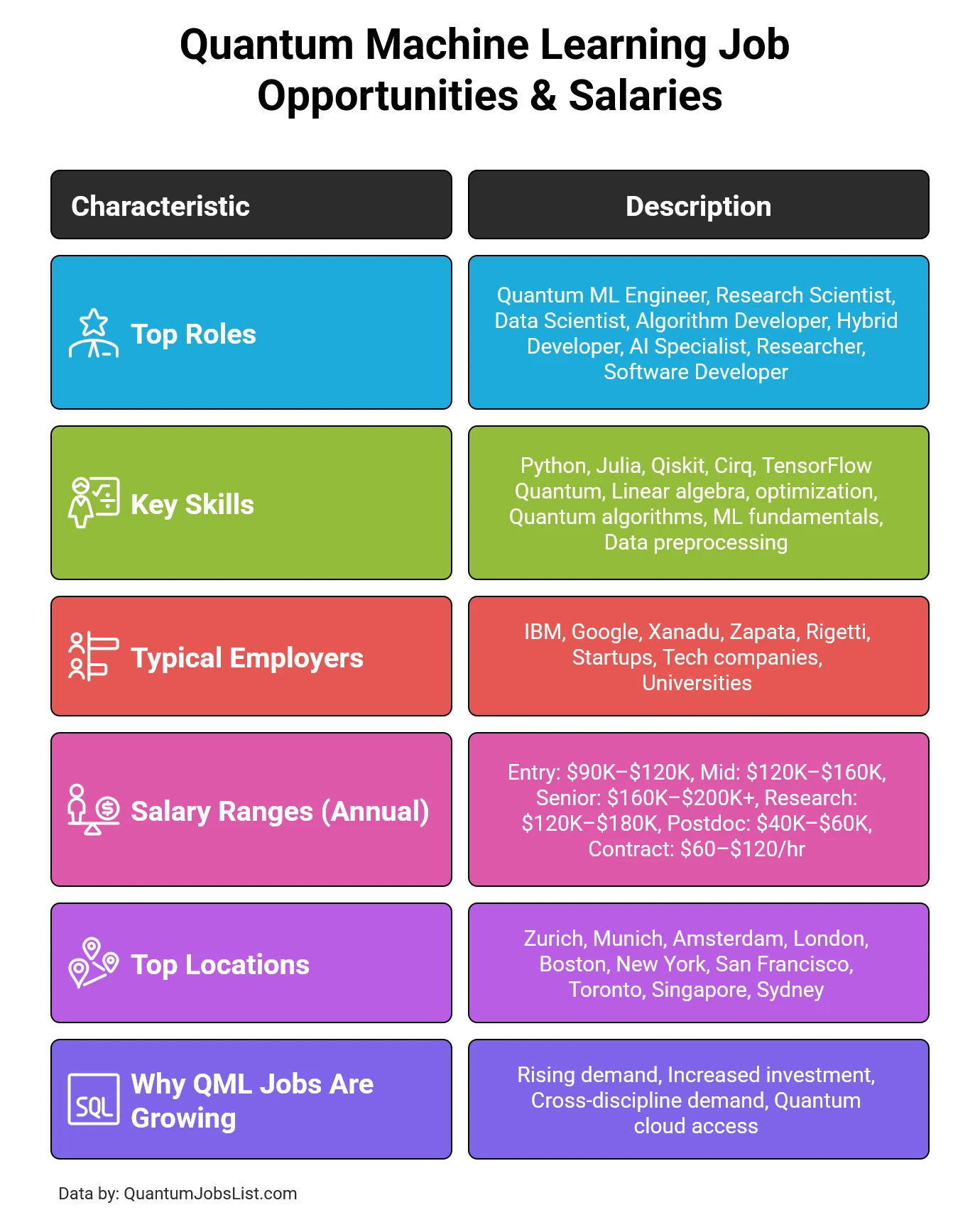
How Much Do Quantum ML Professionals Earn Worldwide?
The very high pay for quantum machine learning jobs shows, how much special knowledge and business value is needed in this field. There is a lot of work available because there are not many experts and many companies want them. It is important to know that quantum machine learning pays 20 to 40 percent more than regular machine learning, no matter what industry you are in.
What Do Entry-Level QML Engineers Earn Globally?
Entry-level quantum ML positions start significantly above traditional ML roles across all major markets. Quantum Jobs USA (2025) reports:
An entry level quantum machine learning engineer earns from $90,000 – 130,000 a year.
Global entry-level salary ranges:
- United States: $95,000 - 130,000 a year (Silicon Valley: $110,000 - 145,000)
- Australia: AUD $95,000 - 125,000 (Sydney/ Melbourne)
- Japan: ¥8,000,000 - 11,000,000 (Tokyo)
- Canada: CAD $85,000 - 115,000 (Toronto: CAD $95,000 - 125,000)
- United Kingdom: £65,000 - 90,000 (London: £75,000 - 100,000)
- Germany: €70,000 - 95,000 (Munich/Berlin: €80,000 - 105,000)
- Switzerland: CHF 95,000 - CHF 130,000
- Singapore: SGD $90,000 - 120,000
How Much Do Senior Quantum ML Experts Make?
Senior quantum ML professionals with 5+ years of experience command premium salaries globally. Often exceeding $200,000 total compensation when including bonuses and equity.
Senior-level global compensation:
- United States: $150,000 - 210,000+ (Big Tech: $180,000 - 250,000+)
- Canada: CAD $140,000 - 190,000
- Australia: AUD $145,000 - 195,000
- United Kingdom: £110,000 - 160,000
- Germany: €110,000 - 150,000
- Switzerland: CHF 150,000 - CHF 200,000+
- Singapore: SGD $140,000 - 190,000
Suggested Read: Top Quantum Jobs and Salaries
Which Countries Pay the Most for QML Skills?
Switzerland, United States (Silicon Valley), and Singapore lead global quantum ML compensation, when adjusted for purchasing power parity and cost of living.
Highest-paying markets:
- Switzerland: Premium salaries with high quality of life
- Australia (Sydney): Emerging quantum ML market
- United States (Silicon Valley): Highest absolute salaries with significant equity
- Germany (Munich): Growing quantum industry presence
- Singapore: Competitive Asian hub with tax advantages
- Canada (Toronto): Strong quantum ecosystem and favorable immigration
- United Kingdom (London): European quantum ML center
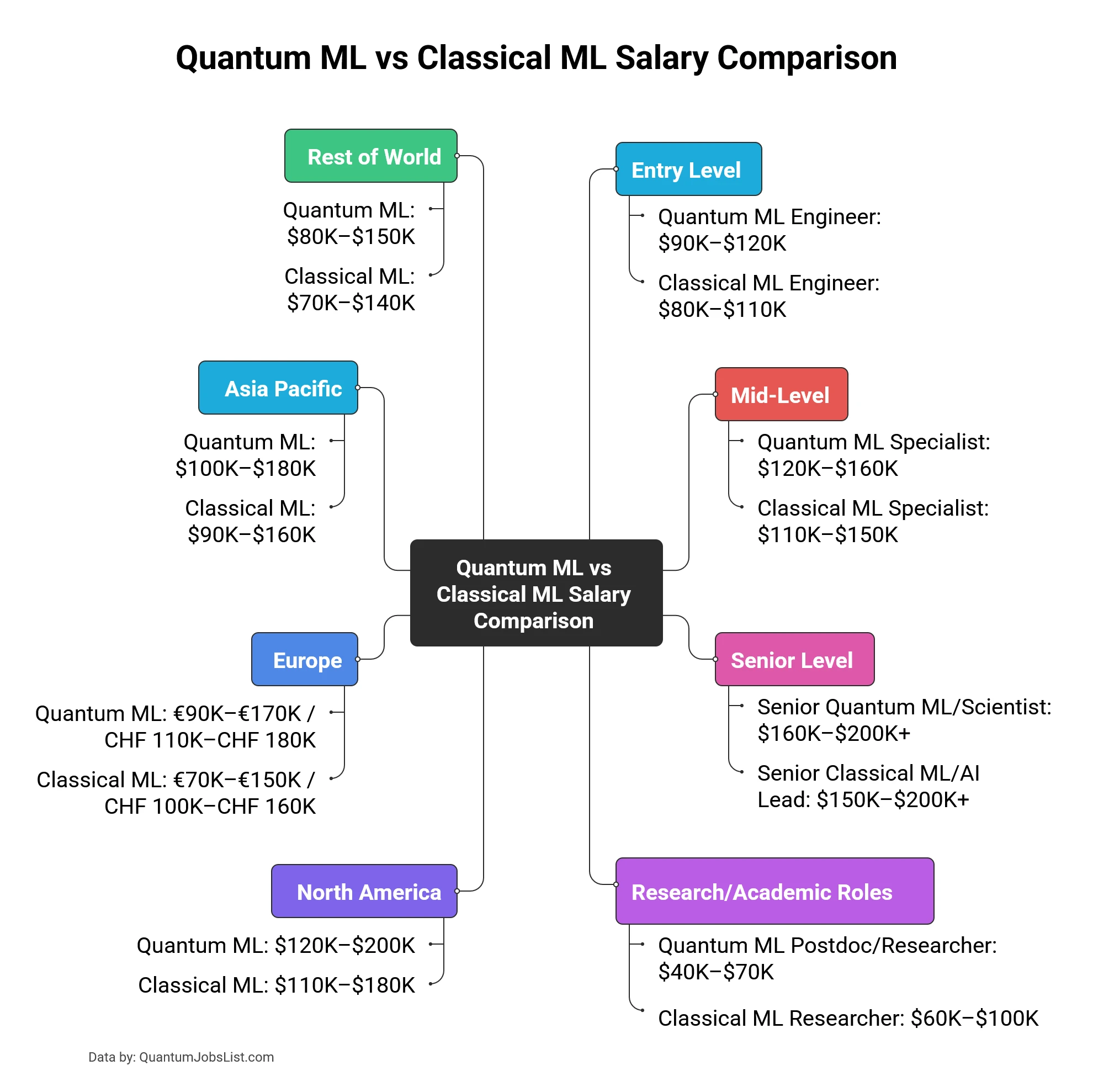
How Do QML Salaries Compare to Classical ML?
Quantum ML professionals typically earn 20 - 40% premiums over classical ML roles at equivalent experience levels, reflecting specialized knowledge requirements and limited talent supply.
Salary premium factors:
- Interdisciplinary expertise: Quantum physics + ML knowledge commands premium
- Business value: Potential for significant competitive advantages
- Talent scarcity: Limited professionals with quantum ML skills;
- Research requirements: Often requires advanced degrees (Master/PhD)
- Cutting-edge technology: Working on emerging technology frontier
What Skills Do You Need for Quantum ML Careers?
There is still a lot to do in quantum machine learning. We are far from finishing the work. Each topic also needs much more attention. Where artificial intelligence and quantum computing meet, there are chances to work on many projects. Quantum machine learning lets you work on several difficult projects at the same time.
What Technical Skills Are Essential?
Core Technical Requirements:
The quantum machine learning professional has multiple and solid foundations in diverse technical domains. The quantum ML professional is rightly regarded as the most accomplished in having interstellar competence in the domains of classical machine learning and the principles of quantum computing.
Quantum Computing Fundamentals:
- Knowledge of quantum gates and the construction of quantum circuits
- Familiarity with quantum algorithms such as Grover’s, Shor’s, VQE, and QAOA.
- Work with quantum error mitigation strategies.
- The limitations of quantum hardware in relation to the capabilities
- Principles of quantum mechanics, such as superposition, entanglement, and measurement
Classical Machine Learning Expertise:
- Deep learning architectures (CNNs, RNNs and Transformers)
- Experience with large-scale ML model deployment
- Classical ML algorithms (SVM, decision trees and ensemble methods)
- Training methodologies and optimization techniques
- Model evaluation and validation practices
Hybrid Algorithm Development:
- Variational quantum algorithms and parameterized quantum circuits
- Barren plateau problem understanding and mitigation;
- Quantum-classical co-processing strategies
- Classical-quantum interface design and optimization
- Gradient computation for quantum circuits
Which Programming Languages and Frameworks?
Essential Programming Languages:
- Python: Universal programming language in ML and quantum computing (95% QML jobs require)
- C++: Performance-critical quantum simulation and hardware integration.
- Julia: Up-and-coming language in scientific quantum computing.
- JavaScript: Quantum visuals and browser-based quantum tools.
Quantum ML Frameworks (Must Know):
- PennyLane: Top quantum ML library with great docs.
- TensorFlow Quantum: Google's QML framework with TensorFlow.
- Qiskit ML: IBM's quantum ML toolkit with great docs.
- Cirq: Google's quantum framework with ML.
Classical ML Libraries:
- TensorFlow/Keras: Industry-standard deep learning framework.
- PyTorch: Preferred ML framework in academia with dynamic computation graphs.
- Sci-kit learn: Classical ML algorithm and preprocessing library.
- NumPy/SciPy: General scientific computing and numerical optimization.
Supporting Tools:
- Jupyter Notebooks: Interactive dev and research doc.
- Git/GitHub: Version control and collab development.
- Docker: For reproducible quantum ML environments.
- MLflow/Weights and Biases: Experiment tracking and model management.
Suggested Read: Quantum Programming languages to learn for jobs
What Mathematical Background Is Required?
Linear Algebra (Critical Foundation):
- Vector spaces, basis transformations, and eigenvalue problems
- Density matrices related to quantum computation
- Theoretical perspective of quantum measures and Born’s rule
- Mathematics of quantum gates and unitary transformations
Quantum Mathematics:
- Hilbert spaces and quantum state vector representations
- Density matrices for mixed quantum states
- Quantum measurement theory and Born rule
- Unitary transformations and quantum gate mathematics
Probability and Statistics:
- Distribution of probability and inferential statistics
- Bayesian analysis and graphing with probability
- Estimation of max likelihood and methods of expectation-maximization
- Interval of confidence and statistical test
Optimization Theory:
- Gradient-based optimization (SGD, Adam, advanced optimizers)
- Convex optimization and handling of constraints
- Calculus of variations and variational methods
- Non-convex optimization challenges in quantum ML
Additional Mathematics:
- Complex analysis and complex-valued functions
- Group theory for quantum symmetries (advanced roles)
- Information theory and entropy measures
- Functional analysis for understanding quantum spaces
Which Classical ML Skills Transfer to Quantum ML?
Many classical ML skills provide strong foundations for quantum ML transitions. These skills are making the field accessible to experienced ML practitioners willing to learn quantum computing fundamentals.
Highly Transferable Skills:
- Architecting of the model: Principles and transfer design of quantum circuits
- Hyperparameter optimization: Similar challenges in quantum algorithm tuning
- Data preprocessing: Critical for quantum data encoding strategies
- Model assessment: Performance of quantum to classical benchmarking
- Logical techniques of debugging in circuit quantum systems are akin to troubleshooting.
- Research Methodology: Directly transfers to empirical design in quantum ML
Skills Requiring Quantum Adaptation:
- Feature engineering becomes quantum feature map design
- Ensemble methods evolve into quantum ensemble strategies
- Network depth becomes quantum circuit depth with hardware constraints
- Batch processing adapts to quantum sampling and measurement
- Regularization transforms to quantum circuit regularization techniques
The transition from classical to quantum ML typically takes 6-12 months for experienced ML practitioners, who dedicate focused learning time to quantum computing fundamentals.
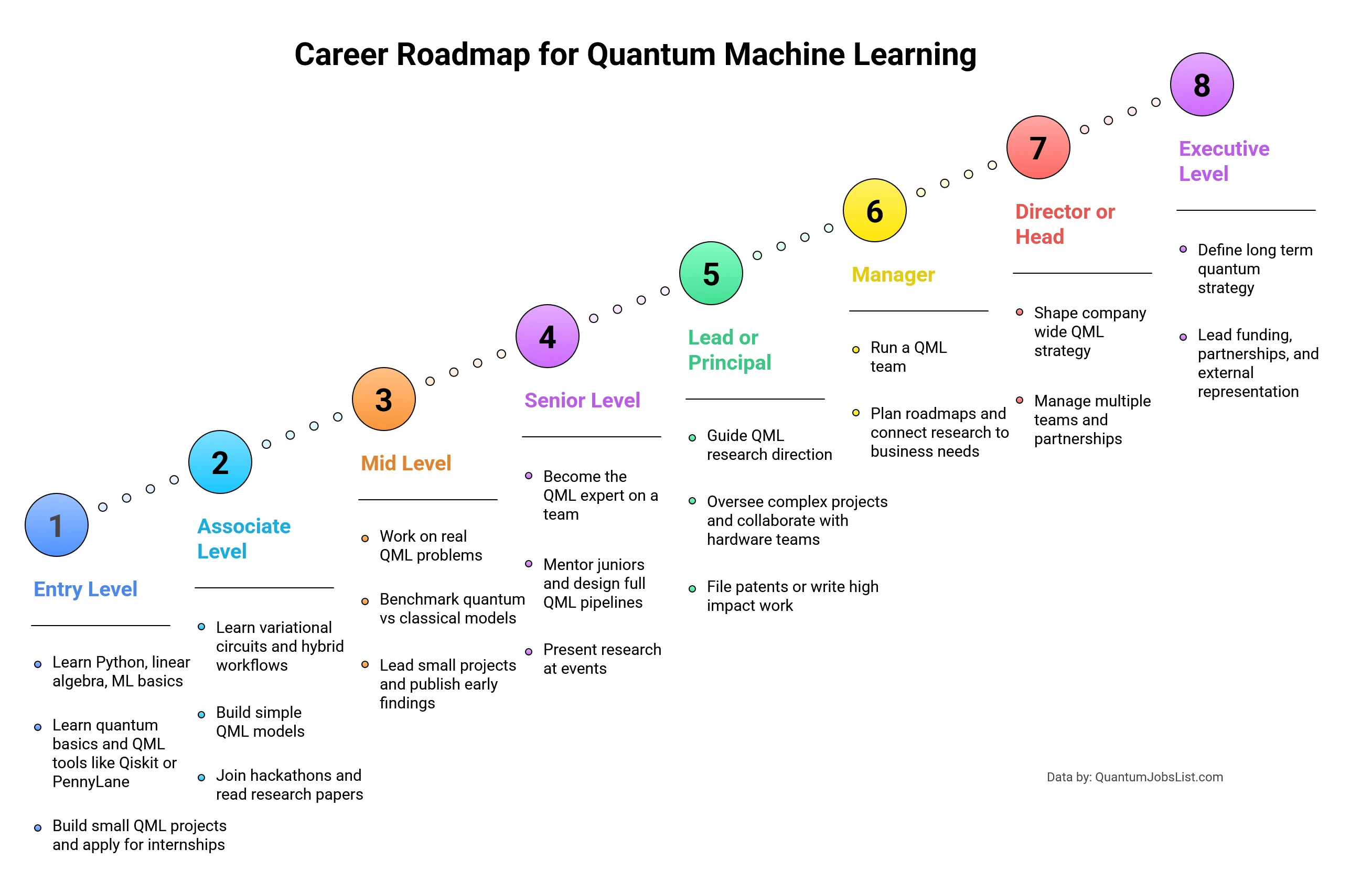
How Do You Break Into Quantum Machine Learning?
You can enter the quantum ML field, which requires strategic planning, structured learning and hands-on experience building quantum ML projects. The pathway varies based on your current background. Most successful transitions follow similar patterns, combining formal education, self-directed learning, and practical project development.
What Educational Path Should You Follow?
For Current ML Practitioners (6-12 Months):
Start with quantum computing fundamentals while leveraging your existing ML expertise. This path works best for professionals with strong classical ML backgrounds who want to add quantum capabilities.
Phase 1: Quantum Foundations (2-3 months)
- Take online courses in quantum computing basics
- Study through IBM Qiskit textbook or Microsoft Q# tutorials
- Learn quantum gates, circuits and simple quantum algorithms
- Understand quantum measurement & state preparation
Phase 2: Quantum ML Specialization (3-4 months)
- Learn variational quantum algorithms and quantum neural networks
- Complete PennyLane quantum ML tutorials
- Study quantum feature maps & quantum kernels
- Understand current quantum ML research directions
Phase 3: Project Development (3-5 months)
- Build quantum ML projects for portfolio
- Participate in quantum ML hackathons
- Implement research papers in quantum ML
- Contribute to open-source quantum ML projects
Suggested Read: Why Choose Quantum over Classical Computing Jobs
For Physics/Quantum Computing Backgrounds (6-12 Months):
Leverage quantum knowledge while building ML expertise, focusing on classical ML fundamentals before quantum-specific applications.
Phase 1: Classical ML Foundations (3-4 months)
- Learn supervised and unsupervised learning fundamentals
- Implement classical ML projects;
- Master neural networks & deep learning
- Study through fast.ai, Coursera ML courses
Phase 2: Advanced ML Techniques (2-3 months)
- Deep learning architectures and training strategies
- PyTorch or TensorFlow mastery;
- Reinforcement learning fundamentals
- Generative models and probabilistic ML
Phase 3: Quantum ML Integration (3-5 months)
- Apply quantum knowledge to ML problems
- Research quantum ML literature;
- Study quantum advantage in ML contexts
- Build hybrid quantum-classical systems
For Complete Beginners (12-18 Months):
Build both quantum computing & machine learning foundations systematically before specializing in quantum ML applications.
- Months 1-4: Python programming, linear algebra, and probability.
- Months 5-8: Classical machine learning and deep learning.
- Months 9-12: Quantum computing fundamentals.
- Months 13-18: Quantum ML specialization & projects.
Which Online Courses and Certifications Help?
Top Quantum ML Courses:
Foundational Courses:
- Qiskit Global Summer School: Annual intensive quantum computing program (free)
- Coursera Quantum Computing Specialization: University of Toronto series;
- PennyLane Codebook: Interactive quantum ML tutorials (free)
- edX Quantum Machine Learning: From TU Delft comprehensive QML course
Advanced Courses:
- MIT Quantum Information Science: Theoretical foundations (EdX)
- TensorFlow Quantum Tutorial: Via Google quantum ML tutorial series
- Quantum Machine Learning: From University of Toronto (Coursera);
- Applied Quantum Machine Learning: Qiskit Advocates courses
Valuable Certifications:
- IBM Qiskit Developer Certification: Industry-recognized quantum programming ( $300 )
- Classical ML Certifications: TensorFlow Developer, AWS ML Specialty add credibility;
- Microsoft Azure Quantum Certification: Cloud quantum development credentials
- PennyLane Certified Quantum ML Developer: Specialized QML certification (emerging)
Free Learning Resources:
- Xanadu Quantum Codebook: Comprehensive quantum ML tutorials
- ArXiv papers: Latest quantum ML research (free access);
- Qiskit Textbook: Free quantum computing and ML chapters
- PennyLane QML Demos: 100+ quantum ML implementation examples
How Can You Build a QML Portfolio?
A strong quantum ML portfolio demonstrates practical skills to employers & differentiates candidates in competitive hiring processes.
Essential Portfolio Projects:
Beginner Projects (Choose 2-3):
- Quantum classifier: Implement quantum neural network for MNIST digit classification
- Quantum feature map exploration: Visualize different quantum data encoding strategies;
- Quantum kernel SVM: Compare quantum vs classical kernels on benchmark datasets
- VQE implementation: Solve small molecule ground state energy problems
Intermediate Projects (Choose 1-2):
- Quantum generative model: You can build quantum GAN or quantum Boltzmann machine
- Industry application: Apply quantum ML to finance, drug discovery or optimization
- Hybrid quantum-classical network: Integrate quantum layers with classical neural networks
- Quantum reinforcement learning: Implement quantum RL algorithm for control problem.
Advanced Projects (Optional):
- Novel quantum ML algorithm: Implement recent research paper
- Research reproduction: Reproduce and extend published quantum ML research;
- Quantum ML benchmark: Systematic comparison of quantum vs classical approaches
- Open-source contribution: Contribute to Qiskit, PennyLane or TensorFlow Quantum
Portfolio Presentation Best Practices:
- Host code on GitHub with clear documentation and README files
- Document challenges faced & solutions implemented
- Write blog posts explaining projects and quantum ML insights
- Create visualizations of quantum circuit architectures;
- Include benchmark results comparing quantum and classical approaches
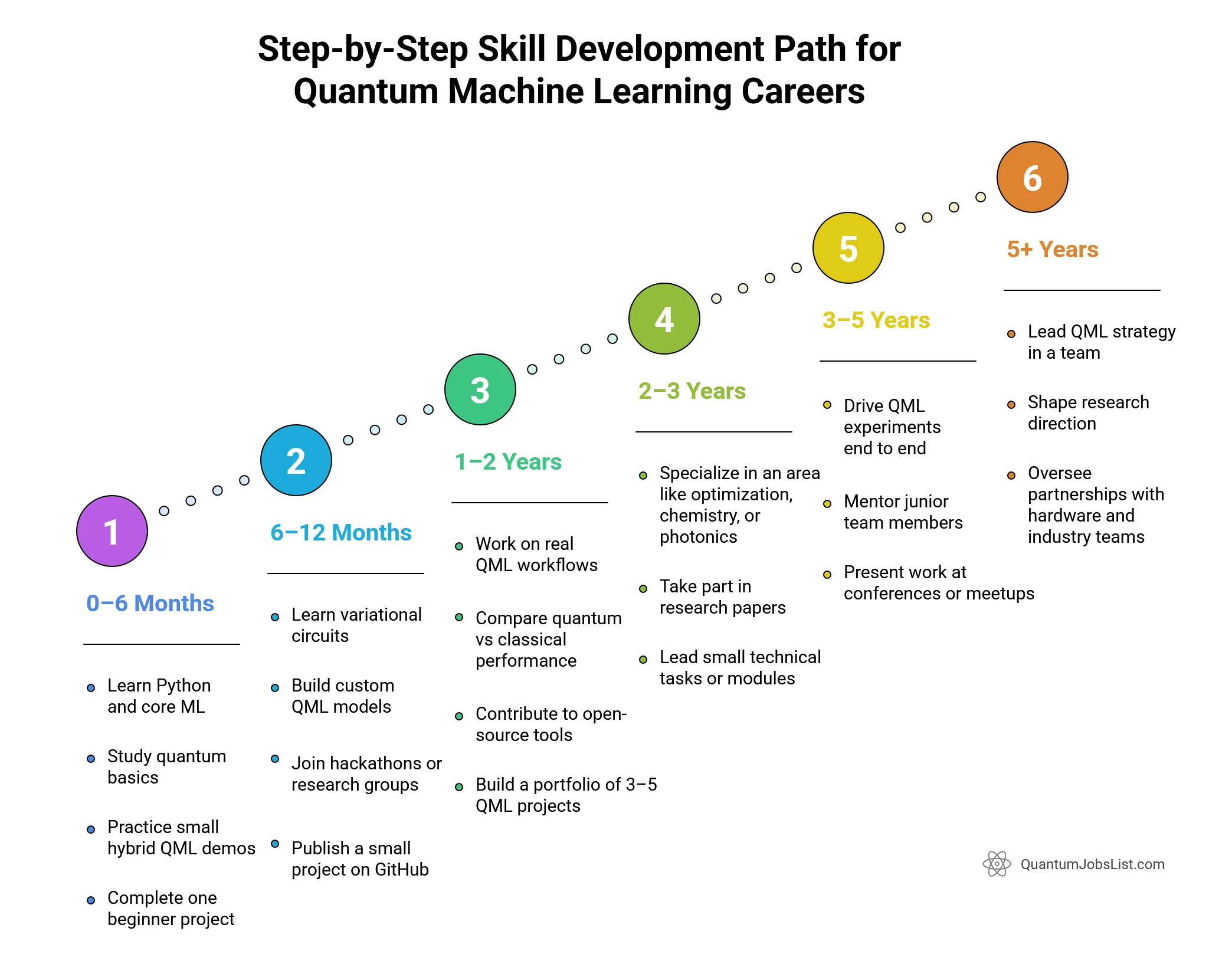
What Timeline Should You Expect?
Realistic Transition Timelines:
ML Background to QML (6-9 Months):
- 2-3 months: Quantum computing fundamentals
- 2-3 months: Quantum ML specialization
- 2-3 months: Portfolio development & job applications
- Weekly time commitment: 10-15 hours
Physics Background to QML (6-9 Months):
- 3-4 months: Classical ML and deep learning
- 1-2 months: Quantum ML frameworks & applications
- 2-3 months: Portfolio building and job search;
- Weekly time commitment: 10-15 hours
Complete Beginner to QML (12-18 Months):
- 4-6 months: Programming and math foundations
- 4-6 months: ML and quantum computing basics
- 4-6 months: Quantum ML specialization & projects
- Weekly time commitment: 12-18 hours
Accelerated Path (3-6 Months):
- Intensive bootcamp or full-time learning
- Aggressive networking and job applications via Quantum Jobs List, Indeed, and Quantum Jobs USA.
- 30-40 hours per week dedicated study
- Rapid portfolio development
Where Are Quantum ML Jobs Located Globally?
Quantum machine learning opportunities span every continent, with concentrations in technology hubs, research centers and cities with strong quantum computing ecosystems. By understanding global QML job distribution you can target job searches and relocation decisions.
Which Countries Lead in QML Hiring?
Top 10 Countries for QML Jobs:
1. United States
- Country is the largest quantum ML job market globally
- Major hubs: Silicon Valley, Seattle, Boston, Austin, and Chicago
- Companies: Google, IBM, Microsoft, Amazon, quantum startups
- Estimated QML jobs: There are 800-1,000+ positions
2. Canada
- Strong quantum ecosystem centered on Toronto/ Waterloo
- Leading companies: Xanadu, D-Wave, and 1QBit
- University connections: University of Waterloo & Perimeter Institute
- Estimated QML jobs: Around 150-200 positions
3. United Kingdom
- European quantum ML center
- Hubs: London, Cambridge, and Oxford
- Companies: Cambridge Quantum Computing and Quantum Motion
- Estimated QML jobs: Approx. 200-250 positions
4. Germany
- Growing quantum industry presence
- Hubs: Munich, Berlin and Stuttgart
- Companies: Fraunhofer institutes, BMW, Volkswagen quantum initiatives
- Estimated QML jobs: There are around 150-180 positions
5. China
- Massive quantum investment and research
- Hubs: Beijing, Shanghai, and Hefei
- Focus: Government-funded quantum research centers
- Estimated QML jobs: Approx. 300-400 positions (many research-focused)
Additional Strong Markets:
- Singapore: Asian quantum hub (80-100 jobs)
- Japan: Quantum computing investment (100-120 jobs)
- Australia: Growing quantum presence (70-90 jobs);
- Switzerland: Pharmaceutical quantum applications (60-80 jobs)
- Netherlands: QuTech research center (50-70 jobs)
What Are the Top QML Cities Worldwide?
Global QML Job Hotspots:
North America:
- San Francisco Bay Area: Google Quantum AI, quantum startups and highest concentration
- Austin: IBM Quantum, growing quantum startup scene
- Seattle: Microsoft Quantum, Amazon Braket headquarters
- Boston: MIT quantum research and IonQ presence
- Toronto: Xanadu headquarters, quantum ML ecosystem
Europe:
- London: Financial quantum ML, Cambridge Quantum Computing
- Zurich: ETH research, IBM Research presence
- Cambridge (UK): University research & quantum hardware companies
- Munich: German quantum industry center;
- Amsterdam: QuTech, European quantum ML research
Asia-Pacific:
- Singapore: Asian quantum hub and government quantum investment
- Shanghai: Financial quantum ML applications
- Tokyo: Japanese quantum computing companies
- Beijing: Chinese quantum AI research
- Sydney: Australian quantum research centers
Are Remote QML Jobs Available?
Remote quantum ML opportunities are increasingly common. These jobs are especially in software-focused roles, though some positions require occasional on-site collaboration.
Remote-Friendly QML Roles:
- Quantum ML software engineers (60-70% remote-friendly)
- Quantum ML DevOps engineers (70-80% remote-friendly)
- Quantum ML consultants (70-80% remote-friendly)
- Quantum data scientists (50-60% remote-friendly)
Usually Requires On-Site Presence:
- Quantum hardware research roles (requires lab access)
- Few national lab positions (security requirements);
- Experimental quantum ML positions (hardware interaction)
Remote Work Trends:
- Hybrid arrangements increasingly common (2-3 days per week office).
- Time zone overlap often required for team collaboration.
- Full-remote positions available at quantum startups & consulting firms.
- Geographic salary adjustments may apply for remote positions.
How Do Different Regions Compare?
Regional Comparison:
United States:
- Strengths: Highest salaries, most job opportunities and strong startup ecosystem.
- Challenges: Visa requirements for international candidates, high cost of living.
- Best for: Maximizing compensation and career opportunities.
Europe:
- Strengths: Strong research culture, work-life balance and multiple quantum hubs.
- Challenges: More fragmented market, varying regulations by country.
- Best for: Research-oriented careers, EU citizens seeking quantum ML roles.
Canada:
- Strengths: Growing quantum ecosystem, favorable immigration and quality of life.
- Challenges: Smaller job market, slightly lower salaries than US.
- Best for: International candidates seeking accessible entry into quantum ML.
Asia-Pacific:
- Strengths: Rapidly growing quantum investment and lower cost of living.
- Challenges: Varying English language requirements, smaller current market.
- Best for: Long-term quantum industry growth, Asian market access.
What Industries Need Quantum ML Professionals?
Applications in quantum machine learning span across different industries, and these industries present a variety of problems, compensation, and career growth opportunities. Learning about the specific industry applications of QML helps direct job searching toward industries that match your preferences and skills.
How Is Finance Using Quantum ML?
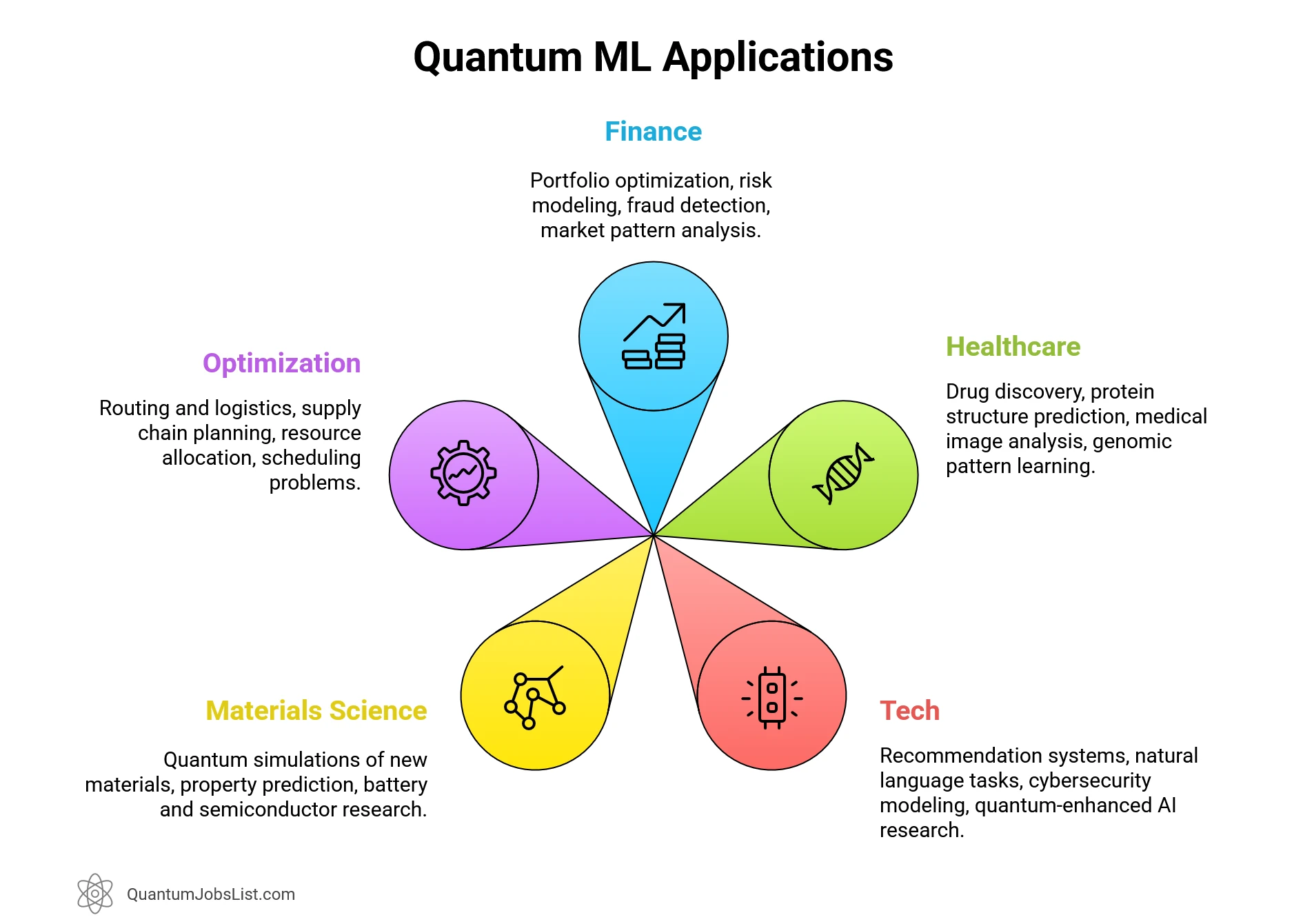
Financial services represents one of the most active quantum ML adoption sectors. This is driven by potential competitive advantages in trading, risk management, and fraud detection. You can learn more about top quantum banking and finance jobs here.
Key Financial QML Applications:
- Portfolio optimization: Quantum strategies for selecting a set of assets from thousands of securities.
- Risk Modeling: Quantum ML for credit risks and market risks.
- Fraud detection: Identifying patterns in transactional data of a high dimension.
- Algorithmic trading: Quantum-augmented ML for transactional trading strategies.
- Derivative pricing: Quantum Monte Carlo for more complex financial instruments.
Major Hiring Institutions:
- Investment banks: JPMorgan Chase, Goldman Sachs, and Morgan Stanley.
- Trading firms: Citadel, Jane Street, Two Sigma (with quantum research teams).
- Financial technology: Quantum-hopeful Fintech startups.
- Insurance firms: Risk modeling and actuarial work.
Financial QML Compensation:
- Entry-level: $100,000 - 140,000 + bonus
- Senior roles: $160,000 - 220,000 + significant performance bonuses.
- Bonuses can equal 30-100% of base salary at top firms
What Healthcare Applications Exist?
Healthcare and pharmaceutical industries leverage quantum ML for drug discovery, personalized medicine and medical imaging applications worth billions in potential value.
Healthcare QML Use Cases:
- Drug discovery: Quantum ML for predicting molecular properties and lead optimization.
- Folding proteins: Quantum algorithms for predicting protein structures.
- Medical imaging: Quantum-augmented image reconstruction and analysis.
- Genomics: Quantum ML for identifying patterns in data.
- Personalized medicine: Optimizing treatments through quantum ML.
Leading Healthcare Employers:
- Pharmaceutical companies: Roche, Merck, Pfizer, Johnson & Johnson
- Medical device manufacturers: Imaging & diagnostic applications
- Biotech firms: Menten AI, ProteinQure (quantum-focused)
- Healthcare AI companies: Companies adding quantum ML capabilities
Healthcare QML Roles:
- Quantum computational chemist: $110,000 - 180,000
- Quantum bioinformatics specialist: $100,000 - 170,000
- Quantum drug discovery engineer: $115,000 - 185,000
Which Tech Companies Lead QML Development?
Major technology companies invest heavily in quantum ML research and development, offering excellent compensation, cutting-edge research opportunities, and career advancement potential.
Tech Company QML Initiatives:
Google Quantum AI:
- TensorFlow Quantum development
- Published breakthrough quantum ML results
- Quantum ML algorithm research
- Quantum hardware optimization
IBM Quantum:
- Qiskit Machine Learning development
- Active quantum ML research publications;
- Industry quantum ML partnerships
- Quantum ML cloud services
Microsoft Quantum:
- Azure Quantum ML services
- Enterprise quantum ML consulting
- Q# ML library development
- Quantum chemistry applications
Amazon Web Services:
- Amazon Braket ML capabilities
- Quantum ML customer solutions
- Braket SDK development
- Quantum ML research partnerships
Other Major Players:
- Apple (quantum ML research, undisclosed projects)
- Intel (quantum hardware and algorithms)
- Meta (quantum ML AI research)
- Alibaba (quantum ML cloud services)
What Other Industries Are Hiring?
Logistics and Optimization:
- Applications: Route optimization, supply chain management and warehouse logistics.
- Employers: DHL, FedEx, Amazon (logistics), automotive manufacturers.
- Roles: Quantum optimization engineer and quantum logistics analyst.
Materials Science:
- Applications: Materials discovery, catalyst design, battery optimization.
- Employers: Chemical companies, energy companies and automotive manufacturers.
- Roles: Quantum materials scientist, quantum chemistry ML engineer.
Telecommunications:
- Applications: Network optimization, 5G/6G planning, and quantum communication
- Employers: AT&T, Verizon, telecommunications equipment manufacturers
- Roles: Quantum network engineer, quantum telecom analyst
Aerospace and Defense:
- Applications: Satellite optimization, defense system design, aerospace materials
- Employers: Boeing, Lockheed Martin, Airbus and defense contractors
- Roles: Quantum aerospace engineer, defense quantum ML specialist
Energy Sector:
- Applications: Grid optimization, renewable energy forecasting and battery design
- Employers: Energy companies, utilities, renewable energy firms
- Roles: Quantum energy analyst and quantum grid optimization engineer
Do I need a PhD for quantum machine learning jobs?
It isn't true to think that all quantum machine learning positions require a PhD. More than 40 to 50 percent of quantum machine learning positions take candidates with bachelor's or master's degrees. What really matters is your actual skill set, professional experience, and the quality of your previous projects. The type of job and the company really impact the degree requirements.
Research roles usually need a PhD
If you want to be a research scientist working in a university, a national lab, or a large technology company research branch, a PhD is generally required. These positions are for people who would like to develop new quantum ML algorithms, publish papers, and work on very theoretical problems. They want people with a lot of publications and a very strong research background. The salary for these positions is usually very high and can reach from 150k to 210k dollars, or more.
Engineering and applied roles are more flexible
If you want to work as a quantum ML engineer, software developer, or applications engineer, you have more options. Many companies hire people with a master’s degree or a bachelor’s degree plus strong skills. If you can code well, understand quantum computing basics, and show real projects, you can qualify. Online courses, GitHub projects, and working demos matter a lot here. Salaries for these roles are still strong and often fall between $115,000 and $175,000.
Skills and projects can replace advanced degrees
The quantum ML field is growing fast, and companies now need people who can build & deploy real solutions. This means practical skills are becoming more important than titles. If you build a strong portfolio, and contribute to open source quantum ML projects, and show that you can solve real problems, you can compete even without a PhD. For many roles, what you can do matters more than the degree you hold.
Suggested Read: Get Quantum Job without PhD.
Can I transition from classical ML to quantum ML?
Most have this experience, so the transition will be easy, and it will take about 6 to 12 months of structured learning to make the shift to quantum ML. You hold a significant advantage if you work in classical machine learning. There is already a strong knowledge base in the area and an understanding of the concepts and principles of quantum ML.
What new skills do you need to add?
Firstly, you’ll need to learn the basics about quantum computing. Familiarise yourself with easy concepts such as quantum circuits, gates, and foundational ideas of quantum information. The PennyLane codebook and IBM Qiskit’s textbook are valuable, free educational offerings. You can progress to learn about quantum ML when you’re more familiar with the relevant basics, such as quantum feature maps, variational quantum algorithms, and quantum neural networks.
Most successful transitions follow a clear path. Spend the first 2-3 months learning the basic principles of quantum computing. Spend the next 2-3 months learning quantum ML tools and their applications. Spend the last 3-6 months focusing on implementing quantum ML projects. Employers focus on projects more than certificates because projects demonstrate real capability.
Why your ML background helps a lot
Your existing ML competencies will make learning quantum ML easier and less time-consuming. ML concepts like gradient descent, backprop, and model tuning are the same. The difficulty lies in understanding the quantum behavior of systems and the novel, hardware-constrained ML systems, unlike classical ML. This career shift is in high demand; many companies need ML engineers with skills to shift quantum teams to execution.
What's the difference between quantum ML and quantum computing jobs?
Quantum ML roles sit at the meeting point of quantum computing and machine learning. General jobs in quantum computing focus on several other topics apart from ML, like quantum hardware, ML-agnostic quantum algorithms, quantum networking, and software for other non-ML quantum applications.
What you do in a quantum ML role?
Quantum computing and machine learning are both required for jobs in quantum ML. Responsibilities in this position involve quantum neural networks, quantum feature engineering, and variational quantum ML algorithms. It also includes developing hybrid quantum and classical ML systems. Common tasks include coding quantum ML algorithms, benchmarking quantum and classical ML models, and developing ML applications for different sectors.
What general quantum computing roles focus on?
General computing quantum jobs also have different scopes. Some are more focused on engineering hardware, research on error correction, and building quantum devices. Others work on quantum algorithms for optimization and simulation that don’t involve ML. Some are focused on quantum software and cloud systems, and also don’t include ML. These roles are all about having strong quantum knowledge and very little in machine learning.
Pay, growth, and career paths
Salaries are similar across both paths and often range from $100,000 to $200,000 or more, depending on experience. They are in high demand for their integration of quantum ML with practical applications and the existing ML market. These career paths are different as well. The quantum ML professionals tend to have frequent rotations between classical ML and quantum ML teams, while the quantum hardware engineers tend to keep a more focused alignment with deep quantum specialization.
How long does it take to become job-ready in quantum ML?
The starting point is crucial in determining how long is needed. Most people fall into one of three categories. For those already in the machine learning field, it takes about 6 to 9 months. For those in physics or quantum computing, it takes 6 to 9 months. For complete novices, 12 to 18 months is the minimum.
Timeline for ML professionals
If you already understand classical machine learning, you can go even faster. Start with 2 to 3 months of quantum computing fundamentals like gates, circuits, and simple algorithms. Then, 2 to 3 months should go to learning theory and quantum ML tools. After that, you should spend 2 to 3 months building real projects for your portfolio. If you are working full-time, studying about 10 to 15 hours a week should be enough to reach readiness for a job in 6 to 9 months.
Timeline for physics or quantum backgrounds
If you have a background in physics or quantum, then your main challenge will be to learn machine learning on your own. Spend 3-4 months learning classical machine learning, then spend 2-3 months learning deep learning frameworks such as PyTorch or TensorFlow. After this, you can combine ML with your quantum knowledge to address quantum ML use cases, and spend 2-3 months on that. Putting in 10-15 hours a week, this path also stretches over a 6-9 month period.
Timeline for complete beginners
If you are new to both fields, expect a longer journey. You will need to learn Python, math basics, classical ML, quantum computing and then quantum ML. This usually takes 12 - 18 months and builds a strong foundation. Studying full time can shorten this.
Conclusion
The quantum machine learning revolution is opening global career opportunities by combining two powerful fields. Businesses around the world, from Silicon Valley to parts of Asia and Europe, are funneling massive investments into Quantum ML to secure profitable business opportunities. Hence, the diversification of careers, including core Quantum ML Engineering roles that range from $115,000 to $175,000 to specialist roles in consulting, finance, and healthcare that are over $200,000. Such roles indicate the vast and immeasurable value that the field offers.
Careers in quantum ML are also easier than before. PhDs and other formal, higher levels of education are definitely necessary for more research-intensive roles; however, currently, approximately half of all quantum ML roles, whether core or lateral, are open to most candidates with master’s or bachelor’s degrees with high competency and satisfactory project completion.
A large number of current professionals are in a position to pivot in 6 to 12 months, and there is a high volume of available roles, including those based on remote work, distributed all around the globe. As the launch of quantum computers becomes imminent, the most needed professionals will be Quantum ML experts. They will be the ones redefining the world of artificial intelligence.
Suggested Read:
- How to prepare for Quantum job interview
- Get Entry level jobs without experience
- What Does a Quantum Physicist Do
Editorial Team
Author: Quantum Jobs List Editorial Team
This resource is curated by the Quantum Jobs List team, a specialized group of technical recruiters and industry analysts dedicated to the quantum computing sector. Every listing and career guide is manually reviewed for accuracy and technical relevance to ensure high-quality opportunities for the global quantum community.
FAQs
What programming languages do quantum ML engineers use?
Python is the main language. This is required in over 95% of roles. Most quantum ML tools like PennyLane, Qiskit and TensorFlow Quantum use Python. C++ is useful for high performance code and simulators. Julia is growing in research use. Classical ML tools like, TensorFlow and PyTorch are also essential.
Are quantum ML jobs remote-friendly?
Yes. About 50-70% of roles offer remote or hybrid work, mainly in software and consulting. Cloud quantum platforms support remote development. Some ML research jobs that need hardware access require on-site work. Remote pay is usually 80-100% of on-site salaries.
Can I freelance in quantum machine learning?
Freelance work exists but is limited. Most opportunities are consulting projects for experienced professionals. Education and content work also exist. Most roles are full time due to long research cycles and hardware access needs.
Which quantum ML framework should I learn first?
PennyLane is best for beginners due to clear tutorials and strong links with classical ML. Qiskit Machine Learning is also a strong choice; especially for IBM-focused roles. Learning one framework makes others easier to learn.
Do quantum ML jobs require security clearances?
Most do not. Commercial companies, startups, and universities hire without clearances. Some government and defense roles may require clearance. Finance and healthcare quantum ML roles do not require clearances.
What’s the job market outlook for quantum ML?
The outlook is very strong. Jobs are growing at about 25 to 30% per year through 2027. Demand is higher than supply. Salaries continue to grow around 10% yearly, along with many roles expected globally by 2027.



.svg)