

10 Min. Read

Dec 4, 2025
15 Quantum Banking & Finance Jobs: Skills & Salary Guide
Discover 15 quantum banking & finance high-paying jobs globally. Essential skills and qualifications required at JPMorgan, Goldman Sachs, HSBC + top banks.
SHARE


The financial services industry stands on the brink of a quantum revolution worth $400 - 600 billion by 2035, according to McKinsey Digital Quantum Technology Monitor. This is not a distant future scenario, major banks are hiring quantum professionals right now, with eFinancialCareers JPMorgan Analysis (2025) reporting that:
JPMorgan's quantum jobs typically pay ~$135k salaries to associates and ~$315k to executive directors.
Fintech companies, hedge funds and investment banks are competing to use quantum computing. They aim to enhance their pricing of derivatives, risk management, portfolio optimization, and adoption of post-quantum cryptography. In this guide, we analyze 15 quantum finance careers that span from $95,000 to $250,000+ (for senior researchers) and provide the opportunity to earn one of the highest salaries for graduates.
These roles offer great chances to earn above-average salaries and work with cutting-edge technology to change global finance. They are ideal for quantitative analysts looking to start a future-proof career, for software engineers wanting to move into finance, and for finance professionals eager to embrace new developments. Investment banks, for example, that are the first to successfully implement quantum computing will have highly valuable competitive advantages, and their vision will need talented professionals.
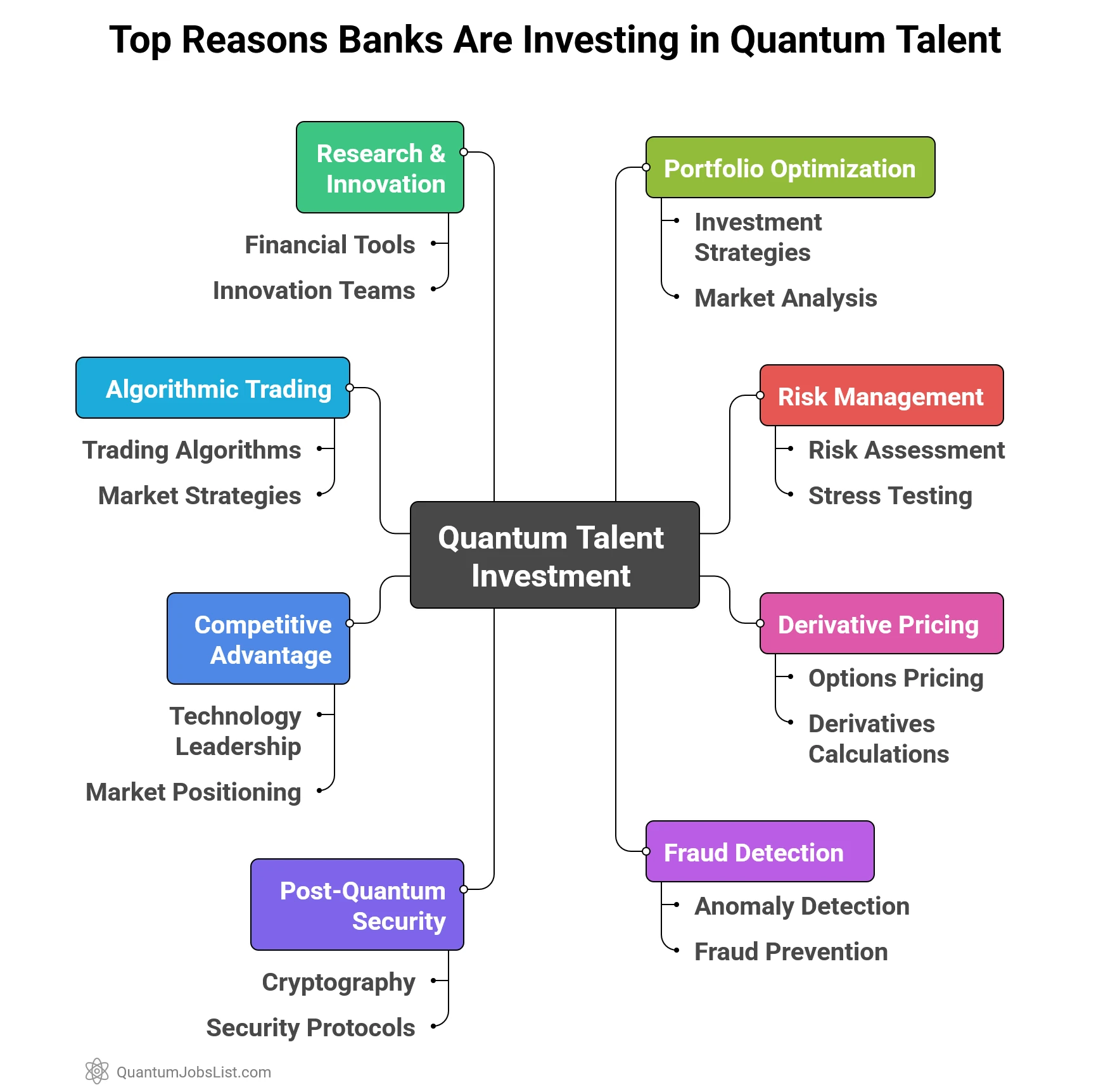
Why Is Quantum Computing Transforming Banking and Finance?
In the past five years, finance and technology have come together. It is creating new job fields to address the specific challenges of the financial sector, which is one of the most advanced in the world.
What Makes Quantum Computing Perfect for Financial Services?
Quantum computers excel at solving optimization problems, simulating complex systems and analyzing high-dimensional data …exactly the challenges that dominate modern finance.
Key quantum advantages for finance:
- Portfolio Optimization: Analyzing a multitude of asset combinations at once to emerge with the most optimal portfolios.
- Algorithmic Trading: When compared to classical means, quantum algorithms learn to take advantage of the market more instantaneously.
- Pricing of Derivatives: Quantum Monte Carlo approaches gain a quadratically higher efficiency in more complicated instruments.
- Risk management: Assessing a multitude of risk scenarios in unison for an overall risk evaluation.
- Fraud Detection: Quantum machine learning detects fraudulent patterns from gigantic sets of transactions.
Goldman Sachs Quantum Expert (2024) explains:
Quantum optimization could find hidden market efficiencies worth billions of dollars.
How Much Is the Quantum Finance Market Worth?
The quantum computing revolution in finance represents one of the largest technology opportunities in financial services history.
Market projections and investment:
- $400-$600 billion: Projected quantum finance market value by McKinsey for the year 2035.
- 72% annual increase: Rate of Growth for quantum computing investments from 2022 to 2032.
- 3:1 Ratio: Quantum finance job openings to qualified individuals are 3 to 1.
- $15 Billion+: Investments in quantum computing for the year 2022 alone.
- 50+ institutions: Number of financial institutions with ongoing quantum exploration.
Which Major Banks Are Investing in Quantum Technology?
JPMorgan Chase leads the quantum finance revolution with the industry's largest quantum team. JPMorgan Quantum Leadership (2023) reveals:
Marco Pistoia, JPMorgan's global head of quantum computing, said at a conference last September that: Bank had been 'hiring aggressively' and had already accrued a 'very large team of PhDs, some software engineers & network Engineers.'
Evident Research Report (2025) confirms JPMorgan's dominance:
"Two thirds of quantum job postings come from the bank [JPMorgan] … and that JPMorgan has published more than half of all quantum related research papers in finance."
Other major quantum finance investors:
- Goldman Sachs: Joint ventures with AWS and quantum software firms for pricing derivatives.
- Wells Fargo: Quantum risk modeling and post-quantum cryptography research.
- Citi: Portfolio Optimization through Innovation Labs - Classiq partnership.
- HSBC: Exploring quantum computing to detect fraud and assess credit risk.
- BNP Paribas: Application of Quantum algorithms for the pricing of complex derivatives.
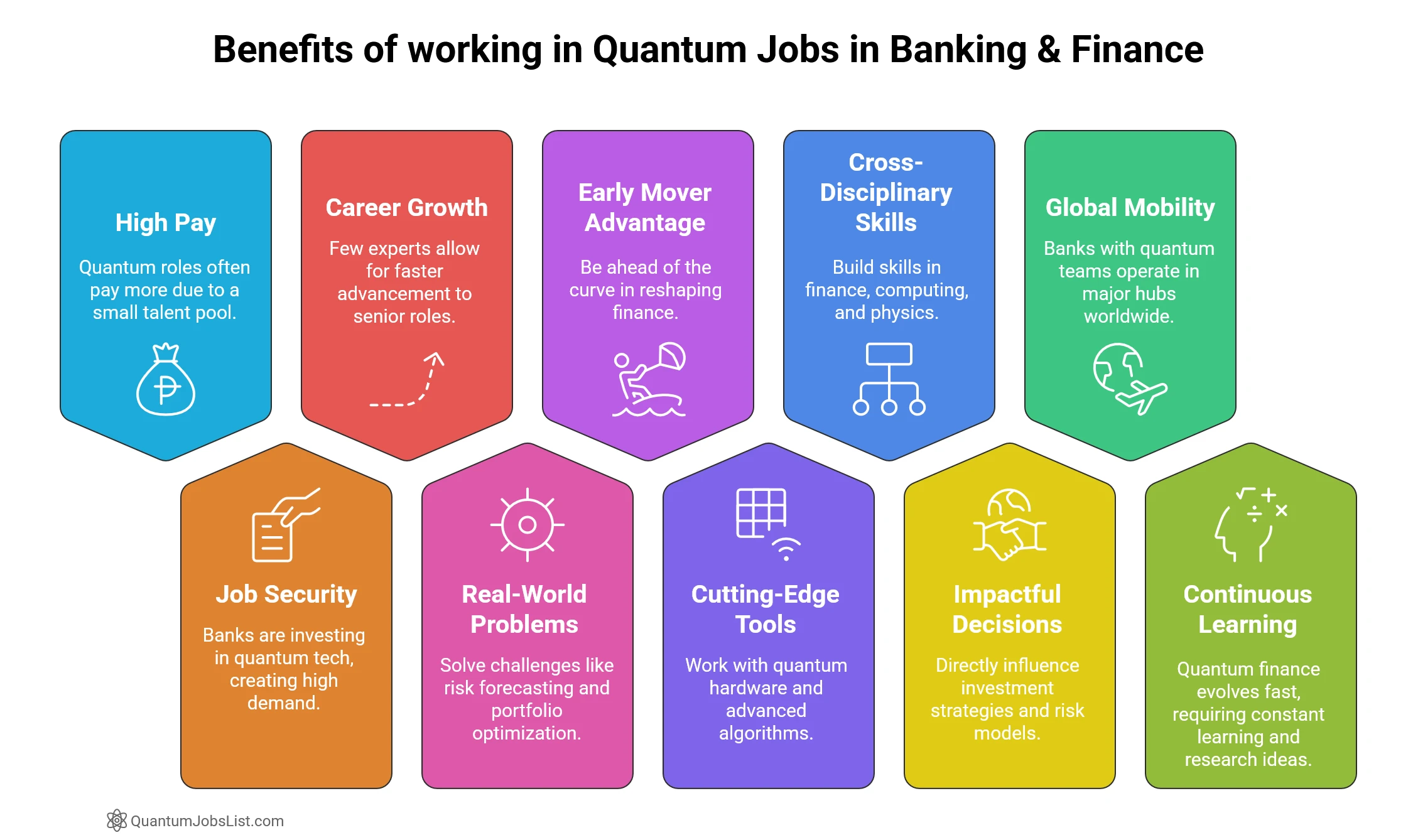
What Are the Top 5 Quantum Investment Banking Jobs?
Investment banking quantum roles focus on applying quantum algorithms to core banking functions like portfolio management, derivatives pricing and risk analysis. These positions offer competitive salaries and direct impact on billion-dollar financial decisions.
1. Quantum Portfolio Optimization Specialist
Salary: $110,000 - $180,000 a year
Industry: Investment banks, hedge funds and asset managers
Requirements: Bachelor's in Finance/CS/Math + Quantum programming
What Does a Quantum Portfolio Optimization Specialist Do in Banking?
- Develop algorithms for portfolio optimization using QAOA and VQE.
- Dissociate quantum tools for the distribution of assets among numerous securities.
- Evaluate quantum optimization against traditional portfolio methods.
- Work alongside portfolio managers to convert quantum outcomes to investment strategies.
- Explore new quantum methods for the optimization of portfolios with constraints.
What Skills Are Required for Success?
- Ability to program quantum computers using Qiskit Finance, Cirq, or PennyLane.
- Good grasp of contemporary portfolio theory and the associated mean-variance optimization.
- Ability to program in Python and use financial libraries (NumPy, Pandas, SciPy).
- Familiarity with quantum approximation optimization algorithms.
- Experience in financial modeling and a good understanding of investment strategies.
Which Financial Institutions Hire for This Role?
JPMorgan Chase, Goldman Sachs and major asset managers like BlackRock & Fidelity are actively recruiting quantum portfolio specialists. Hedge funds, including D.E. Shaw and Renaissance Technologies quietly build quantum optimization capabilities.
2. Quantum Derivatives Pricing Analyst
Salary: $100,000 - $170,000 a year
Industry: Investment banks and trading firms
Requirements: Bachelor's in Math/Physics/Finance + Derivatives knowledge
What Does a Quantum Derivatives Pricing Analyst Do in Banking?
- Use quantum Monte Carlo methods to value complex derivatives.
- Utilize quantum amplitude estimation methods to price exotic options.
- Construct quantum algorithms for credit derivatives and structured financial instruments.
- Compare the quantum time value of money pricing with classical Black-Scholes quantum pricing.
- Assess the quantum computational benefits for different types of derivatives.
What Skills Are Required for Success?
- Deep understanding of derivatives pricing theory and stochastic calculus.
- Quantum algorithm knowledge including amplitude estimation and phase estimation.
- Knowledge of options pricing models (Black-Scholes, Heston, etc.)
- Programming experience in Python, C++ and quantum frameworks.
- Monte Carlo simulation expertise and financial engineering background.
Which Financial Institutions Hire for This Role?
Goldman Sachs leads quantum derivatives research, followed by JPMorgan, Citi and specialized derivatives trading firms. European banks including Deutsche Bank & BNP Paribas explore quantum derivatives applications.
3. Quantum Risk Analyst
Salary: $95,000 - $165,000 a year
Industry: Banks, financial institutions and regulatory bodies
Requirements: Bachelor's in Finance/Statistics/CS + Risk management
What Does a Quantum Risk Analyst Do in Banking?
- Formulate Quantum Algorithms for the Computation of Value at Risk and Expected Shortfall
- Conduct quantum-based machine learning for the assessment of credit risk.
- Conduct quantum simulations capable of examining thousands of risk scenarios at once.
- Employ quantum-enhanced methodologies for stress testing.
- Investigate quantum methods for operational risk and regulatory capital.
What Skills Are Required for Success?
- Familiarity with the principles of Risk management and the fundamental principles of regulation (Basel III, Dodd Frank)
- Quantum machine learning models and quantum sampling methods
- Proficiency in statistical methods and probability theory
- Risk modeling in Python and R
- Familiarity with methodologies related to Market, Credit and Operational risk
Which Financial Institutions Hire for This Role?
Major banks including Wells Fargo, Citi and Bank of America explore quantum risk management. Regulatory consulting firms & risk software companies like Moody's Analytics investigate quantum risk applications.
4. Quantum Algorithmic Trading Developer
Salary: $120,000 - $200,000 a year
Industry: Hedge funds and proprietary trading firms
Requirements: Bachelor's in CS/Math + Trading experience
What Does a Quantum Algorithmic Trading Developer Do in Banking?
- Conceive quantum algorithms for the extraction of arbitrage opportunities within microseconds.
- Create quantum machine learning models for the prediction of market prices.
- Apply quantum methods to the improvement of execution orders and the management of liquidity.
- Conduct backtesting of quantum trading models against historical datasets.
- Work with quantitative traders to apply quantum methods cost-effectively.
What Skills Are Required for Success?
- High-performance computing and low-latency system development
- Experience with algorithmic trading platforms and market data feeds;
- Quantum algorithms including Grover's search and quantum machine learning
- Deep understanding of market microstructure and trading strategies;
- C++ and Python programming with focus on execution speed
Which Financial Institutions Hire for This Role?
Hedge funds like Citadel, D.E. Shaw and Renaissance Technologies lead quantum trading research. Proprietary trading firms including Jane Street & Jump Trading explore quantum advantages in high-frequency trading.
5. Quantum Financial Engineer
Salary: $105,000 - $185,000 a year
Industry: Investment banks, fintech and consulting
Requirements: Bachelor's in Engineering/Math/CS + Finance knowledge
What Does a Quantum Financial Engineer Do in Banking?
- Bridge the ability to do quantum computing with applications in finance.
- Create hybrid quantum-classical systems that achieve quantum advantage in the near term.
- Provide new financial products that quantum computing’s speed makes feasible.
- Identify financial problems for which quantum computing approaches may provide the greatest benefits.
- Build quantum finance applications that can serve as proof of concept for potential business stakeholders.
What Skills Are Required for Success?
- Baseline knowledge of financial engineering and structured products
- Knowledge of the different architectures of quantum computing: gate, annealing, and analog.
- Experience in software engineering along with the integration of financial systems
- A solid grounding in mathematics, especially in the areas of optimization and numerical methods
- Ability to simplify and explain complex concepts in quantum technologies to finance professionals.
Which Financial Institutions Hire for This Role?
JPMorgan, Goldman Sachs, and consulting firms like McKinsey and BCG hire quantum financial engineers. Fintech companies and quantum computing startups focusing on finance applications offer additional opportunities.
What Are the Best 3 Quantum Cybersecurity Jobs in Finance?
Financial institutions face existential threats from quantum computers breaking current encryption methods. Quantum cybersecurity jobs protect all trillion-dollar financial systems from quantum attacks, while implementing quantum-safe security measures.
6. Post-Quantum Cryptography Specialist (Finance)
Salary: $100,000 - $175,000 a year
Industry: Banks, payment processors and financial infrastructure
Requirements: Bachelor degree in CS/Cybersecurity + Cryptography expertise
How Does This Role Protect Financial Systems?
- Implement post-quantum NIST-compliant cryptography in the banking system.
- Transition payment systems from RSA to quantum-safe algorithms.
- Evaluate the quantum threat and the organization’s weakness within finance.
- Establish criteria for the rapid modification of cryptography.
- Evaluate post-quantum systems to determine their security and operational efficiency.
What Technical Expertise Is Needed?
- Deep cryptography knowledge including lattice and hash-based systems
- Security testing and penetration testing experience
- Understand financial systems & payment processing
- Programming in C/C++ for cryptography libraries;
- Knowledge of NIST post-quantum standards and migration
Where Can You Find These Positions?
Major banks, payment networks like Visa & Mastercard and financial infrastructure providers actively recruit post-quantum cryptography specialists. Cybersecurity firms focusing on financial services offer consulting positions.
7. Quantum Security Architect (Banking)
Salary: $110,000 - $190,000 a year
Industry: Financial institutions and fintech
Requirements: Bachelor degree in Cybersecurity + Architecture experience
How Does This Role Protect Financial Systems?
- Design quantum-safe security architectures for banking platforms
- Utilize quantum key distribution for the secure exchange of financial information
- Pioneer quantum RNGs for key creation
- Develop models of quantum disruptions for financial systems
- Oversee quantum defense advisory and allocation of strategy resources.
What Technical Expertise Is Needed?
- Enterprise security architecture and defense-in-depth principles
- Quantum-safe cryptography as well as QKD and quantum-resistant algorithms
- Network security and secure communications architecture
- Security in the cloud for banking
- Risk assessment and NIST Cyber Security Framework knowledge.
Where Can You Find These Positions?
JPMorgan Chase, Goldman Sachs and other major banks hire quantum security architects. Fintech companies building quantum-safe platforms and security consulting firms offer additional opportunities.
8. Quantum Compliance Officer
Salary: $90,000 - $155,000 a year
Industry: Banks, regulatory firms and compliance consulting
Requirements: Bachelor's in Finance/Law + Compliance certifications
How Does This Role Protect Financial Systems?
- Assure financial institutions adhere to quantum security
- Draft procedures for quantum security audits and compliance
- Evaluate vendor quantum security and third-party risk.
- Document quantum-safe migration for regulatory reporting
- Guide management regarding quantum security compliance.
What Technical Expertise Is Needed?
- Experience in compliance oversight in the financial services sector (SOX, GDPR, PSD2).
- Awareness of and familiarity with quantum security standards and practices
- Risk assessment and audit procedures
- Knowledge of financial regulations
- Strong documentation and policy development skills.
Where Can You Find These Positions?
Large banks with extensive regulatory obligations, compliance consulting firms and fintech companies, which are seeking regulatory approval for quantum-safe systems, hire quantum compliance officers.
Which 4 Quantum Finance Research Roles Offer the Highest Salaries?
Quantum finance research positions offer the highest salaries in the field, with senior researchers at major banks earning $160000-$250000+ a year. These roles focus on developing novel quantum algorithms and identifying new quantum applications in finance.
9. Quantum Finance Researcher
Salary: $130,000 - $250,000 a year
Industry: Investment banks, research institutions and think tanks
Requirements: Master's/ PhD preferred in Physics/CS/Math + Publications
What Research Do You Conduct?
- Create new quantum algorithms for financial problems that remain unresolved.
- Conduct research and publish in journals that address quantum computing and finance.
- Work together with quantum computing companies and university researchers.
- Locate additional financial uses for quantum capabilities.
- Disseminate research through presentations at quantum computing and finance symposiums.
What Advanced Skills Are Essential?
- Have an extensive understanding of quantum computing and algorithms
- Show experience in research methodology and writing
- Strong mathematical command in optimization, probability, and linear algebra
- Proficiency in quantum programming languages through Qiskit, Cirq, and Q#
- Know about quantitative finance and financial markets
Which Organizations Offer These Positions?
Quantum Jobs USA Compensation Research (2025) confirms:
Senior quantum finance researchers enjoy an annual pay between USD 160000 and USD 250000.
JPMorgan Chase employs the largest quantum research team, followed by Goldman Sachs, Citi, and academic research institutions partnering with financial institutions.
10. Quantum Machine Learning Specialist (Finance)
Salary: $115,000 - $195,000 a year
Industry: Hedge funds, investment banks, and fintech
Requirements: Bachelor degree in CS/ML + Finance knowledge
What Research Do You Conduct?
- Create quantum ML models for detecting fraud and for credit scoring.
- Use financial pattern recognition with variational quantum classifiers.
- Design quantum neural networks that analyze complex financial datasets.
- Investigate quantum kernel methods for classification and regression.
- Compare classical methods with quantum machine learning.
What Advanced Skills Are Essential?
- Expert in machine learning with a focus on deep learning and ensemble models.
- Experience with quantum ML algorithms (VQE, QAOA, quantum kernels).
- Proficient in Python and ML frameworks like Tensorflow, PyTorch, and scikit-learn.
- Know market behavior and financial data.
- Experience with hybrid ML approaches that incorporate both quantum and classical computing.
Which Organizations Offer These Positions?
Hedge funds are looking into ways to combine AI and quantum technology. Major banks have innovation labs, and fintech startups are developing financial products that use quantum technology. They are actively seeking specialists in quantum machine learning.
11. Quantum Applications Scientist (Finance)
Salary: $105,000 - $180,000 a year
Industry: Banks, financial services and quantum computing companies
Requirements: Master degree in Physics/CS/Math + Applied research experience
What Research Do You Conduct?
- Evaluate use cases for quantum computing in finance
- Develop banking use cases for quantum computing
- Classify quantum computers’ algorithms and develop classical counterparts
- Work with other departments to develop quantum algorithms.
- Use quantum computers and simulators to develop working prototypes.
What Advanced Skills Are Essential?
- Fundamental knowledge of quantum computers and quantum computing
- Work applying research to solve real problems
- Expertise in finance and banking
- Programming quantum frameworks & other programming languages for computers
- Project managing cross-departmental quantum computing projects
Which Organizations Offer These Positions?
Investment banks' quantum labs, quantum computing companies (such as IBM, Rigetti, IonQ) with finance focus and consulting firms helping banks adopt quantum technology hire quantum applications scientists.
What Are the Top 3 Quantum Strategy and Management Positions in Finance?
Strategic quantum roles combine technical quantum knowledge with business acumen and leadership capabilities. These roles help financial institutions adopt quantum technology and develop strategies for using it effectively.
12. Quantum Strategy Consultant (Finance)
Salary: $120,000 - $210,000 a year
Industry: Consulting, and investment banks
Requirements: Bachelor degree + Finance/Tech experience + MBA preferred
What Strategic Responsibilities Do You Have?
- Advise banks and other institutions on quantum computing
- Evaluate quantum computing and other technologies for banking
- Design a roadmap for quantum computing adoption
- Evaluate potential vendors and partnerships for quantum computing
- Inform executives of potential and possible risks of quantum computing
What Leadership Skills Matter Most?
- Ability to think strategically and understand the role of technology in the future
- Use management consulting frameworks to solve problems
- Communicate complex issues clearly and concisely
- Knowledge of banking policies and other financial services
- Change management expertise for quantum technology adoption
Which Financial Services Companies Hire These Roles?
McKinsey Digital, Boston Consulting Group and Deloitte Consulting hire quantum strategy consultants serving financial services clients. Investment banks including JPMorgan and Goldman Sachs employ internal quantum strategists.
13. Quantum Product Manager (Fintech)
Salary: $110,000 - $185,000 a year
Industry: Fintech startups, banks and quantum software companies
Requirements: Bachelor degree in Business/Tech + PM experience
What Strategic Responsibilities Do You Have?
- Define Quantum Product Roadmaps for Financial Services
- Define quantum features based on customer needs and the competitive landscape.
- Align engineering with sales and customer stakeholders.
- Conduct market opportunity analysis to determine product-market fit.
- Oversee quantum product launches and develop go-to-market plans.
What Leadership Skills Matter Most?
- Familiarity with product management frameworks, including Agile, Lean, and Design Thinking.
- Technical understanding of quantum computing - what is possible versus what is not.
- Empathy for the customer and the ability to discern underlying market needs.
- Cross-functional leadership and stakeholder management.
- Development of business models and expertise in pricing strategy.
Which Financial Services Companies Hire These Roles?
Fintech companies developing quantum-enhanced products, quantum software companies targeting finance (Zapata, Classiq), and banks' innovation divisions building quantum applications, are hiring quantum product managers.
14. Quantum Data Scientist (Finance)
Salary: $105,000 - $175,000 a year
Industry: Banks, hedge funds and fintech
Requirements: Bachelor degree in Data Science/Statistics + Quantum knowledge
What Strategic Responsibilities Do You Have?
- Applying quantum algorithms to large and complex financial datasets.
- Building quantum-enhanced analytics for business intelligence and reporting.
- Identifying data science challenges and problems that lend themselves to quantum computing.
- Developing data pipelines that interlace quantum and classical systems.
- Working with analysts to convert the quantum-derived insights into actionable recommendations.
What Leadership Skills Matter Most?
- Expertise in data science, including statistical and predictive modelling.
- Knowledge of quantum algorithms and their potential for data analysis.
- Management of financial data from an SQL and database administration perspective.
- Ability to visualize data and communicate the results effectively.
- Business understanding with a strong grasp of financial metrics and KPIs.
Which Financial Services Companies Hire These Roles?
Major banks' data science teams, hedge funds leveraging big data and fintech companies building data-driven products recruit quantum data scientists.
15. Quantum Technology Program Manager (Banking)
Salary: $115,000 - $195,000 a year
Industry: Major banks, and financial institutions
Requirements: Bachelor degree + PM certification + Technical background
What Strategic Responsibilities Do You Have?
- Head company quantum computing programs at financial institutions
- Oversee quantum research funding allocation and spend
- Integrate and synchronize multiple quantum activities across departments
- Monitor and update on quantum tech and competition
- Update and brief senior management and board on the quantum program
What Leadership Skills Matter Most?
- Program and Project management (PgMP, PMP etc.) and extensive experience
- Ability to make informed decisions backed by knowledge of quantum computing
- Financial knowledge to manage budgets and plan expenditures
- Manage stakeholders across technical teams and management
- Systemic thinking and strategy formulation to create long range quantum roadmaps
Which Financial Services Companies Hire These Roles?
Quantum program managers are hired by banks like JPMorgan Chase, Goldman Sachs and other large institutions with significant investments in quantum for multidisciplinary coordinated quantum programs.
How Much Do Quantum Finance Professionals Actually Earn?
Quantum finance careers offer exceptional compensation that reflects both specialized expertise requirements and the strategic importance of quantum technology to financial services competitiveness. You can learn more about Quantum Jobs salaries here.
What Do Entry-Level Quantum Finance Jobs Pay?
Entry-level quantum finance positions pay significantly above traditional finance analyst roles:
Quantum Jobs USA Compensation Research (2025) reports:
"Juniors in quantum finance typically earn substantive salaries ranging from USD 95,000 to USD 140,000."
Entry-level salary breakdown:-
- Quantum Risk Analysts: $95,000 - $120,000 starting salaries
- Associate Quantum Analysts: $105,000 - $135,000 initial compensation
- Junior Quantum Developers: $100,000 - $130,000 base compensation;
- Quantum Compliance Officers: $90,000 - $115,000 entry-level pay
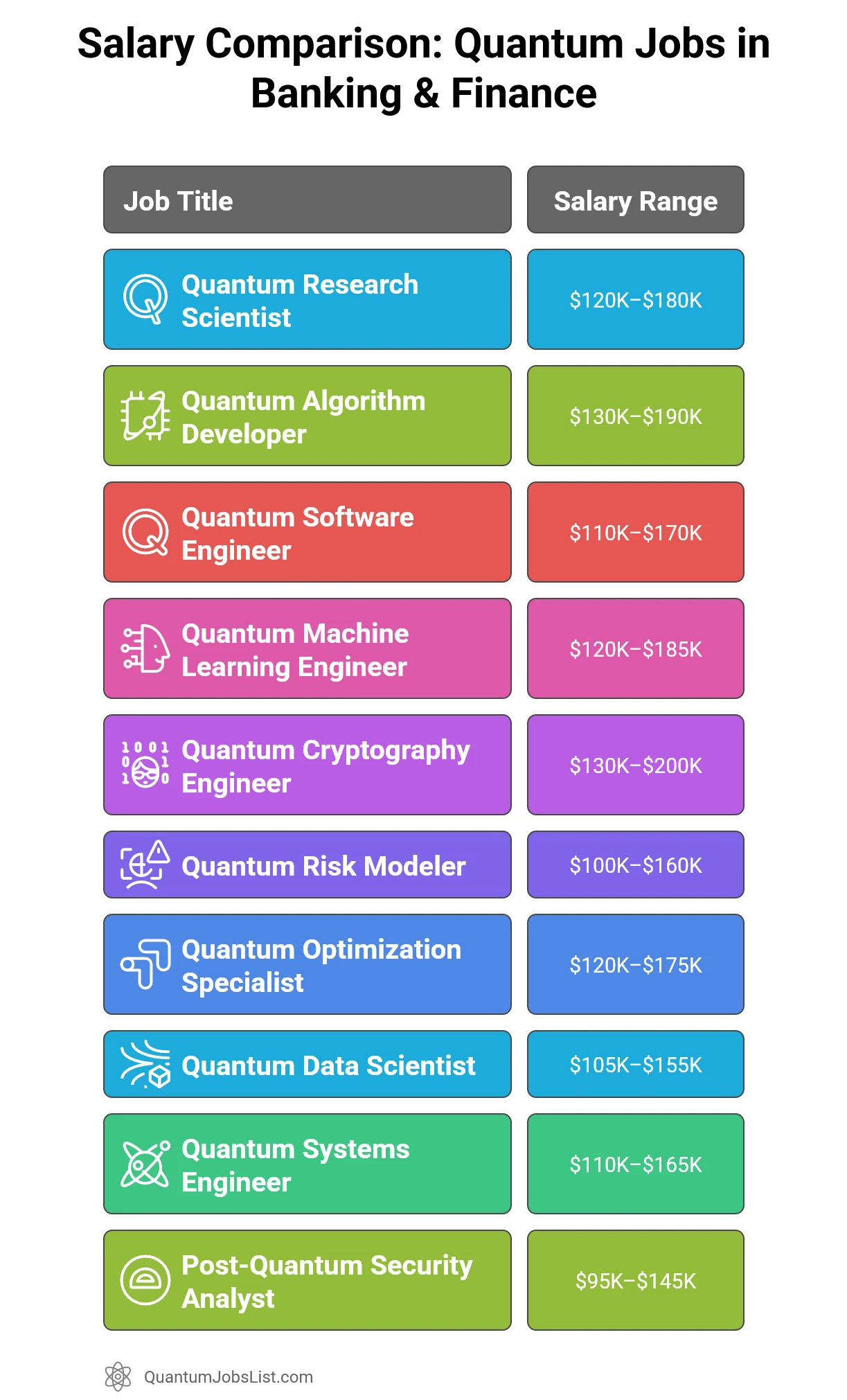
How Much Do Senior Quantum Bankers Earn?
Senior quantum professionals command substantial premiums over traditional finance roles:
eFinancialCareers JPMorgan Analysis (2024) reveals:
"JPMorgan's quantum jobs typically pay ~$135k salaries to associates and ~$315k to executive directors."
Senior compensation ranges:-
- Principal Quantum Researchers: $160,000 - $250,000+ a year
- Executive Directors: $250000 - $315,000+ base salary;
- Quantum Strategy Directors: $200,000 - $280,000+ total compensation
- Head of Quantum Computing: $280,000 - $400,000+ including bonuses
Which Locations Offer the Highest Quantum Finance Salaries?
Top quantum finance markets:-
- New York City: Highest salaries with JPMorgan, Goldman Sachs and Citi headquarters ($180,000 - $315,000+ senior roles).
- Chicago: Quantitative trading firms exploring quantum advantages.
- London: European quantum finance hub with competitive GBP salaries.
- San Francisco: Fintech and quantum computing company convergence.
- Singapore: Asia-Pacific financial center with growing quantum opportunities.
How Do Bonuses Work in Quantum Finance?
Investment banking quantum roles typically include substantial performance bonuses:-
- 20-50% of base salary: Annual bonus at bulge bracket banks
- Stock options/RSUs: Equity at public financial firms;
- Performance incentives: Based on quantum project success
- Retention bonuses: For keeping scarce quantum talent
- Sign-on bonuses: $20,000 - $100,000+ for experienced hires
What Additional Benefits Do Financial Institutions Offer?
Comprehensive benefits packages:-
- Health insurance: Full medical, dental and vision coverage
- Retirement plans: 401(k) matching up to 6%
- Flexible work: Hybrid schedules with remote options
- Education reimbursement: Up to $25,000 a year;
- Conference attendance: Travel to quantum computing & finance events
- Research budgets: Funds for quantum computing resources & cloud access
Suggested Read: Quantum Jobs and Salaries
What Skills Do You Need for Quantum Finance Careers?
Success in quantum finance requires a unique combination of quantum computing expertise, financial domain knowledge, and traditional quantitative skills.
What Technical Skills Are Most Valuable?
Core technical requirements:-
- Quantum programming: Proficiency in Qiskit, Cirq, Q# or PennyLane
- Classical programming: Python, C++ and R for finance
- Quantum algorithms: VQE, QAOA, Grover's, Shor's;
- Cloud quantum platforms: IBM Quantum, Amazon Braket and Azure Quantum
- Financial modeling: Excel, MATLAB or Julia
Which Financial Knowledge Is Essential?
Finance domain expertise:-
- Investment theory: Portfolio optimization, CAPM and efficient market hypothesis.
- Quantitative finance: Stochastic calculus, time series, econometrics.
- Derivatives pricing: Options theory, Black-Scholes model, Greeks.
- Risk management: VaR, CVaR, stress testing and regulatory capital.
- Financial markets: Equity, fixed income, commodities and FX mechanics.
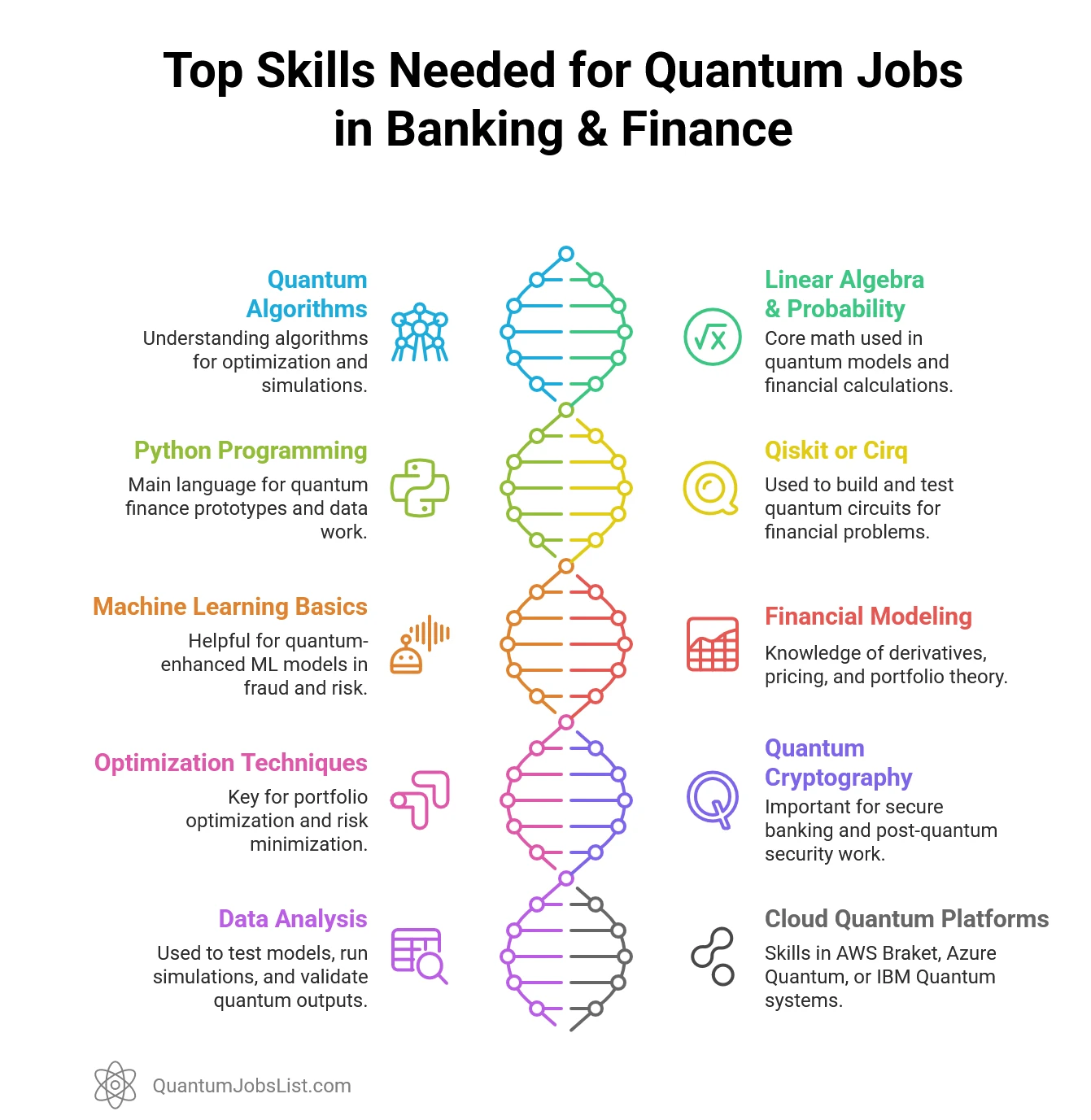
What Quantum-Specific Expertise Matters?
Specialized quantum knowledge:-
- Quantum optimization: QAOA, quantum annealing for portfolio and routing problems.
- Quantum hardware: Understanding of different quantum computing architectures.
- Quantum machine learning: Variational quantum classifiers & quantum kernels.
- Quantum sampling: Monte Carlo methods and amplitude estimation;
- Quantum cryptography: QKD, post-quantum cryptography standards.
Which Programming Languages Should You Master?
Priority programming languages:-
- Python (Essential): Dominant language for quantum and financial programming
- MATLAB (Valuable): Financial modeling & quantitative research
- C++ (Highly Valuable): Performance-critical trading & optimization
- R (Valuable): Statistical analysis and risk modeling;
- SQL (Essential): Financial data management and analysis
What Certifications Boost Your Quantum Finance Career?
Having specific certifications in quantum computing and finance can help advance your career. In quantum computing, you can earn the Qiskit Certification to demonstrate quantum programming proficiency and the Microsoft Azure Quantum certification to demonstrate cloud-based quantum development skills. With the AWS Quantum Solutions Architect certification, you can show that you have mastered the Amazon Braket platform.
In finance, you have the CFA, or Chartered Financial Analyst, which is the gold standard in the investment profession. Then there is the FRM, or Financial Risk Manager, which is more centered on the risk management side. The CQF, or Certificate in Quantitative Finance, indicates expertise regarding quantitative finance and modeling.
Suggested Read: Qualifications required for Quantum Jobs
How Do You Break Into Quantum Finance Jobs?
Transitioning into quantum finance requires strategic planning, targeted skill development and understanding of both quantum computing and financial services industries.
What Educational Background Gets You Hired?
Preferred educational paths:-
- Bachelor's degrees: Computer Science, Mathematics, Physics, Finance and Engineering.
- Online courses: IBM Qiskit, Coursera Quantum Machine Learning, edX Quantum Finance.
- Master's programs: Financial Engineering, Computational Finance and Quantum Information Science.
- PhD programs: Quantum Computing, Theoretical Physics, Applied Mathematics.
Which Career Paths Lead to Quantum Finance?
From Traditional Finance:
- Learning quantum programming with certifications is for quantitative analysts.
- Studying quantum algorithms for pricing and hedging are financial engineers.
- Adding quantum computing skills for risk modeling are risk managers.
- Applications for quantum optimization are explored by portfolio managers.
From Technology:
- Learning financial markets and quantum frameworks is for software engineers.
- Focusing on financial use cases a quantum computing researchers.
- Adding quantum machine learning to their skills are data scientists.
- Exploring quantum ML for finance are machine learning engineers.
How Can Finance Professionals Transition to Quantum?
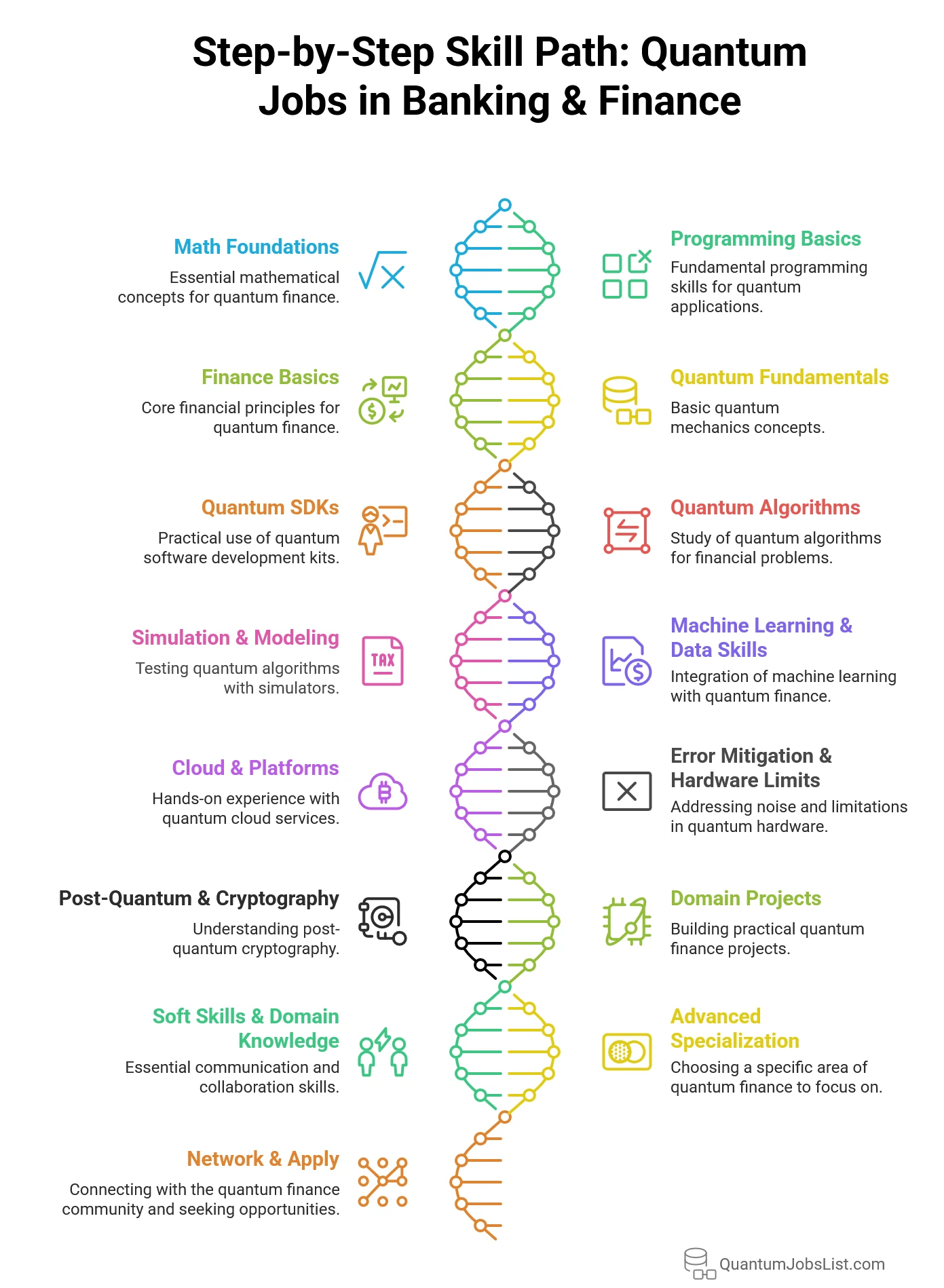
12-month transition roadmap for finance professionals:
Months 1-3: Quantum Fundamentals
Start by focusing on the IBM Qiskit tutorials. These tutorials help you build a strong foundation in quantum computing. You should focus on the basics of quantum mechanics and also try to improve your Python skills. After that, you need to learn about the quantum gates, circuits, and techniques of measurement.
Months 4-6: Quantum Finance Applications
You can use quantum computing in finance by studying two main approaches: quantum algorithms for optimizing investment portfolios and quantum Monte Carlo methods for pricing financial derivatives. You should try to implement quantum risk management algorithms and work on practical projects related to quantum finance.
Months 7-9: Certifications and Specialization
Try to get your IBM Qiskit or Microsoft Azure Quantum certification during this time. You should choose the quantum specializations that best suit your finance background. Participate in open-source quantum finance projects and enhance your professional networking, especially on LinkedIn.
Months 10-12: Job Search and Applications
Look for banks and fintech companies that have quantum programs. Create a portfolio that emphasizes your quantum finance skills and practice your interview skills with a focus on quantum algorithms and their applications to finance. Try to consider internships and contract roles as they help you gain practical experience.
Suggested Read: How to Prepare for Quantum Job Interview
What Companies Should You Target First?
Tier 1: Major Investment Banks
- JPMorgan Chase (largest quantum team)
- Deutsche Bank (quantum computing projects)
- Goldman Sachs (active quantum research)
- Credit Suisse (quantum applications for finance)
- Citi Innovation Labs;
- Wells Fargo quantum initiatives
- BNP Paribas (quantum research in Europe)
Tier 2: Hedge Funds and Asset Managers
- D.E. Shaw Group
- Amundi (quantum research in portfolio optimization)
- Renaissance Technologies
- BlackRock;
- Fidelity Investments
- Allianz Global Investors (EU-based asset manager exploring quantum finance)
Tier 3: Fintech and Quantum Startups
- Zapata Computing (quantum finance focus)
- Financial technology startups implementing quantum solutions
- Consulting firms serving financial services clients
- Classiq (quantum algorithm design);
- Cambridge Quantum (UK-based quantum software for finance)
- Riverlane (quantum algorithms for optimization)
How Long Does the Transition Take?
Typical transition timelines:
Finance Professionals: 8-15 Months
Finance professionals usually need 8 to 15 months to move into quantum finance. They already understand financial markets and applications but need to learn quantum computing fundamentals & programming. Their existing finance network can help them find quantum-related opportunities.
Software Engineers: 6-12 Months
Software engineers usually take 6 - 12 months. They already have strong programming and technical skills but need to gain knowledge of finance and its applications. Learning quantum programming is generally easier for them than mastering financial concepts.
PhD Quantum Physicists: 4-8 Months
PhD quantum physicists can transition in 4 - 8 months. They have deep knowledge of quantum computing, but need to understand financial applications and the business context. Their research experience is highly valued for quantum finance roles.
Do I need a PhD to work in quantum finance?
While earning a PhD can be important for getting top jobs in quantum research, where salaries can reach $160,000 to over $250,000 a year, this is not the case in quantum finance. Many companies in this field will hire candidates with just a bachelor's or even a master's degree.
Some of the most dominant companies in the finance sector, such as JPMorgan Chase, HSBC, and BNP Paribas, will take in applicants possessing top-tier skills in computer science, mathematics, physics, or finance, augmented with quantum programming capabilities. You can learn more about how to get quantum jobs without PhD.
Entry-Level Roles
For quantum finance roles like quantum portfolio optimization or quantum risk analysis; you should look for candidates with at least a bachelor’s degree. They should have studied quantum computing, financial modeling, and computer science, including programming in Python or C++.
A combination of practical skills in quantum programming, strong skills in quantitative analysis, numerous relevant certifications, and tangible familiarity with the mentioned programming languages are very relevant for such roles.
Software Engineering Roles
In software engineering, the main focus is on using quantum algorithms. It is important to note that PhD qualifications are not a requirement of such positions, but strong coding and knowledge of programming frameworks such as Qiskit, Cirq, or Q# are a must.
Ideally, for highly reputable and well-paying positions for senior, or board level, research roles, PhD qualifications will be required, especially for research positions in investment banks that are located in major cities in the West such as London, Singapore, and New York, where the theoretical underpinning of the research is highly complex.
Matching Education to Roles
You have to align your educational experience with the role you are choosing to succeed in quantum finance. For applied areas, such as trading, risk management, and securities, there is a far greater emphasis on application and outcomes of current business activities, with less focus on academic credentials. Meanwhile, in more theoretical research positions, there is greater focus on publishing in peer review journals, building quantum algorithms for finance, and making contributions to new theory.
Regional Variations
Most banks in the EU prefer job candidates with a master’s degree. In contrast, banks in Asian financial markets like Singapore and Hong Kong value work experience and relevant certifications more, alongside a degree. For N.A. banks, there is still a preference to hire PhD candidates for research, but there is a growing trend to hire ‘bachelors only’ for positions in software engineering and other applied areas.
Which banks and financial institutions hire quantum professionals globally?
When it comes to hiring in quantum finance, companies look for talent in North America, Europe, and Asia Pacific. JPMorgan Chase is the leader in this field and has nearly two-thirds of the job openings for quantum finance roles. Other banks such as HSBC, Citigroup, BNP Paribas as well as Credit Agricole are also expanding their quantum finance initiatives to other countries.
North American Leaders
JPMorgan and Goldman Sachs are two of the most respected finance firms in the world. They invest a lot in quantum computing and explore how it can be used in finance. JPMorgan's quantum finance team, led by Pistoia, works on quantum portfolio management, quantum key distribution, and other aspects of quantum cryptography.
JPMorgan collaborates with Chicago's Quantum Exchange. Goldman Sachs, under the leadership of Zeng, works with AWS and other quantum companies to implement quantum algorithms in the pricing of financial derivatives. Wells Fargo is researching post-quantum cryptography. Citigroup collaborates with tech companies like Classiq to use quantum computing for managing investments. Citigroup also studies technology trends.
European Quantum Finance Centers
HSBC has also received EUR 4.7 million from the EU Horizon 2020 project to collaborate with the European NEASQC consortium in developing use cases for drug discovery and energy risk. BNP Paribas has also invested in quantum startups such as C12 Quantum Electronics, and Credit Agricole has backed QuantFi and other startups through its Paris accelerator.
Deutsche Bank, along with UBS and Credit Suisse, seeks to implement quantum technology for risk and derivatives pricing. European banks are also forming consortia to address post-quantum cryptography threats.
Asia-Pacific Quantum Growth
Japan Post Bank and Fujitsu Laboratories are collaborating on optimizing transport networks using Digital Annealer technology. DBS Bank in Singapore, Standard Chartered in Hong Kong and Commonwealth Bank in Australia are exploring quantum computing for financial optimization and security.
Beyond Banks
In the U.S., hedge funds like D.E. Shaw and Renaissance Technologies, along with European firms such as IMC Trading and Optiver, are developing quantum competencies. Global asset managers like BlackRock, Fidelity and Vanguard are also investing in quantum technologies. While fintech firms seek consultants in post-quantum cryptography.

What's the typical career progression in quantum finance across different regions?
Career paths in quantum finance show similarities across regions. But each financial center (North America, Europe, and Asia-Pacific) has unique characteristics shaping its development.
Entry-Level Positions (0-3 Years)
Roles such as associate quantum analysts and junior quantum developers in finance focus on executing quantum algorithms, supporting research teams, and developing prototypes. In Asia’s developing regions in quantitative finance, algorithms, quantitative analysis, AI, machine learning, and programming (especially Python), knowledge and skills are relatively high.
Entry-level salaries in North America are generally higher than in Europe, Asia, and other places like the UK, Switzerland, Singapore, and Australia. In North America, salaries range from $95000 to $140000 per year. In Europe, they range from €70,000 to €110,000, or $75,000 to $120,000. In Asia, entry-level salaries are between $80000 and $130000.
Mid-Level Roles (3-6 Years)
Mid-level quantum finance specialists and senior analysts lead project development, design quantum algorithms, and manage vendor relationships. They specialize in areas like quantum portfolio optimization & post-quantum cryptography.
In Europe, salaries range from €100,000 to €150,000 ($110,000 to $165,000) at banks like HSBC and BNP Paribas. Singapore and Hong Kong offer competitive packages that can match or exceed North American compensation.
Senior Technical Positions (6-10 Years)
Principal quantum researchers and technology leads earn high compensation, ranging from 68,800 - 103,200 CHF in Switzerland, £120,000 - £200,000+ in London, and SGD 180,000 - 350,000 in Singapore. These roles demand specialized expertise, team leadership, and the ability to convert research into business value.
Executive Leadership (10+ Years)
Executive positions like heads of quantum research and chief quantum officers manage large budgets and set strategic priorities, often receiving significant bonuses and equity. Pay is highest in New York, London, and Singapore. European banks offer a good work-life balance, while Asian banks provide competitive performance bonuses.
Career Acceleration Factors Globally
Career advancement is quickest for those combining quantum expertise with industry knowledge in trading, risk management, or cybersecurity. Publications and thought leadership can enhance growth, while demonstrating measurable business impact is crucial for progression.
How does quantum finance differ from traditional quantitative finance globally?
Traditional quantitative finance relies on classical computing and statistical models. While quantum finance uses superposition and entanglement to solve problems more efficiently.
Computational Advantages
Optimizing multiple assets at the same time helps identify the best-performing ones in various markets. Quantum Monte Carlo simulations speed-up the pricing of challenging financial derivatives. Quantum computing allows banks to improve financial risk modeling, optimize portfolios, detect fraud, and carry out quantum machine learning for more precise predictions through efficient data processing.
Security and Cryptography
Post-quantum cryptography secures RSA and RSA-based systems and addresses the vulnerabilities quantum computing creates. Around the world, financial institutions are adopting quantum-safe technologies to mitigate risk and secure interfaces.
Skills and Career Requirements
Statistical modeling, alongside coding in R or Python, is needed for conventional professions, while quantum finance specialists should know Whiskers, Cirq, and other quantum algorithms. Quantum finance goes beyond the basic requirements of traditional finance, and is heavily reliant on quantum know-how.
Compensation and Career Trajectory
Having specific skills in quantum technology explains why jobs in this field pay 20 to 40 percent more than other positions. Entry-level quantum engineers earn a base salary of CHF 68,800 and as you progress to more senior roles, the salary increases significantly. There is a growing demand for a new workforce skilled in quantum technology. Currently, this workforce consists of only about 30,000 people, which is creating quite a stir in the job market.
Regional Focus
North America emphasizes algorithmic trading and derivatives; Europe focuses on security and regulations; Asia-Pacific targets payment systems and financial inclusion.
Conclusion
If you want to build a quantum career in finance, consider exploring opportunities in quantum finance. It offers some of the most practical experiences available today. As an entry-level analyst, for example, you can expect to make just under $100,000. Once you reach the executive director level at a top bank, like JPMorgan Chase, you can expect to make in the $300,000+ range. This speaks to the skillsets required, as well as the growing influence quantum tech holds in the finance world.
Technology is changing all areas of finance. The quantum finance market is expected to grow to $400 - 600 billion by 2035. This will lead banks to quickly invest in tools that improve quantum finance productivity, pricing of derivatives, risk management and strong defenses against post-quantum threats. The front runners in finance tech are cultivating a huge need for specialists to manage these tools and technique in quantum finance.
The career of quantum finance is for you whether you are a quantitative analyst, software engineer, or finance professional. You'll combine the worlds of finance, physics, and computer science to solve challenge problems with advanced tech promptly.
The demand for quantum finance is high, and the rewards are significant. To get started in this field, you need to learn and use quantum computing skills. By doing this, you can lead the way in transforming finance.
Suggested Read:
- Top Quantum Programming Languages to Learn
- Top 15 Entry Level Quantum Jobs
- 10 Quantum Error Correction Jobs and Roadmap
Editorial Team
Author: Quantum Jobs List Editorial Team
This resource is curated by the Quantum Jobs List team, a specialized group of technical recruiters and industry analysts dedicated to the quantum computing sector. Every listing and career guide is manually reviewed for accuracy and technical relevance to ensure high-quality opportunities for the global quantum community.
FAQs
Do quantum finance jobs require security clearances?
Most positions in commercial banking do not require any secret clearances. Positions with government systems, classified financial research, or cryptocurrency security may require Secret or Top Secret clearances. Positions in the regulatory field may require some type of background check, but not a full clearance.
How long does it take to transition from traditional finance to quantum finance?
Finance professionals usually need 8 to 15 months. This includes 3 to 4 months learning quantum fundamentals, 3 to 5 months mastering frameworks like Qiskit, and 2 to 6 months of building quantum finance projects. Existing skills in Python, statistics and financial modeling speed up the transition.
Are quantum finance jobs only in New York?
No. New York leads with JPMorgan, Goldman Sachs and Citi. But opportunities exist globally. London is Europe’s quantum finance hub, Singapore leads Asia-Pacific growth, San Francisco hosts fintech & quantum companies and Chicago has quantitative trading firms. Remote work has become more common since COVID-19.
What programming languages do quantum finance jobs require?
Python dominates due to libraries like Qiskit Finance, Cirq and PennyLane. C++ is valuable for high-performance trading, which requires microsecond execution, while R is important for statistical analysis and risk modeling. Quantum languages like Q# are increasingly relevant. MATLAB or Julia knowledge adds a good advantage for quantitative modeling.
Which certifications help with quantum finance careers?
To show expertise in quantum programming, consider the IBM Qiskit Certification. For cloud and quantum skills, the Microsoft Azure Quantum certification is beneficial. In the investment field, a CFA combined with knowledge of quantum is beneficial. For quantum risk, the FRM certification is helpful. Additionally, certifications in Python and machine learning are relevant as they complement quantum skills.
What's the job outlook for quantum finance through 2030?
The quantum finance market may grow to $600 billion in the next 12 years. It is expected to increase by 72% each year. Unlike the AI competition, banks continue to grow their quantum teams. Because of the Talent shortage of roughly 3 positions for each candidate, the prospects of a career in quantum finance are strong.



.svg)