















Search Jobs
What to Know About Post-Quantum Cryptography Jobs
New mathematical encryption methods designed to run on regular computers but remain secure against attacks from future quantum computers, protecting today's data from tomorrow's quantum threats.
What does a post-quantum cryptography specialist do?
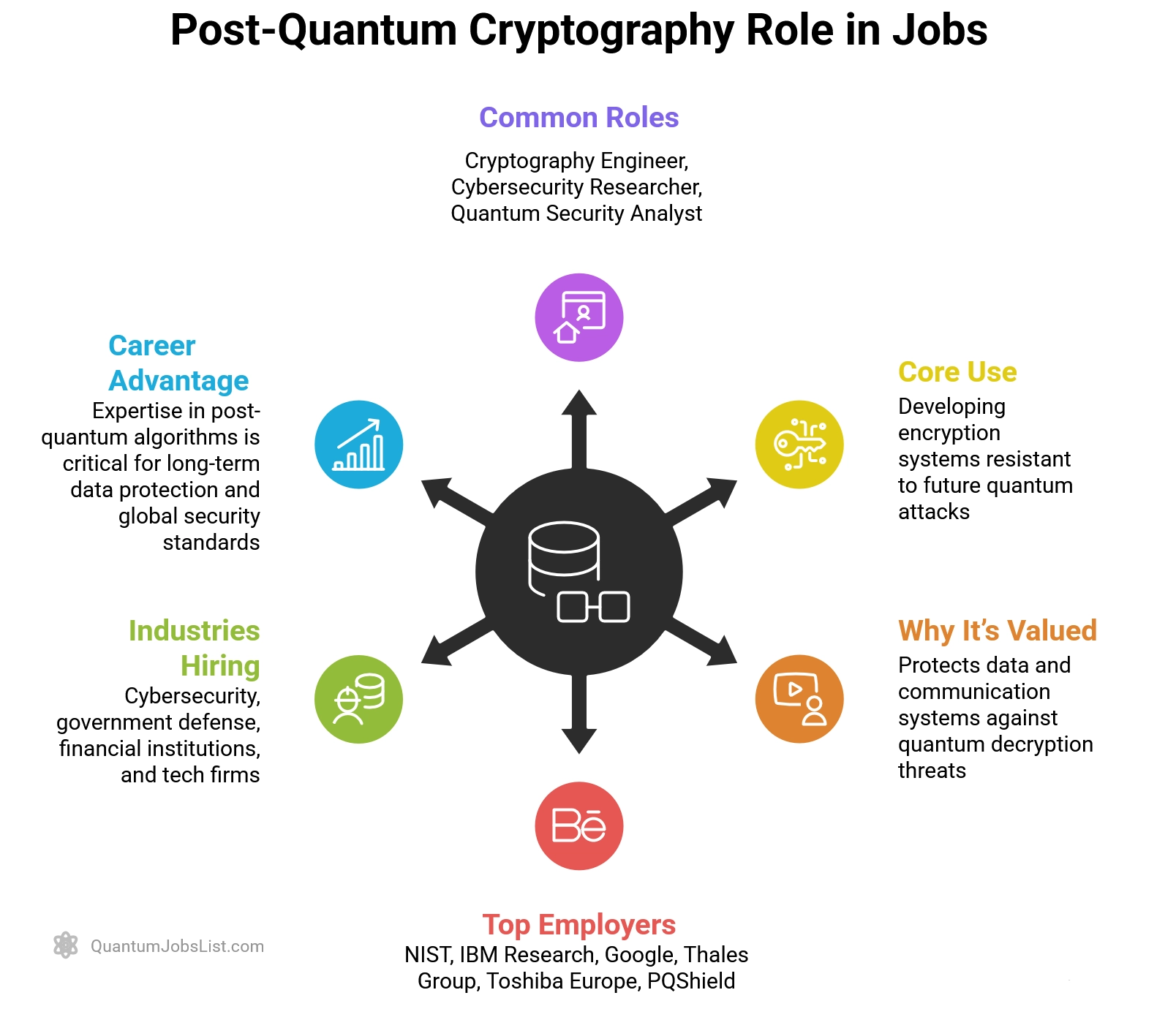
Implementing and evaluating new quantum-resistant cryptography, such as CRYSTALS-Kyber and CRYSTALS-Dilithium, is part of your responsibilities. Migration of current systems to post-quantum algorithms is done, alongside security vulnerability assessments and performance benchmarking, to equip organizations’ infrastructures for the post-quantum era.
We must be clear that when it comes to atoms, language can be used only as in poetry. Niels Bohr, Physicist
How much can post-quantum cryptography experts earn?
An entry level quantum security analyst makes approximately between $80,000 to $110,000 a year, while a senior researcher for quantum cryptography could make anywhere from $140,000 to $200,000 a year. Cybersecurity firms and financial institutions offer the highest compensation. learn more about Quantum Jobs Salaries here.
What's the difference between post-quantum and quantum cryptography?
Post-quantum cryptography is practical and deployable, using new mathematical algorithms on classical computers while remaining impervious to quantum computing capabilities.In contrast, quantum cryptography, including Quantum Key Distribution (QKD), is expensive and inconvenient, as it employs quantum physics alongside custom hardware to guarantee security, requiring specific equipment. Most organizations will utilize post-quantum crypto.
What skills do I need for post-quantum crypto jobs?
Strong foundational knowledge in cryptography (RSA, ECC, AES), an understanding of lattice-based or hash-based cryptography, proficiency in C, C++, or Python, and knowledge of NIST's post-quantum standards would be essential. Prior software engineering experience as well as in security systems and protocol implementation is very important.
The question isn't if quantum computing will transform business, but who will lead the transformation. Whurley, Strangeworks Founder
Why is post-quantum cryptography urgent now?
"Harvest now, decrypt later" attacks mean adversaries are storing encrypted data today to decrypt, when quantum computers become powerful enough. Organizations must transition to quantum-resistant encryption now to protect sensitive information, government agencies, banks, and healthcare systems are actively migrating.
Which organizations hire post-quantum cryptography specialists?
As of today, there are 221 available jobs for Post Quantum Cryptography in government agencies such as the NSA and NIST, in technology companies like Google, Microsoft, and IBM, in the financial sector, in cybersecurity companies, and in defense contractors, as well as in any institution that processes sensitive data that should be protected from future quantum computing attacks and will be using quantum cryptography for the foreseeable future.
.svg)

