
Entanglement Swapping Jobs















Open Quantum Positions
Know the Basics
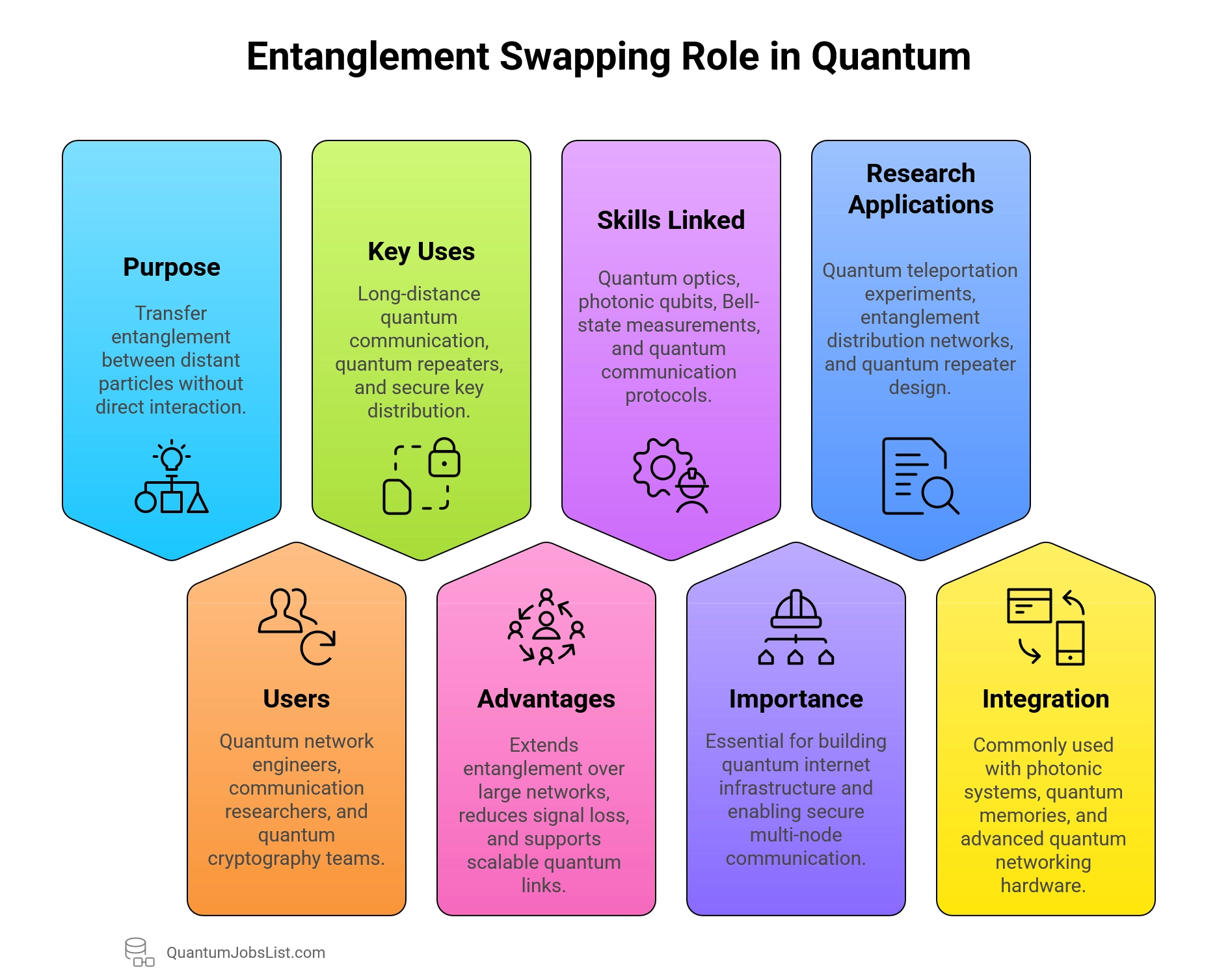
A quantum technique where you create entanglement between particles that never directly interacted. It is like making two strangers best friends by introducing each to a mutual friend, then removing the mutual friend from the picture.
What do entanglement swapping researchers actually do?
They are working on advancing quantum networks to cover longer distances through Quantum Node Entanglement Swapping. You will design optical systems, carry out Bell State Measurements, analyze the efficiency of the time-evolving quantum state swappings, and integrate these subsystems with larger systems for quantum networks for quantum-safe communications. The objective is to establish quantum connections with the ability to transmit quantum states across a large distance.
How much can I earn in entanglement swapping careers?
Entry-level researchers typically earn $80,000-$110,000 a year. Experienced specialists make $115,000-$155,000 a year; while senior scientists at quantum networking companies or national labs working on practical quantum internet implementations can earn $165,000-$210,000+ a year, especially those contributing to record-breaking entanglement distribution distances or improved swapping efficiencies. You can learn more about Quantum Jobs Salaries here.
We must be clear that when it comes to atoms, language can be used only as in poetry. Niels Bohr, Physicist
What technical background do I need for entanglement swapping jobs?
Most positions require a PhD in physics (specializing in quantum optics, atomic physics, or quantum information) or electrical engineering with a quantum focus. You should acquire knowledge on quantum entanglement, Bell Measurements, and networks. Additionally, hands-on experience with single photon sources, optical systems, detectors, and optical alignment is also important. The capacity to code in high-level programming languages for control automation and data analysis is also a must-have.
Suggested Read:
Why is entanglement swapping important for quantum networks?
Sending entangled photons directly over long distances does not work well because photons are absorbed or scattered after about 100 to 200 kilometers in fiber. Entanglement swapping solves this by linking shorter connections through intermediate nodes, creating long-distance entanglement. This is primary and foundational to the construction of a quantum internet that will support ultra-secured communication and distributed quantum computing to be performed across the globe.
The question isn't if quantum computing will transform business, but who will lead the transformation. Whurley, Strangeworks Founder
Which organizations are hiring for entanglement swapping research?
Companies such as Aliro Quantum, Qunnect, as well as the larger businesses like AWS (Center for Quantum Networking) and Microsoft (Azure Quantum) are also recruiting for this field, along with national labs, including, NIST, Oak Ridge and Argonne. Several of the top universities such as Delft, MIT, Caltech, University of Chicago and Harvard are also recruiting postdocs and researchers for their programs related to entanglement swapping and quantum networking.
What's the biggest challenge in practical entanglement swapping?
The difficulty is that it doesn't work all the time. The rate of success is lower than 50%, as photons might become lost, measurements might become flawed, and timing needs to be precise. For every step, the creation of the entangled pairs, the measurement, and storage, all need to happen with close to perfection and to be synchronized.
Additionally, there is the problem of constructing quantum memories that are able to hold entanglement for long enough to complete the swapping. The combination of all these factors are, for now, what keeps this work largely in the labs as opposed to being integrated into real world networks.
.svg)

