Quantum Jobs List
Quantum Computing Jobs France
The quantum computing job market in France is growing fast, with rising demand across software, hardware, and research roles. Learn about leading employers, key skills, and salary trends in France.
What Is Quantum Computing?
Quantum computing has the ability to solve complex problems that other computers cannot. It uses great features of quantum mechanics, like superposition and entanglement. It has the potential to transform the way we operate in fields such as medicine and finance.
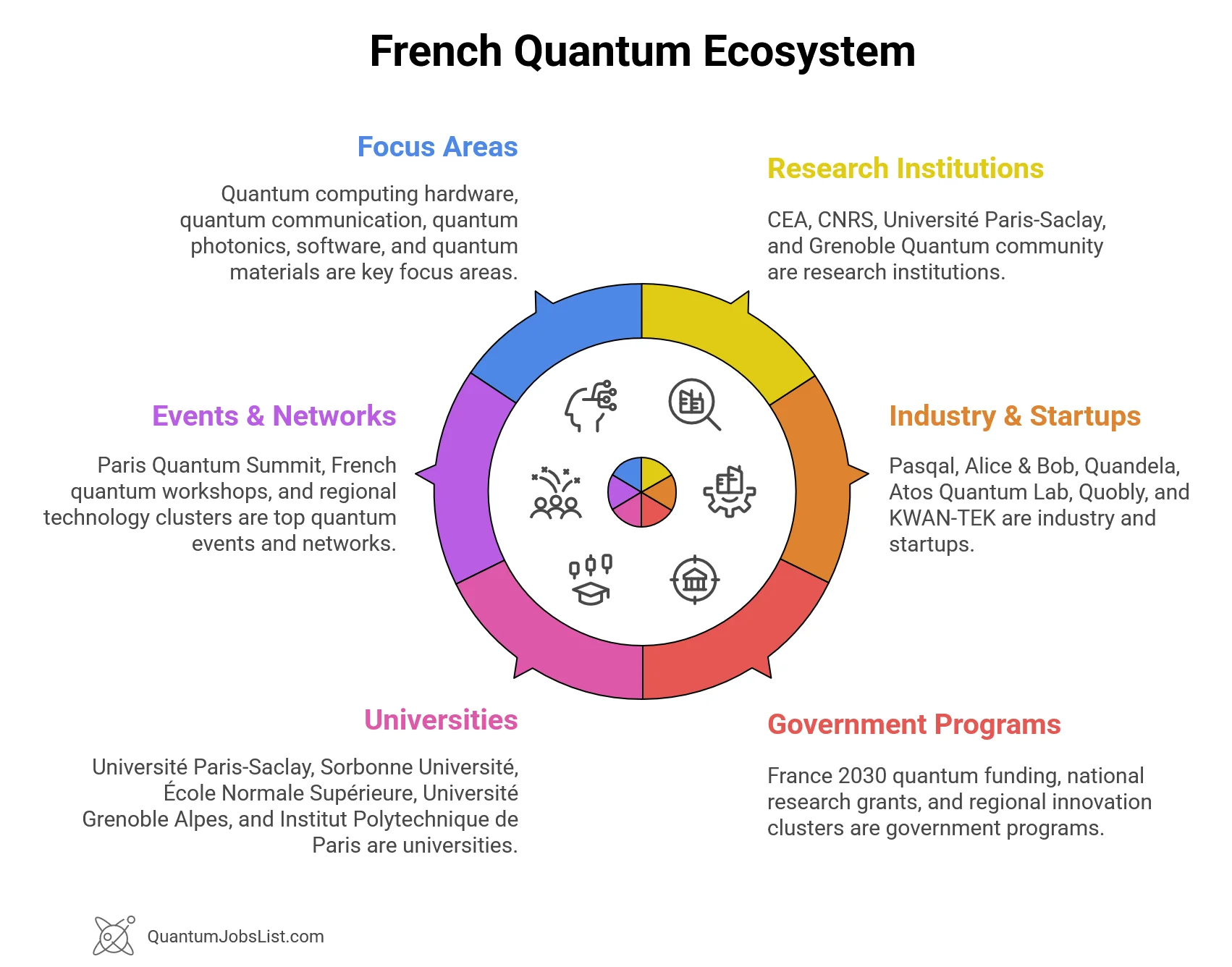
Now, France has overtaken its rivals to lead the European quantum computing sector. Within the framework of the National Quantum Strategy, President Macron’s administration has pledged funding worth €1.8 billion to be invested in quantum research. It aims to establish itself as one of the top three leaders in quantum computing by 2030.
Quantum will always be paired with classical computing to shape and prepare the data because quantum is only good at a handful of things. But these handful of things happen to have real use cases everywhere. Théau Peronnin, co‑founder of Alice & Bob
France's Quantum Legacy
France has been involved in quantum research for many years and has long been a leader in the field. Many French scientists have helped lay the groundwork for today’s quantum technologies, earning several Nobel prizes for their work in quantum physics.
Alain Aspect, who won the 2022 Nobel Prize for his work on quantum entanglement, is a professor at École Polytechnique and a co-founder of PASQAL, a leading quantum computing company in France. His achievements show that France can turn top-level research into successful businesses.
The nation possesses the ability to take scientific discoveries and convert them into offerings for companies and researchers.
Why Companies Choose France for Quantum?
Between 2017 and 2020, France saw a total of 12 quantum startups, formed from university research. By 2021, France also saw 3 foreign quantum companies open offices. They were drawn to the country’s governmental support, skilled workforce, and research institutions.
French quantum startups have raised over €350 million in funding, making France the top country in Europe for quantum investment. Alice & Bob raised €130 million, PASQAL over €140 million, and Quandela more than €50 million. This shows investors trust France’s quantum future.
Beginning from March 2024, the French government has instituted the PROQCIMA program, which has an initial budget of 500 million euros. Of the 5 French companies, each has a contract to develop one of the world’s first fault-tolerant quantum computers. The aim for the first milestone is to achieve a 128-logical-qubit system by 2030 and a second to achieve a 2048-logical-qubit system by 2035.

Quantum Job Market Outlook in France
France’s quantum job market is expanding with strong government support and growing industry demand.
New roles are emerging across research, software, and hardware as the ecosystem matures.
How Many Quantum Jobs Are Available?
France currently has 46 to 50 openings in quantum computing (Nov. 2025). This is a small number with a massive demand. Positions range from software jobs to research scientist roles.
Most openings are in Paris and the surrounding areas, which contain about 60% of the jobs. Grenoble has about 25% of the openings, and the rest are in other cities like Toulouse.
Aside from Paris, there are junior and senior-level openings, startup roles, and large tech companies that are university-affiliated.
University and Research Jobs
Quantum-related positions are always available at the university level and institutes like CNRS, CEA, and Inria. These positions allow freedom to explore at leading labs, and the ability to publish and train the next generation of quantum scientists.
Research roles fall into several categories. Researcher roles are permanent and tend to be matched with tenured positions. Postdoc roles are 2-3 year stints. There are also PhD positions that have 3 years of funded research.
Additionally, there are research engineering positions, where the focus is on the engineering of quantum systems.
There is a high degree of job security, especially for permanent positions. The roles are centered on long-term goals and rigorous science, which are big draws to the academic world for many.
Quantum Startup Opportunities
French quantum startups provide starkly different environments compared to academia. Alice & Bob, for instance, is rapidly expanding and employs over 150 people to build functioning quantum computers.
Jobs in startups can often be very diverse. For instance, in addition to your day job as a quantum algorithm developer, you could be asked to lead a business case for your quantum solution and then assist in some hardware troubleshooting. Some people like these diverse challenges daily.
The opportunity to earn an equity stake and potential upside is often very attractive. Early employees could receive equity of up to 2% of the company, while later-hired employees receive equity of up to 0.5%. In the likely event that the company is a startup, the equity would be very valuable.
Compared to academic institutions, the company’s speed in executing plans and achieving objectives is greater. Their culture is informal and collaborative, and the impact of your work on company objectives is very significant.
Large Technology Companies
Large companies, such as Atos, Air Liquide, Thales, and Orange, have also created their own quantum divisions. These corporate jobs provide stability and the resources that might be missing from the startups.
Atos builds quantum simulators and offers consulting services. Thales works on quantum communication for the defense and security sectors. Air Liquide creates the cryogenic systems that quantum computers require, while Orange is focused on quantum networking.
In comparison to startups, corporate roles tend to offer more work-life balance. Salaries and benefits are often better than in startups, and you can lead quantum initiatives at large corporations while sacrificing job security.
The Quantum Skills Gap in France
France faces a clear quantum skills gap as demand grows faster than available talent. Skilled professionals with practical experience have strong career opportunities.
Why Finding Quantum Talent Is Hard
Around 75% of applicants for quantum jobs lack the needed skills. This happens worldwide. Quantum computing grew so fast that universities struggled to keep up. Most computer science and physics programs only added quantum courses recently.
This shortage is an opportunity. With the right skills and experience, companies will compete for you. The demand far exceeds supply, which favors qualified candidates.
France's Plan to Train Quantum Professionals
The French government plans to train more than 5,000 professionals in the quantum field, from technicians to PhDs. Training is structured around university programs, certificates, and industry bootcamps.
The PEPR Quantum has allocated €150 million for the research and development of talent and skills over the next five years. Universities have started to offer quantum courses at all levels, from undergraduate to Master’s and PhD.
A university degree in quantum physics is not a prerequisite to join the field. Approximately 60% of the workforce has transitioned from other disciplines. Physicists go into quantum, computer scientists pick up quantum algorithms, and electrical engineers work on quantum hardware.
The focus should be on developing a solid underpinning, coupled with the ability to demonstrate practical competencies through work.
Career Paths Without a Quantum PhD
A master’s degree or a solid bachelor’s degree with some relevant experience is good enough for many jobs in Quantum. Programming and learning quickly are valued more in some quantum software positions than having a PhD.
There is a fast-growing area called application engineering. These positions help businesses solve real problems using quantum computing. You need some quantum fundamentals as well as knowledge of a specific domain, such as finance, chemistry, or logistics.
Practical skills matter most. Can you write quantum code? Have you run quantum algorithms? Do you understand the business side? These often matter more than your academic degrees.
Suggested Read: Get Quantum Jobs without PhD.
Quantum has this incredible promise of achieving very powerful computational capability. With a quantum computer, you will eventually be able to solve problems more efficiently than any classical supercomputer. Marco Pistoia, Senior Vice President of Industry Relations at IonQ.
Growth Projections Through 2035
France’s quantum sector is expected to grow steadily through 2035. Long-term government programs and industry investment will continue to create new jobs.
France's Quantum Timeline
France’s quantum sector is expected to grow until at least 2035. The PROQCIMA program is aiming to achieve 128-qubit systems by 2030 and 2048-qubit systems by 2035. Attaining these objectives will require ongoing recruitment.
The government’s commitment is indeed long-term. The National Quantum Strategy allocates the available funding with the long-term anticipation of quantum developments in France. As the quantum computers become better, more use cases will develop, resulting in more job creation.
Global Context for French Jobs
McKinsey predicts quantum computing will create about 250,000 jobs worldwide by 2030 and 840,000 by 2035. As one of the leading three nations in quantum technology, France will obtain a significant portion of these.
The Paris Region is a prime example of fast growth. Between 2017 and 2020, 12 of France’s startups were founded. In 2021, three international companies also established a presence in France. This area is a prime example of growth catalysis.
The presence of more companies increases the availability of talent. An increase in talent leads to the creation of more startups. The emergence of more startups attracts further investment. This cycle is a constant driver of employment in areas like Paris and Grenoble, where it is needed most.
Which Roles Will Grow Fastest?
Quantum hardware development will grow as companies aim for PROQCIMA milestones. This drives demand for experimental physicists, cryogenic engineers, and microwave engineers.
Quantum software and algorithm development is also expanding. Companies need software engineers, algorithm developers, and experts who can mix quantum and classical computing.
Of all the possibilities, quantum applications engineering will grow the fastest. These roles require the least theoretical knowledge compared to research roles, yet substantial skills to implement quantum technology to solve real business issues, instead of just for the finance, pharma, logistics, and defense industries.
Suggested Read: Why choose Quantum over Classical computing
Quantum Computing Jobs Salaries in France
Quantum computing salaries in France reflect specialized skills and experience. Compensation includes healthcare, vacation, and strong work protections that support quality of life.
Suggested Read: Quantum jobs and Salaries
Understanding French Compensation
Although quantum computing salaries in France may seem lower than in the US, the comparison misses context, and they do relate to the specialized skills required.
In France, via Sécurité Sociale, you don’t pay thousands for healthcare, as they have coverage for all. The average worker will see at least five weeks of paid vacation, and employment protections are strong. All of these factors decrease the likelihood of career risk.
Especially outside of Paris, lower living costs combined with all these benefits make the salary of quantum computing professionals supportive of a good living.
.webp)
Entry-Level Salary Expectations
Entry-level quantum jobs in France usually pay €40,000 - €50,000 a year. These include junior software developers, research assistants and applications engineers.
Salaries may seem lower than in the US, but they include full benefits: healthcare, vacation, unemployment insurance, and retirement contributions.
These roles also offer valuable experience. You work with advanced technology and gain skills that make you more valuable over time. You can learn more about entry level jobs you can get without experience.
Mid-Career Earning Potential
Mid-level quantum engineers and researchers in France earn €60,000 - €90,000 per year. These jobs need several years of experience and proven quantum skills.
At this level, you might lead small teams, design quantum algorithms for business use, or manage experimental systems. Pay reflects these responsibilities and expertise.
Location matters. Paris jobs usually pay 10%-20% above average. Grenoble salaries are near the national average; but lower living costs give good purchasing power.
Senior-Level Compensation
Senior engineers, principal researchers, and research leaders in France earn €80,000 - €120,000 or more. Top talent at leading companies or in prestigious research roles can earn even higher.
Salary depends on experience, publications for research roles, technical skills and employer strength. Hardware engineers often earn more than software developers because their skills are rarer.
Salary data compiled from Quantum Jobs USA, Quantum Jobs List, Economic Research Institute, and live job posting.
Beyond Base Salary
French quantum jobs offer more than salary. Startups often give equity from 0.1% to 2% depending on when you join. For well-funded companies like Alice & Bob or PASQAL, this can be very valuable.
Annual bonuses are common. Most companies pay a "13th month" bonus, an extra month of salary each year. Performance bonuses can add another 10%-20% of pay.
Professional development budgets cover conferences, training, and certifications. Both startups and big companies support ongoing learning.
France's Unique Benefits System
France offers a strong employee benefits system with universal healthcare and paid leave. These benefits reduce personal costs and improve long-term job security.
Universal Healthcare Coverage
French quantum professionals have their healthcare costs covered almost entirely by the government, allowing them to access a variety of medical services without financial barriers. This is a €3,000 to €5,000 benefit across several European countries.
France's healthcare system is the only one to offer complete state-funded coverage of doctor appointments, mental health services, prescription drugs, dentistry, and any additional services, without the fear of medical bankruptcy. Additionally, healthcare is free and paid for by the government, so people can access it without the concern of going into debt.
Generous Vacation and Time Off
French law mandates at least five weeks of paid vacation annually. This is legally required, not an incentive. Many employers in the quantum space offer 6+ weeks, plus 11 paid public holidays.
Some companies offer a 35-hour work week, and additionally offer ‘RTT’ (réduction du temps de travail) days. These days are additional days off provided when an employee works more than 35 hours in a week. This is a system that promotes work-life balance in practice, not just in theory.
Family Support Policies
France provides sixteen weeks of paid maternity leave at near-full salary. For paternity leave, you can get 25 days paid. For parental leave, you can take off work for three years and keep your job, but it's only partially paid.
The government pays for a portion of the costs of child care. Some big companies have daycare centers at work. These child care policies are a big reason France is a good choice for quantum professionals who have kids or are about to have kids.
Employment Security
Strong labor laws provide financial security if you lose your job. Severance requirements are generous. Unemployment insurance covers up to 24 months and pays a significant percentage of your previous salary.
With all these protections, you can work on a startup or make a big career change without the risks. You will have a safety net if it doesn't go as planned.
What are Educational Requirements for Quantum Jobs?
Most quantum jobs in France require at least a Master’s degree in physics, computer science, engineering, or a related field. Research-focused roles, especially in universities and national labs, often require a PhD; particularly for senior scientist or algorithm development positions.
That said, not all quantum roles need a PhD. Quantum software engineering, applications engineering, and some hardware roles accept candidates with strong Bachelor or Master degrees if they have solid practical skills. Employers value hands-on experience, project work, and the ability to apply quantum concepts to real problems.
Minimum Qualifications
Most French quantum positions require at least a Bachelor's degree in physics, computer science, electrical engineering, mathematics, or a related field. Nevertheless, a Bachelor's degree in itself rarely gets you a job. France's education-centric culture means higher degrees are preferred. A Master's degree is what allows you to access most positions in quantum engineering or research. French employers appreciate the combination of theoretical knowledge and practical skills that Master's programs provide.
Suggested Read: Qualification required for Quantum jobs
When You Need a PhD
Almost all research scientist positions at CNRS, CEA, or universities require PhDs. Senior positions in algorithm development usually require PhD-level theoretical depth. Leading research teams and securing funding as principal investigators definitely require a PhD and a robust publication record.
Academic positions are highly motivated by postdoctoral experience. If you intend to be a permanent researcher or a professor, expect to complete at least one or two postdoc positions after the PhD. This expresses your capacity for independent research and the ability to cultivate partnerships.
The Grandes Écoles Advantage
École Polytechnique, CentraleSupélec, Télécom Paris, and ENS (École Normale Supérieure) are all examples of Grandes Écoles, which are among France's most prestigious engineering institutions, and are the most in demand.
Along with practical training, Grandes Écoles incorporate rigorous theoretical teaching into their curricula. They also have strong institutional collaborations with quantum startups and research facilities. In France, graduating from a Grande École will accelerate your progress in the quantum field.
These institutions' students frequently receive first-rate opportunities for internships and employment at leading quantum firms. The networks are extensive and provide support at every stage of your professional journey.
French Universities with Quantum Programs
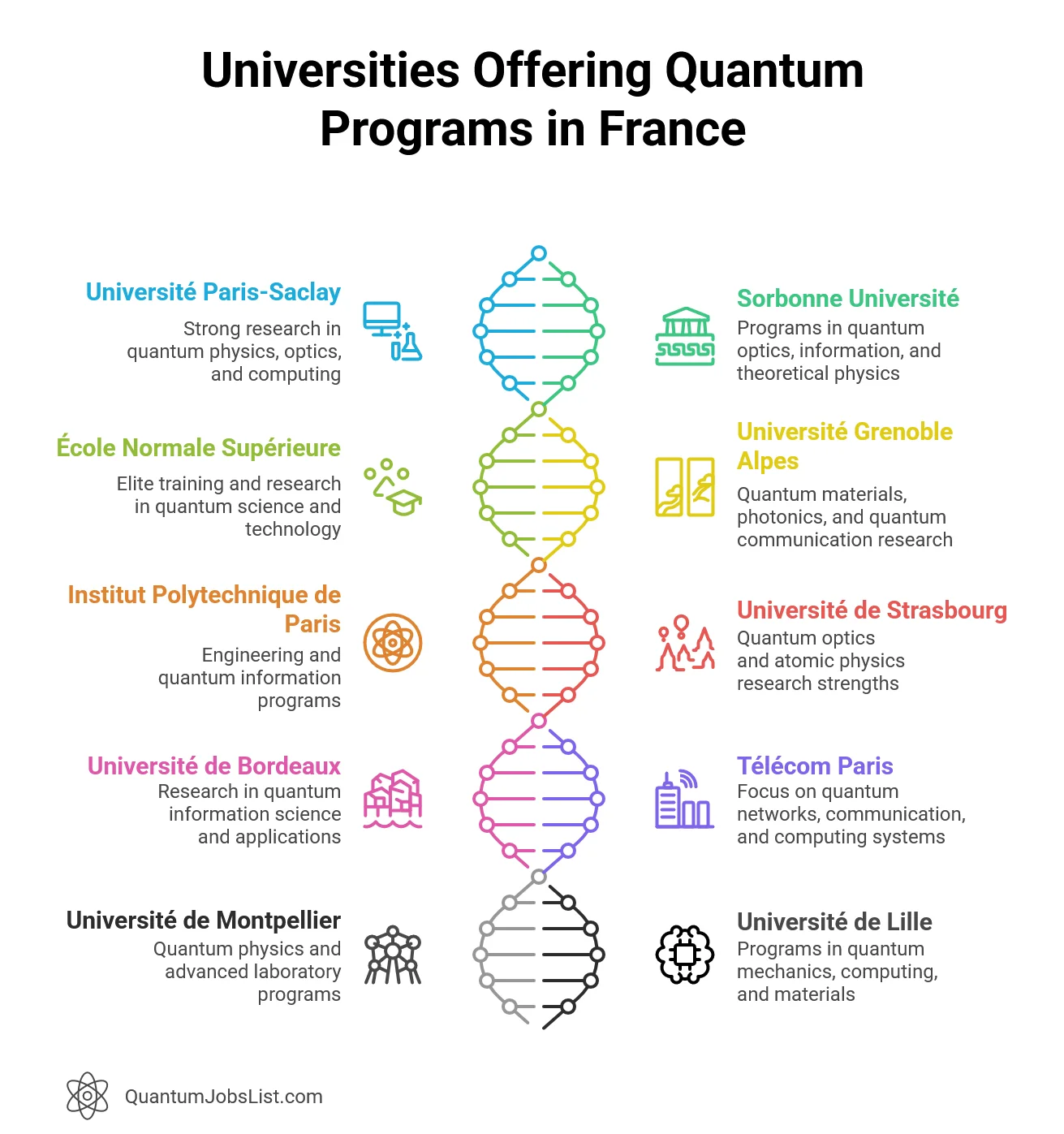
France has several top universities with quantum programs, including Sorbonne Université, École Polytechnique, Université Grenoble Alpes, Télécom Paris, & Université Paris-Saclay. These schools teach both quantum theory and practical skills, with strong links to research labs and quantum companies, preparing students for jobs in France’s growing quantum sector.
Université Paris-Saclay
Paris-Saclay is France's premier quantum education and research hub. As located on the Saclay plateau south of Paris, the university brings together multiple elite schools and research organizations.
More than 40 research teams work on quantum technologies here. They cover quantum computing, quantum communication, quantum sensing, and the enabling technologies that make all of this possible. The QUANTUM center coordinates research across these areas.
Master's Programs at Paris-Saclay
The M2 QMI program is a one-year Master’s degree at Télécom Paris, École Polytechnique, Université Paris-Saclay, and CentraleSupélec. It consists of 14 courses and covers quantum information, cryptography and error correction.
It has industry partnerships. Graduates are often hired by partners such as Quandela, PASQAL, Alice & Bob and IBM.
The M1 and M2 QDCS programs teach quantum computing and distributed computing. You study advanced programming as well as quantum computing.
These programs are integral to France’s quantum ecosystem. Alice & Bob and PASQAL are based on research from Paris-Saclay. Students are able to use the labs of these companies.
École Polytechnique
École Polytechnique is among the premier education institutions in France. Alain Aspect, a Nobel Prize Laureate in Physics in 2022, teaches and conducts research there. He is also a co-founder of a research-based startup, PASQAL. This exemplifies the school’s ability to create companies based on its research.
Charles Fabry Laboratory
At the Charles Fabry Laboratory, research focuses on quantum simulation using optical tweezers and Rydberg atoms. The Theoretical Physics Center specializes in quantum information theory and mathematical physics.
Admission to the school is very selective and competitive, with only 400 students from a pool of thousands of applicants being accepted annually, which is more selective than most of the Ivy League institutions. Due to their superior training, graduates are in high demand from employers in the quantum computing field.
Sorbonne Université
Sorbonne Université is also home to a Quantum Information Center located in the heart of Paris. The students are well-positioned to interact with quantum-oriented companies, research institutions, and the French technology industry.
The programs are designed to cover both theoretical and practical components. The physics training includes quantum mechanics, optics, and information theory. The computer science training includes quantum algorithms, computer programming, and quantum-safe cryptography.
Interdisciplinary education is highly emphasized and a strong feature of the University. Students are encouraged to take classes in physics, mathematics, and computer science, which is a direct reflection of the multi-disciplinary nature of quantum computing.
Université Grenoble Alpes
Grenoble is France’s 2nd quantum hub, with Université Grenoble Alpes at its center. Its quantum engineering programs focus on practical hardware development.
Students gain hands-on experience in device fabrication, cryogenic systems, control electronics, and measurement techniques, skills useful in quantum hardware companies.
The university is close to CEA-Leti, Europe’s top nanoelectronics research center. Collaboration with CEA and industry engineers gives students real-world insight into quantum hardware challenges.
Additional French Quantum Universities
Télécom Paris
At Télécom Paris, the Quantum Information and Applications group specializes in quantum communications, quantum cryptography, and quantum algorithms. Graduates from Télécom Paris are equipped with systems thinking and computer programming abilities, which is typical for graduates from engineering schools.
Quantum Science and Nanomaterials research group
The Quantum Science and Nanomaterials research group is based at the Université de Strasbourg. Being located at the German border, the university is able to facilitate cross-border partnerships with German institutions in quantum research.
University of Montpellier
The University of Montpellier contributes to the geographically dispersed quantum research network in France with its research in theoretical and quantum optics. It also conducts quantum research in the related fields of physics.
Essential Skills for Quantum Careers in France
Essential skills for quantum careers in France include knowledge of quantum algorithms, programming in Python and Qiskit, and understanding quantum hardware like superconducting and photonic qubits.
Quantum Mechanics Fundamentals
You need deep understanding of quantum principles, not just surface knowledge. Superposition means a quantum system can be in multiple states simultaneously. On the other hand, entanglement is a property whereby particles are interlinked, such that the interlinking remains even when the particles are separated. Lastly, quantum measurement is the interaction of the measuring device and the quantum system, which in turn, alters the system being measured.
The concepts highlighted should not be viewed in isolation. Quantum computers are real, and so are the concepts stated above. The converse states that quantum states are destroyed by decoherence and that operations that are quantum operations are corrupted by noise. These are the challenges that systems and algorithms should be designed to address.
Mathematical Foundations
You must learn eigenvalues, eigenvectors, and tensor products fluently, alongside other topics in vector spaces and linear algebra, in order to speak the language of quantum computing. Complex numbers are ubiquitous, and probability theory is also critical to understanding the statistics of quantum measurement.
French employers in quantum physics expect you to read and comprehend the math in research papers. Then, you must derive the necessary steps from a solution to a problem to implement quantum algorithms and solve them. They do not expect a lot of guidance.
Programming Skills
Programming skills are key for quantum jobs in France. Proficiency in quantum frameworks is essential. Knowledge of classical programming, algorithm design, and software development practices helps you implement quantum algorithms effectively.
Python is a must for any quantum-related job. 90% of quantum roles require proficiency in Python. Make sure to learn Qiskit, Cirq, PennyLane, and preferably Perceval, which is a Quandela (French) framework.
C++ is a plus, especially for quantum control systems and other performance-critical tasks, and Julia is being adopted for numerical simulations. Some research work requires MATLAB or Mathematica, so some exposure to those is useful.
You will be most productive if you use these resources the first time you encounter them.
Quantum Algorithms Knowledge
You should know the main quantum algorithms, even if you don’t use them directly. Shor’s algorithm factors large numbers efficiently. Grover’s algorithm speeds up search problems.
Today, focus is on near-term algorithms for noisy devices. Variational quantum eigensolvers (VQE) solve chemistry problems. Quantum approximate optimization algorithms (QAOA) handle combinatorial optimization. Quantum machine learning combines quantum computing with AI.
Learning these algorithms helps you see which problems quantum computers can solve effectively.
Hardware and Systems Understanding
Different Quantum Computing Platforms
French quantum companies use different technologies, and knowing them helps your career choices. While most companies focus on superconductors, PASQAL uses neutral atoms with optical tweezers. Alice & Bob build superconducting cat qubits in order to minimize error. Single-photon quantum computers are developed by Quandela. C12 works on spin qubits made with carbon nanotubes.
Some technologies are better than others, as Neutral atoms in quantum simulation are better than superconducting qubits, which are a lot more developed. Photonic systems are a lot better than the others because they can run at room temperature. Knowing the different technologies helps you pick which company works best with your interests.
Error Correction Is Critical
Every current quantum computer on the market is negatively impacted by noise and mistakes. Via decoherence, qubits lose their quantum characteristics. Not all operations are accurate, and this constrains the number of operations that can be performed before mistakes start to accumulate.
Quantum error correction tackles this issue by encoding information across multiple, redundant physical qubits. The PROQCIMA program in France directly focuses on quantum computers with built-in fault tolerance, making error correction highly specialized.
For French quantum companies working on reaching the milestones of the PROQCIMA program, understanding quantum error correction codes, fault-tolerant quantum computing, and practical error mitigation techniques is tremendously valuable.
Suggested Read: Top Quantum Error Corrections Jobs and Skills
Applied Professional Skills
Domain Expertise Matters
French employers are looking for quantum specialists who also possess knowledge of a particular field. In quantum finance, for example, skills in portfolio optimization, risk assessment, and the pricing of derivatives are required. In the pharmaceutical sector, knowledge of molecular dynamics and drug discovery is essential.
Such a combination of skills is uncommon. Many experts in quantum are not domain specialists, and vice versa. Filling both of these gaps makes you extremely well-positioned for roles in applications.
Problem-Solving Abilities
The ability to identify problems suitable for quantum advantage separates good quantum professionals from great ones. Not every problem benefits from quantum computing. You need to understand which problems are good candidates.
Then you must translate real-world problems into forms quantum algorithms can handle. This requires deep understanding of both quantum capabilities and the application domain, whether that's finance, chemistry, logistics, or something else.
French Language Considerations
Many quantum jobs in Paris and at large international companies operate primarily in English. Multilingual settings are the norm in research environments. In France, you can engage in quantum computing without needing French at the outset.
French is, however, an advantage. It is necessary for cultural assimilation, accessibility to some of the smaller firms, and for certain civil service jobs. Most international quantum workers expect to acquire some French while in the role.
With even a little French, you demonstrate to the employer that you are committed to permanently moving to France and not just using the role for a quick career hop.
In-Demand Specializations for Quantum Jobs in France
In France, top quantum specializations include software development, algorithms, hardware engineering, quantum communication, cryptography, and applications in finance, logistics, and chemistry.
Photonic Quantum Computing
Photonic quantum computing uses light particles (photons) as qubits. Photons are easy to control and transmit, making this approach ideal for quantum communication and scalable quantum computing. Quandela and multiple French research groups work on photonic approaches. You need expertise in single-photon sources and detectors, linear optical quantum computing, integrated photonics, and boson sampling.
Photonic systems have potential advantages like room-temperature operation. Understanding this platform positions you for roles at Quandela and photonics research labs.
Quantum Error Correction Expertise
This aligns perfectly with France's PROQCIMA program goals. Companies require employees trained in topological codes, surface codes, and cat codes (which Alice and Bob specialize in). You need to describe the implementation of error corrections on various hardware systems.
This specialization is the integration of the highest level of theory with the greatest level of limitation of practical hardware. This is possibly among the most difficult yet most rewarding specializations in the field of quantum to develop.
Neutral Atom Quantum Computing
Neutral atom quantum computing uses individual atoms trapped by lasers as qubits. These atoms can be precisely controlled and entangled to perform quantum operations. This approach is scalable and promising for building larger, fault-tolerant quantum computers.
France leads globally in this area through PASQAL. Rydberg atom physics, optical tweezer arrays, laser control systems, and quantum simulation with neutral atoms all offer career opportunities at PASQAL and at research laboratories with similar pursuits.
This specialization uniquely combines atomic physics, quantum optics, and quantum information science.
Quantum Machine Learning
It uses quantum algorithms to process data faster or solve problems that are hard for classical computers, such as optimization, pattern recognition, and simulation of complex systems. You work on hybrid quantum-classical systems that use both types of computation. Applications include optimization and pattern recognition problems.
The commercial potential is significant because machine learning already has proven business value. Adding quantum capabilities could provide competitive advantages.
Suggested Read: Top Quantum ML Careers
Quantum Cryptography and Security
Quantum cryptography uses quantum principles to secure communication. Techniques like quantum key distribution (QKD) make it impossible for eavesdroppers to intercept messages without being detected. It is key for building future-proof, highly secure systems. Government and defense applications drive demand for quantum security expertise. This includes post-quantum cryptography, quantum key distribution, quantum-safe encryption protocols, and security analysis of quantum systems.
Thales and other defense contractors need quantum security professionals. Government agencies implementing quantum-safe communications create additional opportunities.
Top Companies Hiring for Quantum Computing Jobs in France
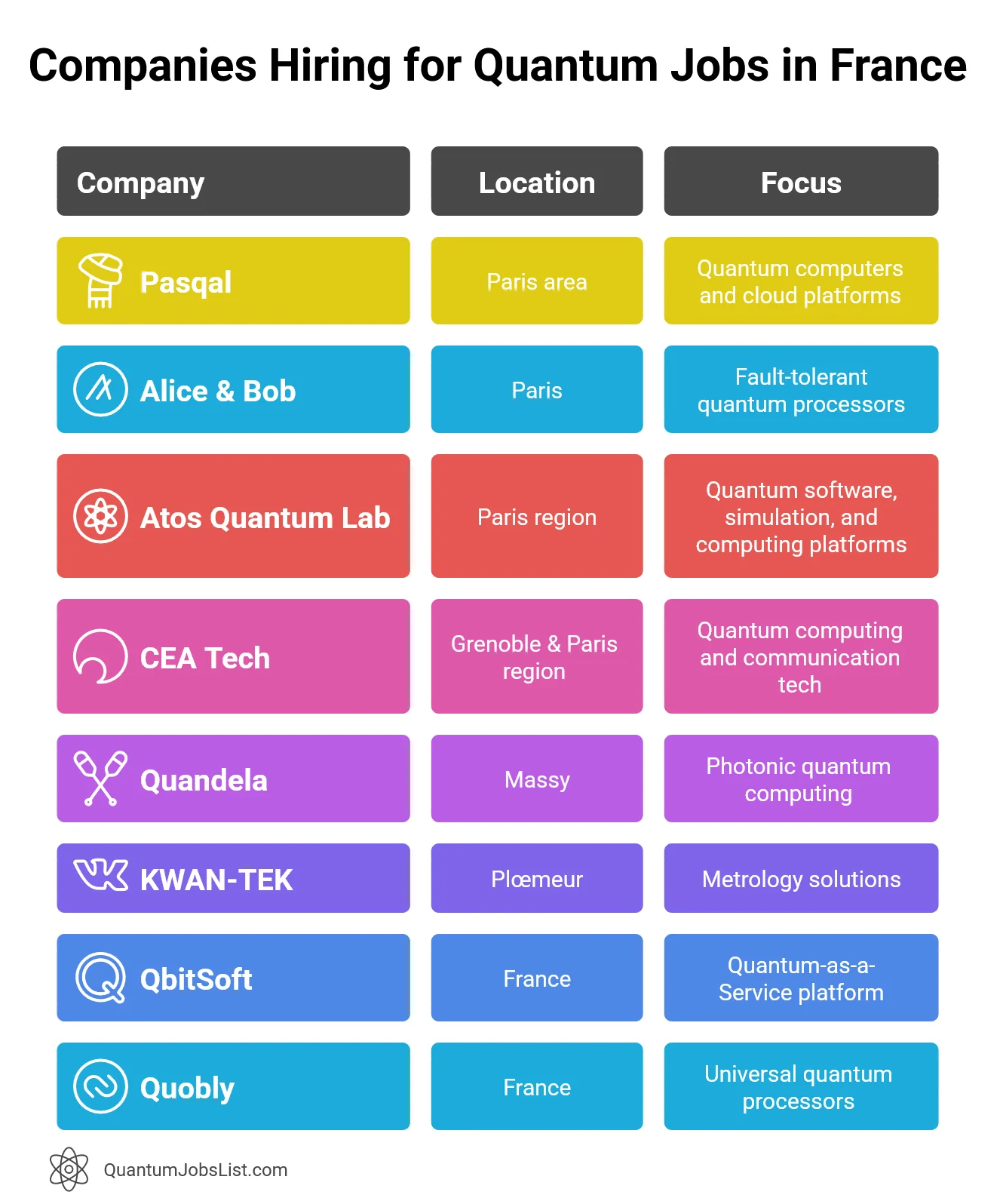
Top companies hiring for quantum computing jobs in France include both dedicated quantum technology firms and major industry players. Leading quantum specialists are Alice & Bob, PASQAL, Quandela, C12 and Quobly, all working on cutting‑edge quantum hardware and software.
French Quantum Startups Leading the Way
Alice & Bob
Alice & Bob is the biggest Quantum start-up in France with over 150 employees in Paris. 2020 was the inception year for the company, and as of now, they have successfully acquired €130 million from various investors. They focus on a unique method of Quantum computing by utilizing “cat qubits.” These qubits have the ability to minimize one of the most fundamental problems in quantum computing - errors.
The company is a participant of the French PROQCIMA scheme which has subsidized government funding for the construction of fault-tolerant quantum computers by the year 2030. The company employs experimental physicists, quantum algorithm developers, software engineers, and cryogenic engineers. The work environment is fast-paced and innovative, and employees get meaningful equity in a company that could become very valuable.
PASQAL
PASQAL was co-founded by Alain Aspect, who won the Nobel Prize in Physics in 2022. This gives you an idea of the caliber of science behind the company. Just south of Paris, in Massy, PASQAL develops quantum computers that utilize neutral atoms that are controlled with lasers.
They are a part of PROQCIMA, and are also developing quickly in the field; with more than 140 million euros, they are employing atomic physicists, quantum software developers, and even employees to assist customers in using quantum computers to resolve practical issues. To put it simply, employees of PASQAL are collaborating with some of the world's best scientists to create commercial quantum technology.
Quandela
Quandela takes a different approach to quantum computing using photons (particles of light) instead of atoms or superconducting circuits. Like PASQAL, Quandela is also based in Massy, France, and has secured over 50 million euros since their launch in 2017. What sets Quandela apart, however, is the fact that they already have quantum computers available to the public that have been usable in the cloud and can even be utilized by researchers and businesses.
They have also developed quantum programming, Perceval, which is tailored to photonic quantum computers. Quandela employs photonics engineers, quantum optics specialists, software developers, and applications engineers to assist assorted industries in utilizing quantum technology.
C12 Quantum Electronics
C12 Quantum Electronics is exploring an innovative approach using carbon nanotubes as qubits, which could potentially work at higher temperatures than other quantum computers.
Quobly
Quobly, based in Grenoble, is developing superconducting quantum processors with support from CEA-Leti, Europe's premier nanoelectronics research center.
Research Institutions and Universities
France’s main research organizations employ hundreds of quantum professionals in both permanent and temporary roles. CNRS, the biggest fundamental research organization, has more than 40 quantum research teams throughout the country. They employ permanent researchers (similar to tenure-track professors), postdoctoral researchers for two to three years, PhD candidates who are funded for three years, and research engineers who construct and service quantum devices. There is stiff competition for these positions, but they offer a high degree of job stability and academic freedom.
CEA-Leti
CEA focuses primarily on applied quantum research and engineering. The CEA-Leti facility in Grenoble is a centerpiece for quantum hardware, while the Saclay campus, which is near Paris, hosts large-scale projects. They employ research scientists and engineers who convert fundamental research into operational devices.
Inria
Inria is involved in the computational and mathematical dimensions of quantum technology. They examine quantum computing, quantum cryptography, and quantum software, and thus attract computer scientists and mathematicians who examine the theoretical aspects of these domains.
Large Technology Companies
Some large French companies have dedicated resources to quantum consulting. For example, Atos developed a simulator called the Quantum Learning Machine, which allows users to evaluate algorithms prior to deploying them on actual quantum computers. Additionally, Atos engages in quantum consulting to assist companies in understanding these benefits.
Thales Group
The defense and aerospace company, Thales, is involved in quantum communications, quantum-safe cryptography, and quantum sensors for navigation and security. The primary telecommunications company, Orange, is building quantum key distribution networks and is working to develop the future quantum internet.
Air Liquide
The industrial gas company Air Liquide builds cryogenic systems that facilitate the cooling of quantum computers, thus financially supporting the field of quantum computing.
Top Cities for Quantum Computing Jobs in France
The best cities for quantum computing jobs in France are Paris, Grenoble, and Toulouse. Paris has the most openings, with many startups, research labs, and global tech teams; Grenoble is strong in quantum hardware and engineering, with close ties to major research centers; Toulouse is growing in quantum sensing and aerospace applications, offering niche opportunities as the sector expands.
Paris
Startups and major research institutions are centralized in the Paris and Île-de-France region, which holds around 60% of France’s quantum computing positions. Alice & Bob is located in Paris. In the quantum hub suburb of Massy, 20 km south of Paris, PASQAL and Quandela are located. C12 also has offices in Paris. Major tech firms such as Atos, Thales, and Orange are located in Paris. Major research institutions are Université Paris-Saclay on the Saclay plateau, École Polytechnique in Palaiseau, Sorbonne Université in central Paris, as well as several CNRS labs.
Who Paris Suits
Paris is best for quantum professionals seeking top career opportunities, big city life, cultural experiences, and an international environment where English is widely spoken at work.
Living in Paris
Living in Paris puts you at the center of French quantum activity. Networking across companies and labs is easy. Career opportunities are abundant, and cultural amenities like museums, restaurants, and entertainment are world-class. Public transport is excellent, so a car isn’t needed.
Challenges and Costs
Paris has France’s highest cost of living. Two-bedroom apartments rent for €1,200 - €2,500 a month. Housing is competitive, and the city is crowded and fast-paced. Salaries in Paris are 10-20% higher than the national average, helping offset costs.
Grenoble
With around 25% of France’s quantum jobs, Grenoble is the second largest for quantum computing in France. The city, located 3 hours southeast of Paris, has a different vibe. The French city also holds equal importance as it specializes in quantum engineering and hardware. Quobly, a PROQCIMA startup is located in the French Alps. Europe’s leading research center for nanoelectronics, CEA-Leti, runs extensive quantum hardware programs using silicon quantum dots, superconducting qubits and control electronics. Université Grenoble Alpes provides quantum engineering education with a focus on device fabrication and testing.
Who Grenoble Suits
Grenoble is ideal for hardware engineers, experimental physicists, and those who enjoy outdoor activities and a smaller city environment. It suits people who prefer deep technical focus over broad career options.
Quantum Community and Collaboration
The close partnerships among CEA, the university, and industry players have developed a robust quantum ecosystem. Researchers change roles across organizations, students do internships at CEA, and companies hire CEA grads. This ecosystem facilitates learning across different organizations.
Challenges and Considerations
There are just a handful of companies in the quantum space, which means the potential for career growth is limited. This also means, in some cases, having to reorganize your life to get a new job. The airport also has less international travel, and French is more necessary because the community is less international.
Living in Grenoble
Grenoble is a huge contrast to Paris. It is 30-40% cheaper and has great purchasing power. It is surrounded by mountains, and the city is perfect for hiking and skiing. You can get to the slopes in 30 minutes. It is also easier to find housing, and the city is a high-quality place to live with a great international community, which comes from the CEA and research centers.
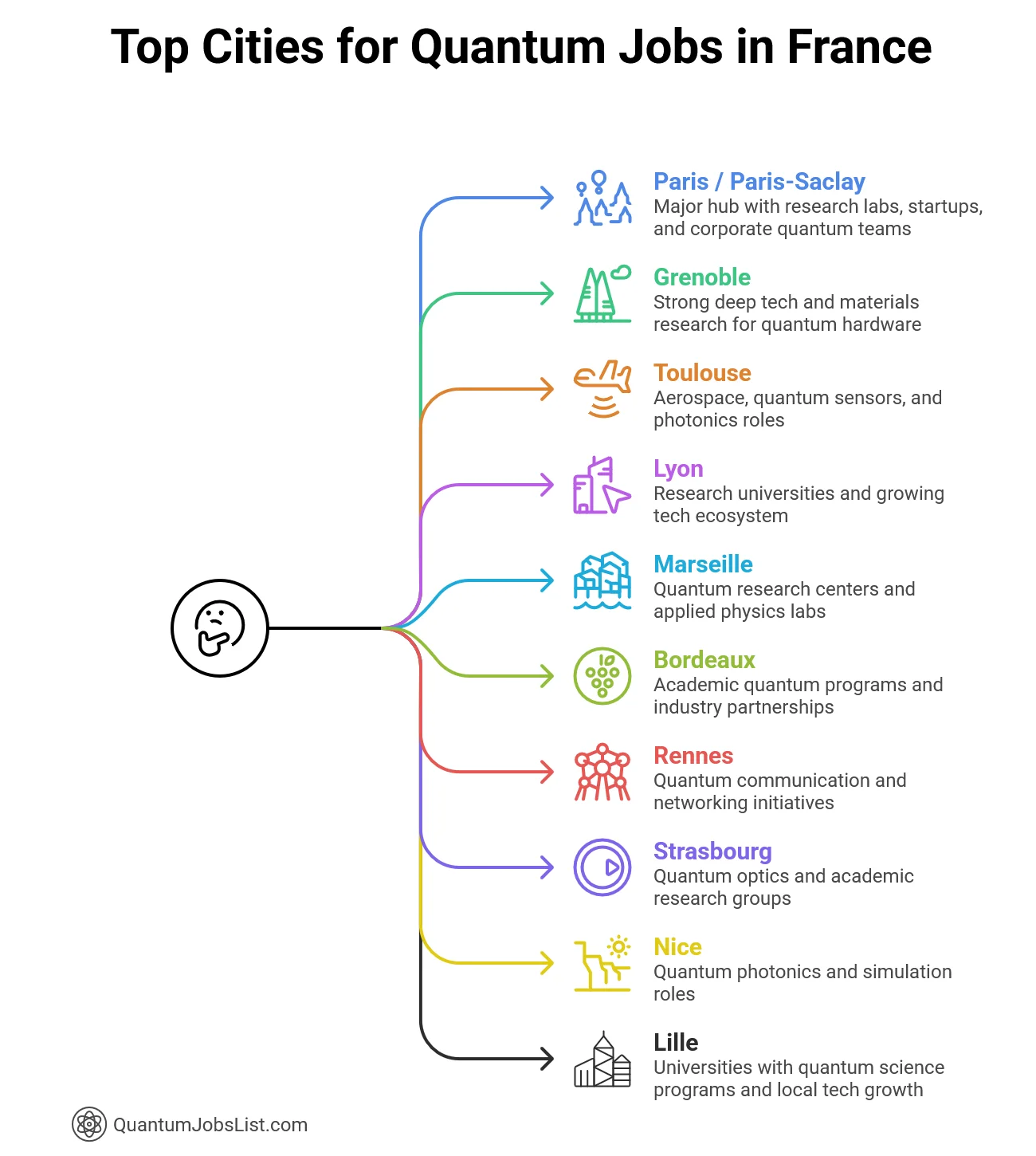
Toulouse
With a population of about 500,000, Toulouse is the fourth largest city in France, located in the southwestern part of the country. It is also regarded as the capital of the aerospace industry for all of Europe. It is also developing its capabilities in quantum technologies, particularly for satellite communications and sensing.
Who Toulouse Suits
Toulouse suits pioneers who want to join a growing quantum ecosystem early and enjoy a high quality of life in southern France. It’s ideal for those focused on aerospace-related quantum work.
Quantum Community and Opportunities
The quantum industry in Toulouse is just beginning to expand. Thanks to government support, the number of quantum-related jobs in Toulouse has increased, although still below that of Paris and Grenoble. The aerospace sector as a whole is also expanding, resulting in a wider number of jobs in aerospace-related industries. In summary, Toulouse presents a developing opportunity for those interested in the fields of quantum sensing and communications as they apply to the aerospace industry.
Living in Toulouse
Toulouse is “La Ville Rose” (The Pink City) for its brick buildings, but it is also a pleasant, affordable city to live in. Compared to Paris and Grenoble, the cost of living in Toulouse is much lower. The weather is also warmer and sunnier than in Northern France. The city has a large, active student population, and there are many cultural activities, good restaurants to enjoy, and a variety of activities to enjoy.
Challenges and Considerations
The quantum job market is small, limiting career mobility. French language skills are more important than in Paris, and the international community is smaller.
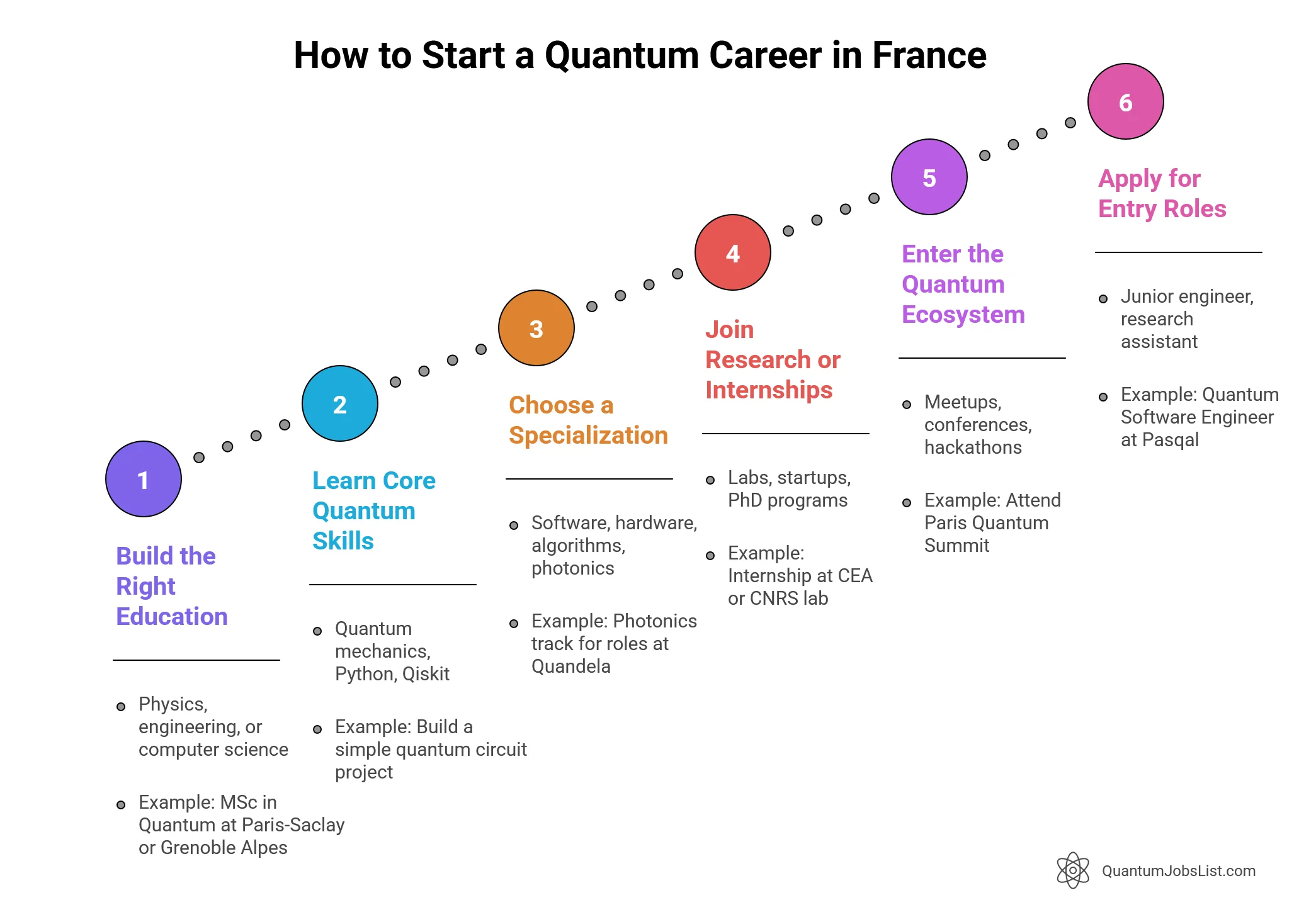
How to Get Quantum Computing Job in France?
To get a job in quantum computing in the France, you need a strong background in physics, computer science, or engineering. Learning tools like Qiskit, Cirq, and Python is important. Gaining hands-on experience through research projects or internships can greatly improve your chances.
Step 1: Build Your Quantum Foundation
Getting into quantum computing requires strong preparation. You need courses in quantum mechanics, linear algebra and quantum algorithms. Most jobs in France expect at least a Master’s degree, while a PhD opens more opportunities. If you are still studying, consider a quantum computing certificate or specialized university courses.
Learn Quantum Programming Frameworks
Familiarity with quantum programming tools is essential. IBM’s Qiskit is the most popular. Other frameworks include Google Cirq, Xanadu PennyLane, and Quandela Perceval (French). These tools let you write quantum programs and run them on simulators or real quantum computers. The more skilled you are with these frameworks, the more attractive you become to employers.
Step 2: Gain Practical Experience
Employers are more interested in your practical skills and experience than your degree. Work on Quantum-related GitHub projects to demonstrate your coding ability and collaboration skills. Most quantum technology software is open-source, so anyone can contribute. Start by fixing small issues or improving documentation, and then move on to implementing bigger changes.
Contribute to Open-Source Projects
Collaborate with open source quantum initiatives on GitHub. Whether it is coding, writing, or editing, all types of contributions show skill, motivation, and a sense of belonging to the community. Great contributors often get noticed by quantum companies.
Compete in Quantum Hackathons and Challenges
Join hackathons or quantum-related contests to improve your skills. These challenges often offer prizes or other rewards, and participating is a good way to build your resume. IBM Quantum Open Challenges and Xanadu have contests where you can practice coding while solving interesting problems.
Create a Portfolio
Show initiative to employers by working on your own projects and documenting your process. You could implement a quantum algorithm, an application of your own, or even something in quantum machine learning. Publishing your projects as a blog or writing a technical paper is a great way to stand out.
Step 3: Network in France's Quantum Community
The quantum job market is more about networking than knowing the right skills. Quantaura hosts regular quantum networking events in Paris. Recruiters, researchers, and people working in quantum at startups and large companies share job openings that are not yet advertised.
Use LinkedIn to network. Most quantum researchers working at French companies and universities are on LinkedIn. After posting a comment that adds value to the conversation, send them a connection request. Many respondents to your comment will appreciate your initiative and offer to help.
Attend Conferences and Workshops
Visit university quantum seminars. They are sometimes not restricted to students, and you can enter. You will find quantum researchers and learn about their latest publications. During the breaks, talk to them and to other attendees. You will be surprised by the number of opportunities that come from casual conversations when you express your interest.
Strengthen Your Networking Skills
Networking in the quantum field can start with LinkedIn. You can connect with researchers from companies that interest you and are in the quantum field. You can start to gain visibility by posting thoughtful comments about the content that they share. There will be opportunities to deepen these connections.
Step 4: Understand Work Visas for France
EU Citizens
If you’re from the EU, you can work in France without a visa. Just arrive, find a job, and register with local authorities.
EU Blue Card
The EU Blue Card is for highly skilled workers. You need a higher education degree and a job paying at least €56,000 per year. After 18 months in France, you can work across the EU.
French Tech Visa (Talent Passport)
Non-EU citizens can apply for the French Tech Visa, designed for tech talent. With a job offer from a French quantum company and a salary of at least €53,836 a year; you qualify. Employers handle the application, which usually takes 2–3 months. The visa gives a four-year residence permit, allows family members, and can lead to permanent residence.
Language
Neither visa requires French. Applications and contracts can be in English. However, learning French makes daily life easier and shows employers your commitment to integrating.
Step 5: Apply Strategically
Resume Tips
French CVs differ from American resumes. Include a professional photo, your date of birth and nationality. Keep it to two pages. Education usually comes before work experience. Highlight publications if you have them, especially for research roles.
Finding Job Postings
Check company websites first … many French quantum companies post openings there before other platforms. LinkedIn is widely used for tech recruiting, so make sure your profile is complete and emphasizes your quantum experience. Follow Niche job boards such as Quantum Jobs USA, Quantum Jobs List. For research roles, CNRS runs annual recruitment campaigns. CEA and Inria post on their career sites. Universities list positions on HR portals or academic job boards.
Interview Preparation
French interviews are more formal than in the US. Expect multiple rounds with HR, technical teams, managers, and senior leaders. Prepare to discuss technical details of your quantum work. Interviews may also cover your interest in French culture, work-life balance and career plans.
Suggested Read: How to prepare for quantum job interview
Language Skills
Be honest about your French skills. If you are learning, say so. Many Paris positions operate mainly in English, but smaller companies or jobs outside Paris may expect French proficiency.
Career Guidance via Quantum Jobs List
Quantum Jobs List helps students and professionals explore career paths in the French quantum ecosystem. The platform connects users with job openings and learning resources across the country. For more, You can have a look at our Blog.




Quantum Jobs in France


For More, Please visit Quantum Jobs in France
FAQs
Here are a few common questions people ask about quantum careers in the France. These cover topics such as required skills, education paths, top employers, and future growth.
What salary can I expect in quantum computing in France?
Entry-level roles start at €40,000-€50,000 a year. Mid-level engineers and researchers earn €60,000-€90,000. While senior professionals make €80,000-€120,000 or more. These figures may seem lower than US salaries. But France provides universal healthcare, at least five weeks of vacation, strong employment protections, and lower living costs outside Paris. Accounting for these benefits, compensation is competitive.
Is a PhD required for quantum jobs in France?
It depends on the role. Research scientist and senior algorithm roles usually need a PhD. Quantum software, applications engineering, and some hardware roles often accept Master’s degrees with strong skills and experience. Advanced education is valued, but practical capability can allow success without a PhD.
Which French city is best for quantum computing careers?
Paris has the most jobs (about 60% of openings), and the widest variety of companies and labs. Grenoble is strong for hardware engineering, offering a smaller city environment and outdoor lifestyle. Toulouse is emerging for quantum sensing and aerospace, but has fewer opportunities currently. Choose based on specialization, language, lifestyle, and career goals.
What are France's top quantum computing companies?
France’s leading quantum companies include Alice & Bob, PASQAL, Quandela, C12, and Quobly. They work on different quantum technologies such as superconducting, neutral atom, photonic, and carbon nanotube qubits. All of them are part of the PROQCIMA program to build fault-tolerant quantum computers by 2030–2035.
How competitive are quantum jobs in France?
The field is competitive, but skilled candidates are rare. About 75% of applicants lack the right skills, which creates strong opportunities. Government programs like the €1.8B National Quantum Strategy and PROQCIMA keep demand growing.
Which industries in France hire quantum professionals?
Quantum professionals in France are hired across many sectors. Defense and aerospace firms like Thales and Airbus, telecom companies like Orange, IT firms such as Atos, banks, industrial companies like Air Liquide, and research institutes including CNRS, CEA, and Inria all employ quantum talent.
How to Start Your Quantum Career in France
France offers an exciting environment for quantum professionals at any career stage:
- World-class research institutions and laboratories
- €1.8 billion National Quantum Strategy supporting research and development
- Innovative startups like Alice & Bob and PASQAL
- Welcoming policies for international talent
France's quantum ecosystem presents a variety of opportunities for recent graduates, seasoned researchers, or transitioning professionals. Having the opportunity to live in France while pursuing a career in a rapidly growing field, coupled with the government support for long-term stability, makes it even more appealing. Add to that the growing field's shortage of skilled workers, and you'll find the prospects are plentiful. The benefits and work-life balance are quite comprehensive, and the work to be done is both meaningful and on the cutting edge of technology.
Next Steps to Launch Your Quantum Career
- Explore current job openings on company websites and research institution career pages.
- Assess your qualifications and address gaps through courses or personal projects.
- Build your network by connecting with French quantum professionals on LinkedIn.
- Start learning French, even at a basic level, to show commitment.
- Prepare a French-style resume highlighting quantum projects and publications.
- Research visa requirements if you are an international candidate.
- Apply to quantum internships and entry-level positions via Quantum Jobs USA, Linkedin or Quantum Jobs List.
🇫🇷 Quantum Interest Form
The quantum computing job market in the France is booming. Whether you are job hunting or simply passionate about quantum, we would love to hear from you and share your story on social media such as Twitter.

.svg)

