
Quantum Jobs List
Quantum Computing Jobs USA
The quantum computing job market in the United States is growing fast, with strong demand across software, hardware, and research roles. Learn about top employers, skills, and salary trends.
What Is Quantum Computing?
Normal computers face difficulties with especially complex problems, but with concepts such as superposition and entanglement, quantum computers are able to overcome this issue.
Quantum computers use different physics than traditional computers. They rely on principles like superposition and entanglement, which let them do things that classical computers cannot.
Classical computers use bits that are either 0 or 1. Quantum computers use qubits, which can be 0, 1, or both at the same time. This allows quantum computers to solve some problems much faster than classical computers.
The U.S. is one of the biggest leaders in the field of quantum computing and is home to many top tech companies, government organizations, and research companies focusing on developing this technology.
IBM is a leading manufacturer of quantum computers, and Google made headlines in the field with its attainment of a milestone called quantum supremacy. Microsoft is conducting research into a new category of qubit, known as topological qubits, and Amazon provides cloud computing services that include quantum computing.
All of these efforts combined help to revolutionize the computing field to help develop a whole new class of technologies.
We are in urgent need of talent. The demand is outpacing the supply by a significant margin. Krysta Svore, General Manager of Quantum Systems, Microsoft.
Why Quantum Computing Matters for the Future?
Quantum Computing has the power to revolutionize multiple sectors.
In the field of medicine, they will assist in the understanding of complex structures in order to design new drugs in a matter of months, rather than the years it normally takes. In addition, banks and financial institutions will boost the speed at which they manage investments, assess risks, and detect fraud. In the world of cyber, quantum computing will be able to eliminate current methods of encryption, and, at the same time, establish a new, unbreakable method of safe communication.
Quantum computing will also be useful in climate studies, artificial intelligence, the development of new materials, logistical optimization (for example, in delivery), and in the field of aerospace. The impact will not be a simple improvement; it will be in a completely new way of computing.
This innovation will help in creating new jobs for those who wish to help make quantum computing a reality.

The US Quantum Computing Job Market: Growth and Opportunity
Current Market Landscape
The market for quantum careers in the United States is on the rise. It is reported to grow at almost 25% every year, with expert predictions estimating roughly 5,000 to 7,000 new quantum computing-related jobs opening up by 2027. This is happening due to the integration of quantum computers into the commercial sphere.
There has been an observed increase in quantum-related roles. From 2020 to 2024, roles that had the word quantum in the title had an increase of 180%. In 2020, there were 3,000 jobs listed, and by mid-2024, this will increase to over 8,400.
The current workforce for quantum research stands at 4,000, but this is just the beginning. The United States currently aims to develop an industry for quantum computing valued at $138.9 billion by the year 2045. This will create a need for 200,000 high-skilled employees, demonstrating the vast potential for career growth for those entering the industry of quantum computing, be it recent university graduates or seasoned professionals from the tech industry.
Growth Drivers and Market Dynamics
The billions invested in quantum computing show confidence in its future, and $2.35 billion is a record for 2024. These numbers suggest a booming industry for quantum computing and its applications. Jobs for quantum hardware, software, and the applications for quantum computing will increase, as the industry is projected to grow to $5 billion in 2029 from $1.1 billion in 2024.
A McKinsey survey from 2024 captured the opinions from 65% of experts who think 2030 is the deadline for fault-tolerant quantum computers. Since these computers will be able to perform complex calculations with very low error, they will be able to serve a huge variety of businesses.
Companies are building quantum teams, and for professionals, this is a chance to enter a new frontier in practice before the field goes mainstream.
The Critical Skills Gap
There is a definable shortage in quantum jobs. Around 75% of the applicants are unqualified for quantum jobs, and so the shortage means candidates are in good demand. To entice more candidates, companies are not generous with salaries and emphasize good career progression and benefits.
With more than 200 new quantum education programs rolling out for the first time in 2024, the gap still continues to widen.
People in quantum were not always in quantum, and from the data, it is apparent that 60% of people with a background in quantum didn’t study physics. A large portion of people in quantum STEM fields of study, like software, electrical engineering, chemistry, and business with a tech background. These individuals learned the skills they needed for quantum with the right courses, certifications, and pragmatic study, and then moved into quantum.
Suggested Read: Qualifications required for Jobs in Quantum
Federal Investment: The National Quantum Initiative
The quantum job market is growing rapidly in the United States. There are currently over 1000 open quantum computing positions nationwide, and demand has risen sharply as more companies and research labs expand their teams. Industry reports show that roles looking for quantum skills have grown significantly in recent years, with U.S. postings tripling over the past decade and strong annual growth continuing.
Historic Government Commitment
The US government's backing is aiding speedy advancements in quantum technology. The 2018 National Quantum Initiative Act, which was passed as a part of a strategic framework for quantum research collaboration, spans the government-university-industry trifecta.
The most recent National Quantum Initiative Act reauthorization was introduced in late 2024. It proposes $2.7 billion in funding over five years to speed up quantum research. For the first time, the legislation expands its focus to include applied science, not just basic research.
“Healthcare, clean energy, sensing and computing, and communications will all be transformed by quantum technology,” stated Senator Maria Cantwell. The National Quantum Initiative Reauthorization Act also enlists the National Institutes of Health, the State Department, and the Small Business Administration.
Addressing the Valley of Death
Federal funding is critical to the transition of quantum technology from research to practical application. It enables the training of quantum engineers, university and laboratory support, and the construction of infrastructure that private companies cannot afford. Federal funding also keeps research jobs funded and provides companies with the tools they need, therefore making quantum careers more secure.
The new legislation will establish three NIST quantum centers, five NSF quantum research and education centers, a quantum workforce hub, and new testbeds for operational implementation. Centers will employ hundreds of quantum experts and, through grants, partnerships with industry, and training, will support thousands more.
Agency-Specific Quantum Programs
From 2025 to 2029, the Department of Energy will get $625 million to fund five national quantum research centers, build quantum instruments, and support user programs. The National Science Foundation will get $640 million for research centers and workforce training. NIST will fund three new quantum centers, and NASA will receive $100 million for quantum satellite communications and sensing for Earth science.
This funding will allocate quantum workforce funding to a variety of agencies, geographies, and fields of research. If you are interested in the NIST centers for quantum research, NSF centers for education and research in quantum science, the quantum workforce center, or the operational implementation testbeds, you will still have funding to support a variety of interests: physics, quantum algorithms, quantum hardware, or quantum applications in climate, space, etc.
Quantum has this incredible promise of achieving very powerful computational capability. With a quantum computer, you will eventually be able to solve problems more efficiently and more accurately than any classical supercomputer. Marco Pistoia, Senior Vice President of Industry Relations at IonQ.
Quantum Computing Jobs Salaries in USA
If you work in quantum computing in the United States, you can expect strong pay. Skills are rare, demand is growing. Roles often offer higher salaries than comparable tech positions.
Quantum software developers and hardware engineers typically earn $120,000 - $180,000. While senior researchers can make over $200,000. Salaries vary by role, experience, and location, but quantum professionals generally earn more than peers in non-quantum roles.
Suggested Read: Quantum jobs and Salaries
Overview: Premium Compensation for Specialized Expertise
Quantum computing jobs in the US pay some of the highest tech salaries because the skills are rare and in demand. In 2025, the average pay was $181,491 per year.
Because of differing roles, experience, location, and companies, salaries differ for many reasons. While senior quantum professionals can earn 50 - 70% more, junior quantum developers earn 20-40% more than regular software developers. Companies offer these higher salaries because the expertise is complex and can offer them a huge competitive edge in the market.
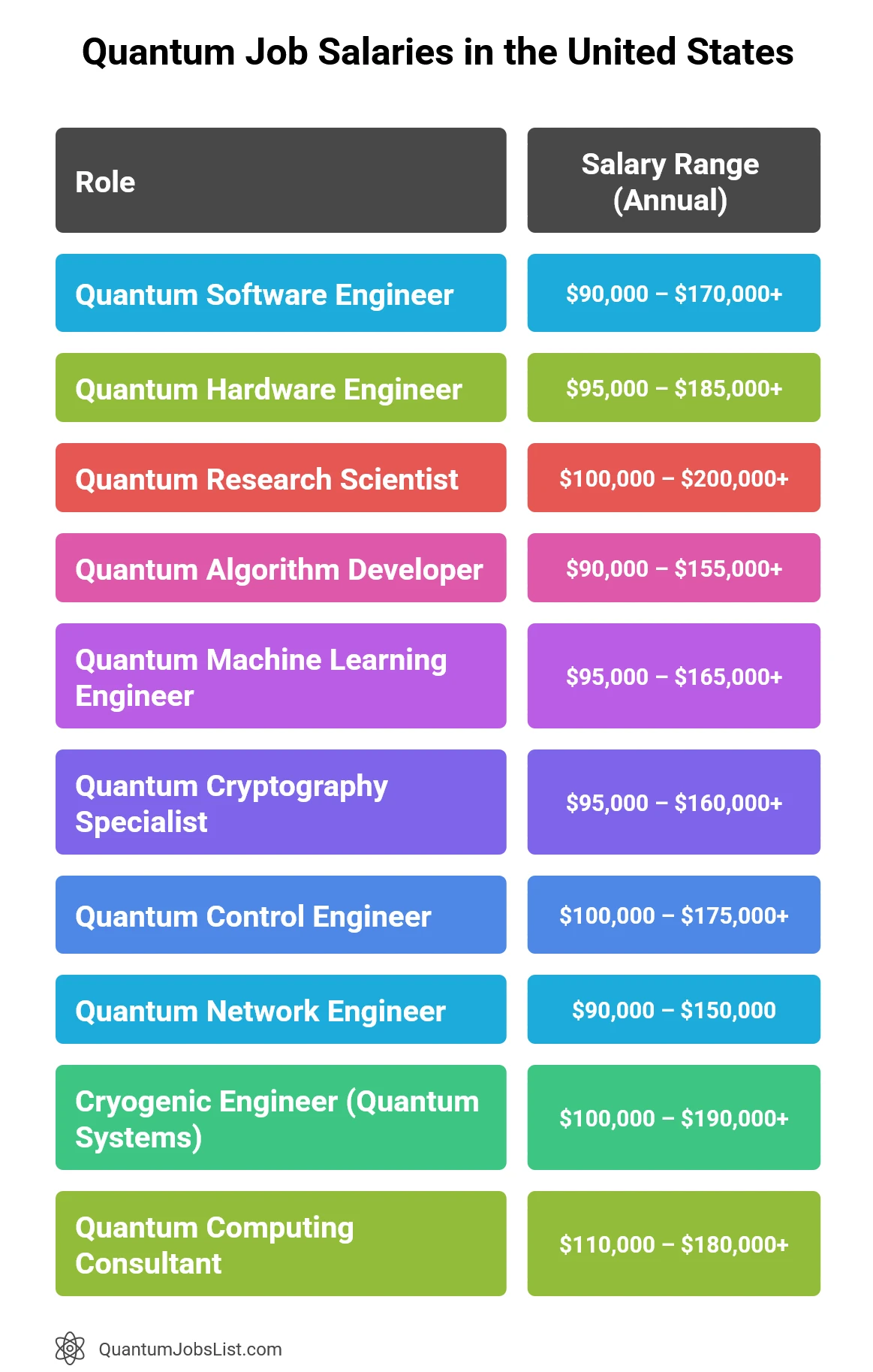
Entry-Level Quantum Positions ($70,000 - $120,000)
Entry-level quantum jobs pay very well because the industry needs new talent with specialized skills.
For research and academic roles, bachelor’s degree holders in physics, math, or computer science can earn $80,000 - $110,000 a year. Courses in quantum mechanics or related topics help candidates stand out.
Tech companies and startups often pay $85,000 - $120,000 for entry-level quantum roles. Big companies like IBM and Microsoft may add signing bonuses, stock options, and benefits, increasing total first-year pay by 20 - 30%, making it as high as mid-level software jobs in classical computing.
Technical writers who explain quantum concepts earn $70,000 - $95,000. While junior quantum software engineers working on algorithms can expect $75,000 - $100,000, along with fast salary growth as they gain experience.
Mid-Level Quantum Professionals ($120,000 - $180,000)
Mid-level quantum professionals with 3–7 years of experience earn $120,000 - $160,000 each year. Experts in areas like quantum error correction or quantum machine learning can earn toward the top of this range.
Quantum Software Engineers
Quantum software engineers who develop practical algorithms are in high demand, earning $130,000 - $170,000 a year, depending on employer and location.
Quantum Hardware Engineers
Quantum hardware engineers working on qubit fabrication, control systems, or cryogenics earn $125,000 - $175,000 a year. These roles need knowledge of electrical engineering, materials science, and experimental physics. Companies compete strongly for engineers who combine quantum theory with hands-on engineering skills.
Research Scientists
Research scientists with PhDs and postdoctoral or industry experience earn $120,000 - $180,000. Well-funded startups and big tech pay more than academic labs. But academic roles offer research freedom, student supervision, and paths to tenure. You can learn more about quantum research scientist salary here.
Senior and Lead Positions ($180,000 - $300,000+)
Senior Quantum Professionals
Senior quantum professionals with 8+ years of experience or special expertise earn $180,000 - $250,000, with some roles exceeding $200,000 before bonuses or equity. These include principal engineers, senior research scientists, and team leaders who have published research, patents, or built quantum systems that deliver business value.
Quantum Systems Architects
Quantum systems architects, who design full quantum solutions combining hardware, software, and classical systems, earn $190,000 - $280,000 a year. These jobs need deep knowledge across multiple areas and the ability to make strategic technical decisions.
Executive and Specialized Roles ($250,000 - $500,000+)
Executive Quantum Roles
Executive quantum roles can pay $300,000 to $500,000+ in total compensation, including salary, bonuses, and equity for roles like Chief Quantum Officer, VP of Quantum Research, or Director of Quantum Engineering. These positions require a particular set of skills, including, but not limited to, technical, managerial, and quantum value articulation to non-technical audiences.
Quantum Algorithm Developers
Quantum algorithm developers working on high value areas like finance or drug discovery can earn $150,000 - $230,000 a year. Companies pay top salaries for professionals, who can show how quantum can create business advantages or revenue. Learn more at Quantum Algorithm Developer salary.
Salary data compiled from Quantum Jobs USA, Quantum Jobs List, Economic Research Institute, and live job posting.
Geographic Salary Variations
Salaries in the quantum field vary significantly by location, with the highest pay in major tech hubs. In the San Francisco Bay Area, for example, Google and Rigetti pay 15-25% higher than the national average. Overall, New York and California pay the highest, but Boston, Seattle, Chicago, and Washington D.C. also have high salaries.
Bay Area mid-level software engineers make $140,000-$200,000, while mid-size cities pay $110,000-$150,000. After adjusting for the cost of living, higher pay is possible in Boulder, Colorado, and College Park, Maryland, even with lower salaries.
Software roles in quantum are frequently remote. Salary is largely based on the employee’s location, but some companies pay location-independent salaries for rare, highly specialized roles.
What are Skills and Educational Requirements for Quantum Jobs?
Most quantum jobs in the United States require a master’s or PhD in physics, computer science, or engineering. Strong knowledge of quantum mechanics, programming, and tools like Qiskit or Cirq is essential. Below is a simple breakdown by category.
Educational Pathways
Most jobs in quantum computing require a bachelor's degree in any of the following: physics, computer science, electrical engineering, or mathematics. These degrees provide the bare minimum to explain quantum principles. Additional quantum study, whether it be courses or self-taught, would be necessary.
Master's degrees increase job prospects and salary. These degrees teach the most about quantum computing, quantum information, or quantum engineering, and cover the most about algorithms, hardware, and applications. A professional with a master's degree would most likely begin their career with a higher salary and would be promoted more quickly than a professional with only a bachelor's degree.
In the majority of cases, a PhD is needed for jobs involving research, algorithm development, and work in academia. About 35% of jobs in quantum computing require a PhD. People with a doctorate degree earn about $20,000 to $50,000 more than people with a master's degree in the same position.
Suggested Read: How to get Quantum jobs without PhD.
Core Technical Skills
Quantum computing starts with quantum mechanics. Professionals need to know superposition, entanglement, quantum gates, and measurement; these work differently from normal physics. Math is also key, especially linear algebra and complex numbers, which describe quantum states and operations. Concepts like vector spaces, eigenvalues, eigenvectors, and tensor products show up in algorithms and system design.
Python is essential, required by 90% of quantum jobs. Most quantum frameworks, Qiskit (IBM), Cirq (Google), PennyLane (Xanadu), and Q# (Microsoft), use Python. Other languages like C++ (fast simulations), Julia (scientific computing), and JavaScript (visualization) can help too.
Knowing quantum algorithms sets quantum professionals apart. Key examples include:-
Shor’s algorithm (factoring), Grover’s algorithm (search), VQE (chemistry), and QAOA (optimization). Quantum machine learning is also growing fast, combining quantum computing with AI applications.
Suggested Read: Programming Languages to learn for Quantum Jobs
Hardware and Systems Knowledge
Quantum professionals have to know a variety of systems: superconducting qubits, trapped ions, photonic systems, neutral atoms, and topological qubits. Different hardware engineers work on the making, controlling, and managing of the noise of each of these systems.
To build a reliable, fault-tolerant quantum computer, the mitigation and error correction must be understood. Advanced professionals know the codes for the correction of errors and the reduction of noise. This is still seen as a practical quantum advantage and is demanded by companies.
Don’t underestimate the value of classical computing either. This area still provides the foundation for one part of a hybrid quantum and classical computing system. When building these systems, it is vital to understand algorithms and data structures, the complexity of the computations, and the best practices of the programs. Most of the real-world applications of quantum computing require both processes, classical and quantum.
Applied and Interdisciplinary Skills
The ability to solve problems and optimize solutions allows quantum specialists to identify and refine problems that quantum computing can solve into quantum algorithms. This requires knowledge of quantum computing and the respective field.
Having cross-disciplinary abilities is very beneficial. For instance, quantum chemistry is applicable in drug discovery, financial mathematics is applicable in quantum finance, and the combination of materials science and engineering with quantum materials research is common, as is the combination of cybersecurity and quantum cryptography. Such cross-disciplinary combinations frequently attract higher remuneration than pure quantum skills.
Communication and collaboration are no less critical. Specialists must describe quantum concepts to people with no technical background, produce unambiguous guides, and work collectively across disciplines to provide the intended results. Solid technical knowledge is not sufficient, success is based on good collaboration and on demonstrating the impact of your contributions.
Top Quantum Universities and Educational Programs
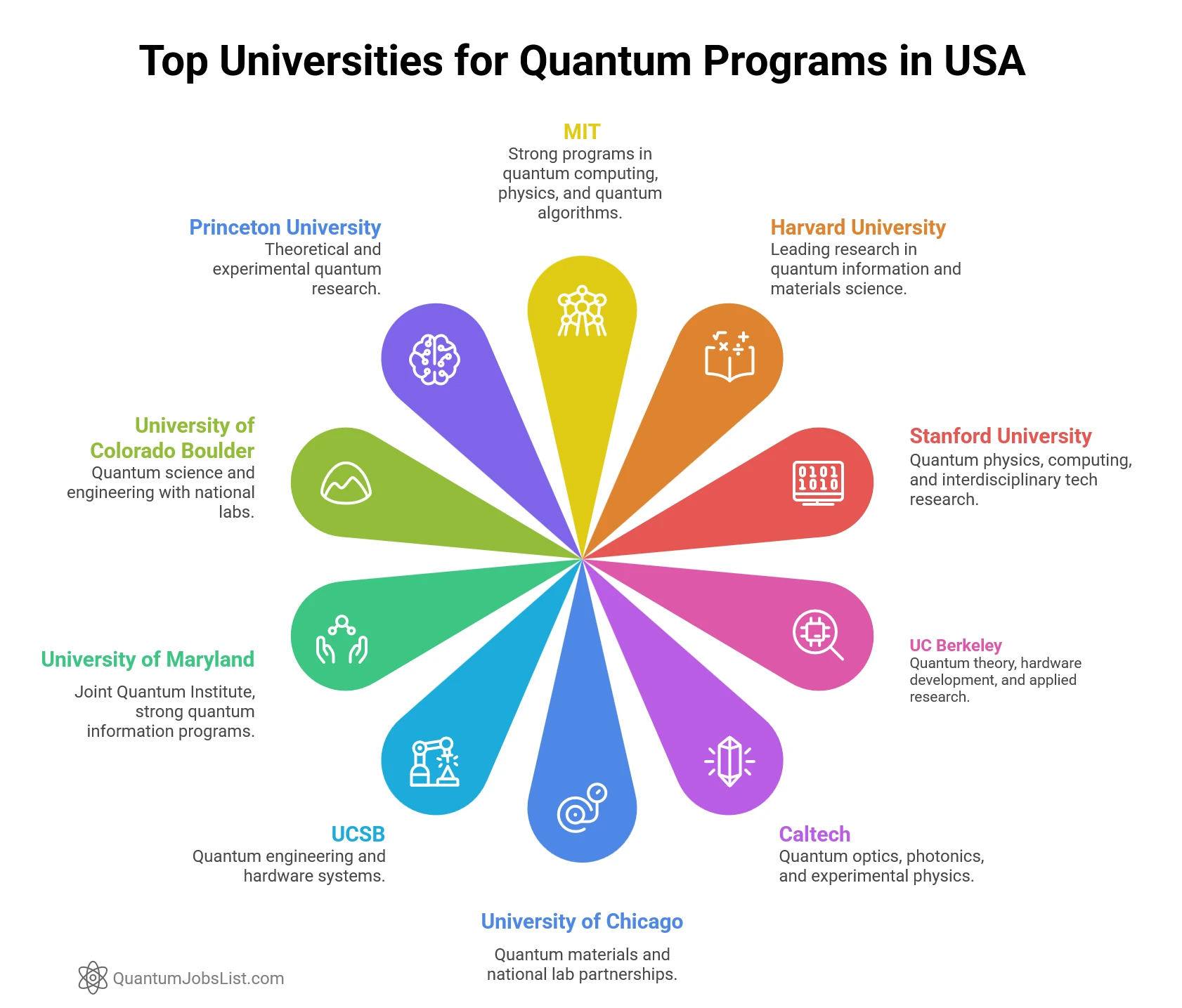
Top quantum-related programs in the United States include dedicated degrees and research tracks at universities such as MIT, Caltech, University of California-Berkeley, University of Chicago and Stanford. These programs offer strong training in quantum computing theory, hardware, and applications, and they connect students with national labs and industry partners.
Leading US Quantum Programs
121 US institutions offer courses or degrees in quantum sciences. Over 45 universities offer degrees in quantum computing. Over 120 universities offer courses in quantum topics. Over 200 institutions conduct active research in quantum. There is a growing interest in student enrollment in quantum courses, reflecting a growing interest in the field from employers.
Massachusetts Institute of Technology (MIT)
MIT’s Center for Quantum Engineering has the best quantum education offerings with the most complete suite of courses and the most research facilities available. MIT has a national and international reputation for quantum research. Being located in the Boston area, there are many quantum-focused start-up companies and established companies.
University of California, Berkeley
The graduate level at the Berkeley Quantum Information and Computation Center, which is part of UC Berkeley, is one of the most comprehensive in the country. In addition, with its location close to Silicon Valley and quantum-related startups, students are able to access some of the best networking and employment opportunities in the field of quantum technology and computing.
University of Chicago
The University of Chicago offers advanced quantum computing courses and is home to the Chicago Quantum Exchange, a collaboration between universities, industry, and federal research labs. Chicago has a strong focus on applied quantum. There are also strong connections to Argonne National Laboratory, and quantum companies are establishing operations in Chicago.
Harvard University
The Harvard Quantum Initiative's blending of physics, computer science, and engineering is what makes its quantum program stand out. Harvard is also notable for its quantum networks, quantum sensing, and quantum computing, and is able to equip graduates for many different career paths in quantum technology R&D.
Yale University
Yale University graduates are among the best in the country regarding experimental quantum computing, particularly with superconducting qubits. The experimental training and skills gained by the graduates are very important for quantum hardware companies and move them into excellent positions in the workforce.
California Institute of Technology (Caltech)
Caltech is one of the universities that incorporates research on quantum computing into all of its Physics and Applied Physics programs. The small size of the research-oriented school allows students to have close relationships with their professors, which helps foster an environment of early involvement in research. This prepares them very well for their careers in quantum research, regardless of whether it is in academia or industry.
Other Notable Programs
University of Waterloo (Canada)
The University of Waterloo’s Institute for Quantum Computing also invites U.S. students and collaborates with U.S. quantum companies. Students can participate in the Institute’s research and training programs. This is a great opportunity for students interested in obtaining international work experience and interacting with the U.S. quantum industry. You can learn more about Quantum jobs canada here.
Other Leading U.S. Quantum Programs:
- Stanford University: Offers strong quantum programs with a balance of theoretical and experimental focus.
- University of Colorado Boulder: Provides programs emphasizing both fundamental quantum theory and applied research.
- University of New Mexico: Specializes in unique quantum platforms and experimental techniques.
- University of Maryland: Known for strengths in quantum hardware and research collaborations with national labs.
Quantum Computing Certificates and Online Programs
Shorter quantum computing certificate programs and online programs for working professionals are being offered by many universities. In these programs, which usually are between 6 and 18 months, a student can learn the quantum fundamentals, programming, and applications. These micro-credentials demonstrate to an employer that an individual has made a commitment to and developed a baseline competency in the quantum technology field.
Companies hiring for quantum computing jobs in USA
There are around 120 quantum companies in the United States. This section highlights who is hiring and the areas they specialize in.
Technology Giants Leading the Charge
IBM
IBM has the largest quantum computing team in the U.S., followed by Google and Microsoft. During the past decade, IBM has attracted talent with its cable quantum computing ecosystem and Qiskit support that employs scientists, hardware and software engineers, business developers, and strategists. Their team has expanded from a handful of people to hundreds, and works on the entire spectrum of quantum computing, from qubit fabrication to business quantum algorithms.
Google Quantum
The Google Quantum AI team obtained the first claim of quantum supremacy with their Santa Barbara lab, which employs a mix of physicists, engineers, and computer scientists, and builds new quantum processors and works on error correction.
Microsoft
Microsoft hires people interested in physics and cloud computing to work on their cloud Azure Quantum, which focuses on topological qubits and the associated cloud services.
Amazon
Amazon creates positions for software engineers with a mix of quantum computing and cloud computing skills as they expand their quantum services with Braket, a cloud service for access to various quantum computing hardware.

Quantum Startups and Scale-ups
Startups like IonQ, PsiQuantum, and Rigetti are all rapidly expanding their teams. They focus on different quantum computing technologies; IonQ specializes in ion traps & Rigetti in superconducting processors, while PsiQuantum employs quantum computing using photonic chips. They recruit physicists, engineers, software developers, and business people in order to transform quantum research into tangible products.
Other US quantum startups, including Atom Computing, Infleqtion, Quantum Circuits and QuEra Computing, are hiring for roles in software, hardware, and applications. Startups offer employees the opportunity to receive stock, rapid advancement, and the ability to influence the direction of the organization, all incentives that come with the challenges associated with working at a smaller company as opposed to a large tech company.
Government Labs and Defense Contractors
Quantum experts also work for defense contractors and government laboratories. Large quantum initiatives are offered at Los Alamos, Sandia, Oak Ridge, Argonne, Lawrence Berkeley, and Lawrence Livermore. These labs hire both engineers and scientists to support quantum computing, sensing, and networking for science and national security.
Defense contractors like Lockheed Martin, Raytheon, Northrop Grumman, and Boeing use quantum technology for secure communications, navigation, and complex problem solving. These jobs often need security clearances but offer stable work, good pay, and projects with real national impact.
Financial Services and Enterprise Adoption
JPMorgan, Goldman Sachs, Citigroup, and other major financial institutions hire quantum teams for fraud detection, risk and for evaluating portfolios and pricing. These roles combine quantum computing with finance and enable the translation of algorithms into business solutions.
Big consulting firms, such as McKinsey, BCG, Accenture, and Deloitte, hire quantum teams for the same purpose. They assess how firms can leverage quantum computing, create small proof-of-concept projects, and advise firms on the business ramifications of quantum computing. These roles require dual proficiency in business and technology, as well as strong interpersonal skills and quantum computing expertise.
Suggested Read: Top Quantum banking and finance jobs
Healthcare, Pharmaceuticals, and Materials Science
Pharma companies like Pfizer, Merck, and Johnson & Johnson use quantum computing for drug discovery and molecular modeling. Chemical and materials companies like BASF and Dow explore quantum for designing catalysts and improving materials. These jobs need skills in quantum computing plus chemistry or biology.
Startups in biomedical research and companies focused on drug discovery are also recruiting quantum specialists. These roles are concerned with the application of quantum algorithms to biological areas such as drug optimization, protein folding, and molecular dynamics. These roles also combine quantum computing with scientific expertise.
Best Cities for Quantum Computing Jobs in USA
Different US cities offer different quantum opportunities. Here's what you need to know about each.
San Francisco Bay Area, California
The San Francisco Bay Area offers the most quantum computing employment opportunities in the US. Notable companies and startups include Google Quantum AI in Santa Barbara and Goleta, Rigetti Computing in Berkeley, and many other developing quantum startups. The area has the most venture financing, tech talent, and research institutions, making it the leading area for quantum innovation.
Key Companies Driving Quantum Innovation:
- Google Quantum AI: Focuses on superconducting qubit technology and quantum algorithm development. Google’s 2019 demonstration of quantum supremacy brought worldwide recognition to the Bay Area.
- Rigetti Computing: Develops quantum hardware and cloud-based quantum services, employing physicists, engineers, and software developers.
Advantages for Quantum Professionals
Already existing tech companies in the Bay Area allow classical software engineers to more easily shift to quantum engineering by building on existing programming skills and developing quantum-specific skills. The area’s venture capital also enables rapid startup formation and job growth. Research universities, particularly Stanford and UC Berkeley, are key in workforce development and leading quantum research.
Compensation and Cost of Living
Quantum salaries in the Bay Area are typically 15–25% higher than national averages. However, high housing costs can consume a significant portion of income, making careful financial planning essential for professionals relocating to the region.
Boston, Massachusetts
Boston's renowned educational institutions make it a leader in various disciplines. Some of Boston's most recognized institutions include Harvard University, MIT, and the many smaller institutions that make up the quantum arena. MIT is the leading player in sponsoring quantum-related companies. These smaller institutions are recognized for their research and MIT-related companies utilize the large number of quantum-trained individuals in the area.
Inter-Industry Collaboration
Boston's large number of universities offers Boston's companies a vast number of quantum graduates and the related inter-industry collaboration. Companies have access to specialized equipment, can partner with the researchers, and have the ability to hire directly from the graduate programs. Additionally, the local government labs and defense contractors focus on hiring quantum professionals, with an emphasis on quantum sensing and secure communications.
Cost of Living
Boston offers a lower cost of living than the San Francisco Bay Area, while still offering all of the Boston quantum opportunities. Boston's combination of established technology and quantum professionals is ideal for assisting established quantum companies and developing tech companies that are developing quantum services, and is therefore an attractive city for quantum technology.

Washington, D.C. and College Park, Maryland
Washington D.C. Metro region, in particular the area surrounding the University of Maryland in College Park, has become a hub for government and defense related quantum research. The D.C. area is home to a number of significant quantum related initiatives, including the National Institute of Standards and Technology, several Department of Defense entities, and various intelligence agencies.
University of Maryland: Collaboration and Research
The University of Maryland is home to the Joint Quantum Institute and the Joint Center for Quantum Information and Computer Science. These institutes engage in federally funded research related to national security, and as a result, there are extensive opportunities for collaboration across the three sectors: university, government, and private industry.
Private Sector Opportunities
IonQ, a leading U.S. quantum computing company, is headquartered in College Park, providing private sector opportunities alongside government positions.
Job Requirements and Benefits:
Many quantum roles in the D.C. area require security clearances. Which can extend hiring timelines but offer job stability. Government positions typically provide good work-life balance, comprehensive benefits, pension options, and competitive salaries, though generally below Bay Area levels.
Seattle, Washington
Seattle’s Quantum industry is primarily driven by Microsoft’s quantum research and the Azure Quantum cloud computing platform. Quantum professionals in the area focus on the development of topological qubits, quantum software, and cloud computing infrastructure for quantum computing.
Cloud and AI Integration
Seattle’s cloud computing and artificial intelligence (AI) capabilities lend themselves to quantum computing, creating opportunities for cloud computing professionals to pivot to quantum computing, and for cloud and AI professionals to support quantum computing initiatives.
Academic and Industry Collaboration
The University of Washington’s quantum programs, combined with Microsoft’s initiatives and Seattle’s broader tech ecosystem, contribute to growing quantum opportunities across research and industry.
Cost of Living and Lifestyle
Seattle offers lower living costs than the San Francisco Bay Area. While providing access to the Pacific Northwest’s outdoor recreation. The city’s tech-friendly culture and presence of major companies, including Amazon with its Braket quantum cloud service, make it an attractive location for diverse quantum careers.
Chicago, Illinois
Chicago's robust quantum infrastructure is partly the result of the Chicago Quantum Exchange, which includes the University of Chicago, Argonne National Laboratory, Fermilab, Northwestern University, and the University of Illinois. It is one of the few partnerships of its kind in the country focused on both advancing quantum science and its applications.
Research and Innovation at Argonne National Laboratory
At the intersection of academia and applied research, Argonne National Laboratory employs professionals in the areas of quantum computing, quantum networking, and quantum sensing. The close partnerships with other research institutions support the transfer of technology and the exchange of personnel.
Career Advantages and Opportunities
Chicago's central location, relatively lower living costs compared to other coastal hubs, and its expanding quantum ecosystem are significant factors attracting professionals to the Midwest to pursue careers in the quantum industry. It enables access to both government-sponsored research and new private sector initiatives in quantum.
Los Angeles, California
Opportunities in aerospace applications, including academic research at Caltech and UCLA, can be pursued at Lockheed Martin and Northrop Grumman. Unique employment opportunities in quantum navigation, quantum sensing, and quantum secure communications for defense and space applications exist in the region due to its aerospace industry. You find Jobs in Los Angeles here.
Caltech: Leading Quantum Research
The quantum program at Caltech is one of the best in the world and serves the Southern California job market with its graduates. This is due to its research strengths being in alignment with the needs of the local industry.
Distinct Quantum Ecosystem
The presence of top-tier academic institutions, aerospace companies, and defense contractors provides applied quantum opportunities that are distinct and not available in the software-driven Bay Area or the government-driven D.C. region.
New York City
New York's financial supremacy is used by its quantum sector to build potential use cases in portfolio optimization, risk modeling, and cryptography. As quantum research divisions get set up at pivotal financial firms like JPMorgan Chase and Goldman Sachs, openings for quantum finance and computing specialists are created.
Collaboration Between Academia and Industry
The capabilities in research and human resource provision by Columbia University and other research institutions are beneficial for academic and industry collaboration. Moreover, the large tech industry in the city provides quantum experts with other career opportunities apart from those that are finance-related.
Salaries and Cost of Living
New York Quantum salaries, aligned with Bay Area salaries, are affected negatively by high living costs. However, the unique availability of integrated finance, tech, and research in one city proves valuable to the professionals.
How to Land a Quantum Job in the USA?
To get a job in quantum computing in the United States, you need a strong background in physics, computer science, or engineering. Learning tools like Qiskit, Cirq, and Python is important. Gaining hands-on experience through research projects or internships can greatly improve your chances.
Step 1: Build Your Quantum Foundation
Enroll in Online Quantum Computing Courses
Start by taking courses on platforms like Coursera, edX, or IBM Quantum Learning. These programs offer flexible learning paths suitable for working professionals. Begin with courses on quantum fundamentals before advancing to quantum programming and algorithms.
Build a Strong Foundation
Acquire the key basics such as linear algebra, complex numbers, and elementary physics. Abstract mathematical concepts are important. No, you don not need a physics PhD, but you should know enough physics to be comfortable with abstract mathematical concepts. Many budding quantum professionals have a background in math, computer science, or engineering, and learn quantum mechanics for computing.
Master Quantum Programming Languages
Begin with the big players, such as Qiskit or Cirq, which have substantial documentation and support. Build confidence with quantum simulators, simple quantum circuits, and basic algorithms. Once you are up to speed, have a go at running your code on actual quantum hardware via the cloud.
Step 2: Gain Practical Experience
Pursue Quantum Internships
Seek internships with companies that have quantum divisions, such as IBM, Google, Microsoft, Amazon, or quantum startups. Many companies offer summer programs designed to introduce students and early-career professionals to quantum computing. Internships provide real-world experience and often lead to full-time job offers.
Contribute to Open-Source Projects
Collaborate with open source quantum initiatives on GitHub. Whether it is coding, writing, or editing, all types of contributions show skill, motivation, and a sense of belonging to the community. Great contributors often get noticed by quantum companies.
Compete in Quantum Hackathons and Challenges
Compete in hackathons, challenges, and tournaments hosted by IBM, Xanadu, and other quantum companies. For example, the IBM Quantum Challenge is an amazing opportunity to gain practical experience with problem solving, get in touch with other participants, and even win awards or get interview opportunities.
Create a Portfolio
Develop a portfolio on quantum projects you have worked on with algorithms, applications, and other instructional materials. Having a GitHub repository that is well-organized and documented is a better demonstration of your skills than just stating them in your resume. It will enhance your visibility to potential employers.
Step 3: Network in the Quantum Community
Engage in Quantum Communities
Participate in forums and online communities such as Quantum Computing Stack Exchange, Reddit’s r/QuantumComputing, and Slack channels for specific quantum frameworks. Ask questions, share answers, and join technical discussions to build your reputation and deepen your understanding.
Attend Conferences and Workshops
Participate in Quantum-related activities such as IEEE Quantum Week, APS March Meeting, or Q2B (Quantum to Business). Events like these have great potential for learning, networking, and staying up to date with industry trends. Students and early-career professionals can benefit from paying reduced registration fees, so attending these events should be affordable. Learn more about quantum events here.
Strengthen Your Networking Skills
Networking in the quantum field can start with LinkedIn. You can connect with researchers from companies that interest you and are in the quantum field. You can start to gain visibility by posting thoughtful comments about the content that they share. There will be opportunities to deepen these connections.
Attend Quantum Meetups
In most major cities, you will be able to find groups that have regular cross-sector quantum meetups. These are often more impactful than large-scale industry events and can provide better access to key industry thought leaders. Informal settings and small groups create the opportunity for more in-depth discussion that can be valuable to your career.
Step 4: Develop Your Personal Brand
Use different social media platforms, blogs, or videos to document and share your learning experiences, especially your learning about quantum concepts. Sharing your learning process may be beneficial to others, and you don't have to be an expert to do so. Teaching can even showcase your skills to prospective employers.
Whenever you have the opportunity, share your findings at conferences, online forums, and meetups. Even sharing failed experiments and your work-in-progress can showcase your willingness to make contributions. Engaged presentation skills can be very beneficial to you.
If you’re in academia, publish research. Having research publications demonstrates the ability to see the end of a project. Research publications also demonstrate technical skill. Industry values the preprints you have on arXiv because they indicate to them that you are generating new work.
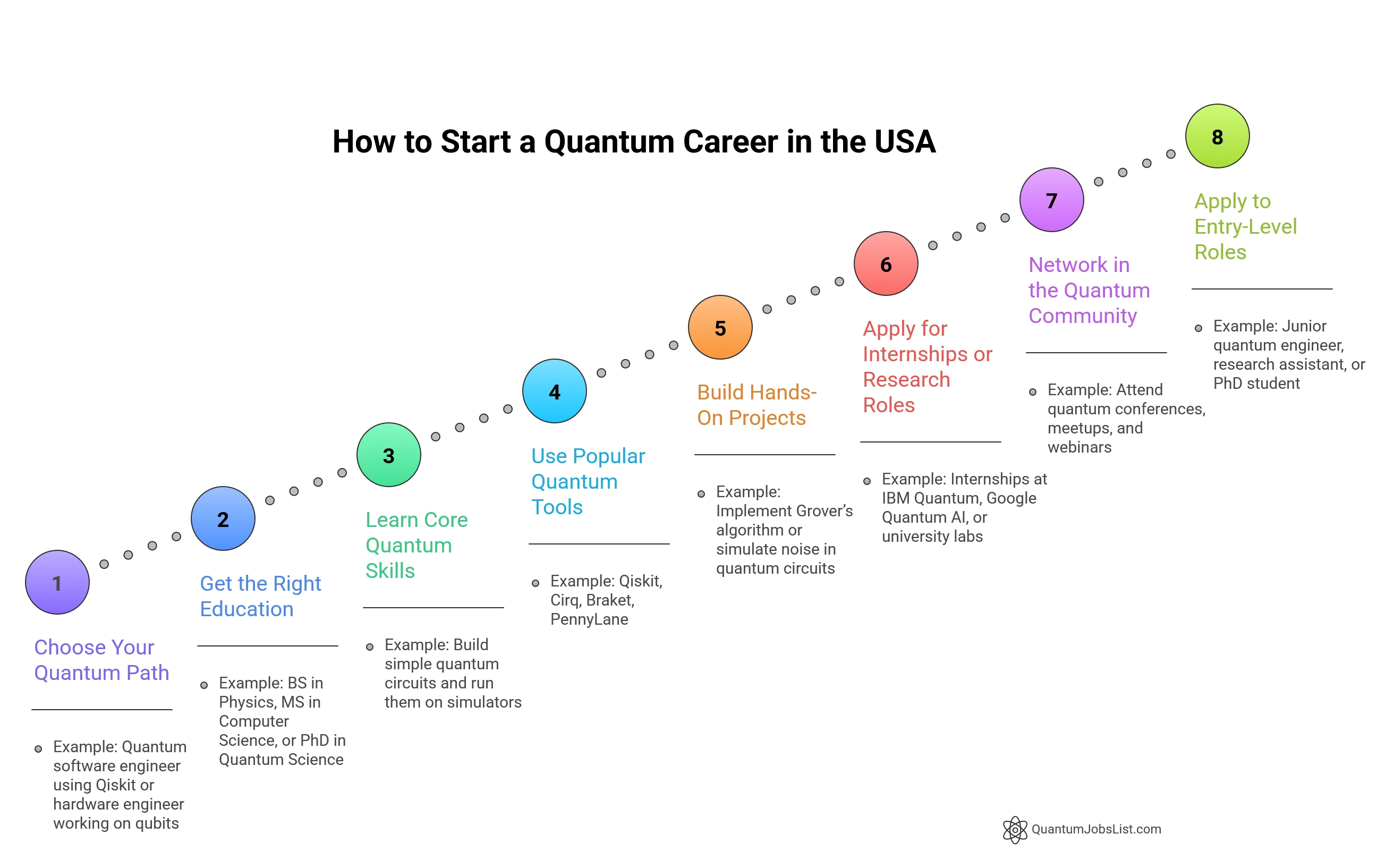
Step 5: Apply Strategically
Target Roles that Match Your Background
Focus on positions aligned with your expertise instead of applying broadly. For example, software engineers should pursue quantum algorithm or software development roles, while electrical engineers should target hardware or control systems positions. Tailored applications demonstrate genuine interest and help hiring managers see your fit.
Highlight Transferable Skills
Emphasize relevant skills from your classical background. Software engineers bring best practices in coding, physicists contribute experimental design expertise, and mathematicians offer strong analytical thinking. Quantum teams require diverse skills, not just PhDs in physics.
Prepare for Technical Interviews
Expect questions on quantum fundamentals, algorithms, and programming challenges. Practice clearly explaining quantum concepts and be ready to discuss your projects, including design decisions and tradeoffs. Strong communication skills are as important as technical knowledge.
Suggested Read: How to prepare for quantum job interview
Research Companies Thoroughly
Research the quantum strategies, target applications, and culture of each company. In your interviews and cover letters, refer to the particular pieces of their organization that interest you. Sending out a lot of the same applications on a mass scale will be ineffective for you because employers want to know that you understand and are interested in the questions they are trying to answer.
Professional Development and Certifications
Professional development for quantum computing jobs in the United States includes online courses, university programs, and industry workshops. These options help professionals build practical skills and stay up to date with new quantum technologies.
Online Learning Platforms
edX Quantum Programs
edX provides MIT quantum computing courses and programs from other top universities. Students can learn from world-renowned instructors without relocating or enrolling full-time. Many courses are available for free auditing, with certificates offered for a modest fee, making advanced quantum education accessible to a global audience.
Coursera Quantum Computing Courses
Quantum computing courses, including those from the University of California, San Diego, are available on Coursera, allowing professionals to learn on their own schedule. The courses address quantum fundamentals and advanced concepts, and many programs provide a professional certificate upon completion. This helps learners showcase their skills to employers.
IBM Quantum Learning
IBM Quantum Learning provides free Qiskit tutorials and extensive documentation, allowing hands-on experience with real quantum computers through cloud access. Over 15000 learners have earned IBM’s Quantum Developer Certification, validating practical quantum programming expertise to potential employers.
Microsoft Learn: Azure Quantum and Q#
Microsoft Learn offers tutorials and documentation for Azure Quantum & Q# programming. Developers can prepare for Microsoft’s quantum ecosystem and the Azure Quantum Developer Certification demonstrates verified proficiency for career advancement in the quantum computing.
Industry Certifications
Qubit by Qubit Certification Programs
Qubit by Qubit programs, often in partnership with universities and companies, provide pathways to demonstrate quantum competency. These certifications are well suited for students and early-career professionals developing strong foundations in quantum computing.
IBM Quantum Certifications
The IBM Certified Associate Developer for Quantum Computation using Qiskit is a recognized credential in the quantum industry. It requires demonstrating proficiency in quantum programming, algorithm implementation and use of IBM’s quantum computers.
Microsoft Azure Quantum Certifications
Microsoft’s Azure Quantum certifications validate expertise in Q# programming and Microsoft’s quantum cloud platform. These certifications are especially valuable for professionals with cloud computing experience, who want to specialize in quantum technologies.
QWorld Certifications
QWorld offers bronze, silver, and gold certificates, providing structured learning from quantum basics to advanced topics. Certificates cost between $0 and $300 and showcase systematic learning on resumes, rather than scattered knowledge.
Books and Self-Study Resources
"Programming Quantum Computers" by Johnston, Harrigan, and Gimeno-Segovia takes a more practical approach, teaching quantum programming through hands-on examples and focusing on building useful quantum software.
"Quantum Computing: An Applied Approach" by Jack Hidary balances theory with applications, making it accessible to professionals transitioning from classical computing or domain expertise in finance, chemistry, or other fields.
"Quantum Computation and Quantum Information" by Nielsen and Chuang remains the foundational textbook for quantum computing, covering mathematical foundations, quantum algorithms, and quantum information theory comprehensively. While challenging, it provides the theoretical depth serious quantum professionals need.
"Dancing with Qubits" by Robert Sutor provides a gentler introduction for those without strong physics backgrounds, explaining quantum concepts through analogies and building intuition before diving into mathematical details.
Career Guidance via Quantum Jobs List
Quantum Jobs List helps students and professionals explore career paths in the United States’ growing quantum ecosystem. The platform connects users with job openings and learning resources across the country. For more, You can have a look at our Blog.




Quantum Jobs in United States



For More, Please visit Quantum Jobs in United States
FAQs
Here are a few common questions people ask about quantum careers in the United States. These cover topics such as required skills, education paths, top employers, and future growth.
Do I need a PhD to get a quantum computing job in America?
No, approximately 65% of quantum jobs do not require PhDs. While research scientist positions typically need doctorates, quantum software engineering, applications roles, and technical consulting accept bachelor or master degrees with relevant skills and experience.
Which US cities have the most quantum computing jobs?
The San Francisco Bay Area leads with Google, Rigetti, and numerous startups. Boston offers strong opportunities through MIT and Harvard connections. Washington D.C./Maryland focuses on government and defense roles. Seattle hosts Microsoft's quantum division, while Chicago, New York, and Los Angeles have growing quantum ecosystems.
Can international candidates get quantum computing jobs in the USA?
Yes, US companies actively recruit international quantum talent through H-1B visas, O-1 visas for exceptional ability, and green card sponsorship. The National Quantum Initiative prioritizes building America's quantum workforce, and quantum computing is considered a critical technology sector for visa purposes.
What programming languages should I learn for quantum jobs in the USA?
Python is essential (required by 90% of quantum jobs) with frameworks like Qiskit, Cirq, and PennyLane. Additional valuable languages include C++ for performance-critical work, Julia for scientific computing, Q# for Microsoft quantum, and JavaScript for visualization tools.
What is the average salary for quantum computing jobs in the USA?
The average quantum computing salary in the United States is $181,491 per year. Entry-level positions start at $70,000-120,000, mid-level roles pay $120,000-180,000, and senior positions earn $180,000-300,000+. Bay Area salaries run 15-25% higher than national averages. You can learn more about quantum jobs salaries here.
Are there entry-level quantum computing jobs in the USA?
Yes, entry-level positions include Junior Quantum Software Developer, Research Assistant, Applications Engineer, and Technical Support roles at companies like IBM, Google, and quantum startups. Many companies offer internships that convert to full-time positions.
How competitive is the quantum job market in the USA?
Moderately competitive but talent-short. While top companies receive many applications, 75% of candidates lack necessary skills. The market strongly favors qualified candidates with quantum fundamentals, programming skills, and project portfolios. Demand currently exceeds supply of qualified professionals.
Start Your Quantum Computing Career Today
When it comes to quantum computing careers, the United States is the best place to be, owing to the leading companies, prominent universities, a growing startup ecosystem, and robust government funding. There is rapid industry growth, coupled with a skills gap and a predictable shortage of adequate workers. Because of these factors, it is an excellent option for everyone, be it entry-level job seekers or seasoned technology professionals.
You can work in national labs on research, at tech giants developing algorithms, in startups building new products, or in specialized areas like finance, pharma, or defense. High salaries, challenging work, and the chance to shape a technology that will change computing make quantum careers very rewarding.
Before the quantum technology industry matures and becomes overly competitive, it is advisable to enter the industry now in order to gain the necessary skills and knowledge that will prove to be advantageous as the technology becomes pervasive.
Suggested Read: Get entry level Quantum Jobs without experience
Today, we break ground on a landmark project that will establish Illinois as the nation’s leading hub for quantum innovation while attracting billions in economic investment and creating thousands of jobs. JB Pritzker, Governor of Illinois, on the new PsiQuantum facility.
Your Next Steps:
- Browse quantum computing job listings at major companies and startups
- Enroll in an online quantum computing course to build foundations
- Join quantum communities on LinkedIn, Slack, and Stack Exchange
- Start a quantum project to demonstrate your capabilities
- Apply to quantum internships and entry-level positions via Quantum Jobs USA, Linkedin or Quantum Jobs List.
🇺🇸 Quantum Interest Form
The quantum computing job market in the United States is booming. Whether you are job hunting or simply passionate about quantum, we would love to hear from you and share your story on social media such as Twitter.

.svg)

