















Quantum Careers Near You in Bengaluru
Get the Basics
Bengaluru is India’s undisputed quantum capital — home to IISc, IBM Quantum, QNu Labs, and a startup ecosystem that rivals small European quantum hubs.
Bengaluru’s quantum ecosystem is comparable to small European hubs now, IISc and IBM together have created something genuinely world-class. Dr. Urbasi Sinha, Professor & Quantum Optics Lab Head, Raman Research Institute, Bengaluru
What qualifications do Bengaluru-based quantum employers require?
- PhD or M.Tech in Physics, ECE, or CS from IISc, IIT, or RV College of Engineering for research-focused roles at IBM or QNu Labs
- Familiarity with quantum photonics or trapped-ion systems is increasingly sought as Bengaluru labs diversify beyond superconducting qubit platforms;
- Qiskit Developer Certification is treated as a near-mandatory credential by Bengaluru’s MNC quantum teams, especially at IBM and Wipro;
- Startup roles at BosonQ Psi and similar firms accept strong B.Tech graduates with demonstrated quantum project portfolios on GitHub
Which Bengaluru areas have the highest concentration of quantum employers?
In terms of where one could get a job in quantum computing, the best places in the city are located in Whitefield and along the outer ring road, where there are offices for IBM, Infosys, and Wipro quantum teams. QNu Labs and a few other deep-tech startups that are quantum adjacent and part of the NASSCOM DeepTech Club are in Electronics City.
The Malleshwaram campus of IISc is the center of quantum research in Bengaluru, and there are many spin-offs and labs in collaboration with the university within a 5km radius. You can learn more about quantum jobs India here.
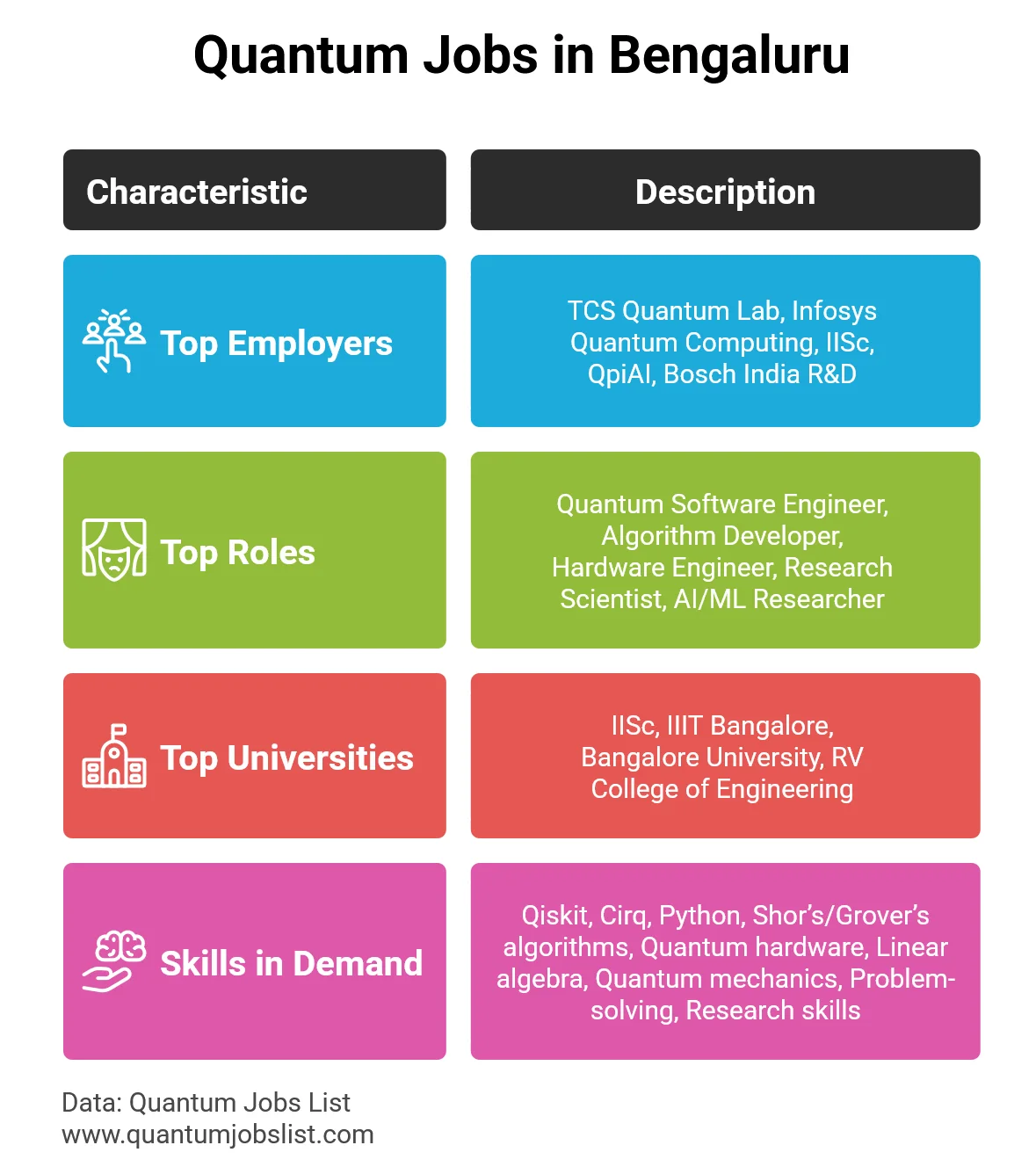
What skills are most in-demand for quantum roles in Bengaluru?
- Qiskit and PennyLane proficiency remain the top technical requirements across 70%+ of Bengaluru quantum job postings in 2024–25
- Cross-domain skills combining quantum computing with drug discovery or materials science are a standout differentiator for Bengaluru’s biotech-adjacent quantum startups.
- Quantum machine learning (QML) skills , specifically quantum kernel methods and variational classifiers, are in high demand at Wipro and Infosys labs;
- Post-quantum cryptography implementation experience is urgently needed by Bengaluru’s cybersecurity firms serving banking and defence clients.
What is the salary range for quantum jobs in Bengaluru?
Entry-level Quantum Engineers at Bengaluru startups like BosonQ Psi earn ₹10–16 LPA. This is slightly above the national average due to the city’s competitive tech talent market. Mid-level Quantum Researchers at IBM India or Wipro Quantum Lab command ₹28-50 LPA.
Senior Quantum Scientists at IISc-affiliated spinoffs or MNCs earn ₹45-70 LPA, with stock options increasingly offered by funded startups. Bengaluru’s quantum salaries are the highest in India, driven by direct competition with global tech firms present in the city.
Suggested Read: Quantum jobs and Salaries
Which Bengaluru companies are most actively hiring in quantum right now?
QNu Labs is looking to hire a lot of people in software and hardware to work on quantum random number generators and QKD systems. Therefore, they are the largest pure-play quantum employer in Bengaluru.
The best employer for Bengaluru quantum researchers is IBM Quantum India, as they provide a gateway to IBM’s worldwide quantum network. With a small, highly efficient engineering team, BosonQ Psi is undertaking quantum simulation for aerospace and pharma, and thus is the fastest-growing quantum startup in the city.
We didn’t choose Bengaluru by accident — the density of quantum-ready talent here is unmatched anywhere else in India. Sunil Gupta, CEO, QNu Labs
How will Bengaluru’s quantum job market evolve by 2030?
Bengaluru is projected to account for 35–40% of all quantum computing jobs created in India under the National Quantum Mission, given its existing talent density and MNC presence. With the NQM's hub allocation, the city’s Indian Institute of Science (IISc) is expected to increase its quantum research by two and a half times by 2028.
The city's startup ecosystem is expected to grow to at least 25 deep tech firms focused on quantum technologies by 2027. Each of these firms will employ 15–80 specialists, significantly strengthening Bengaluru’s position as a global quantum employment hub.
.svg)

